
Our verdict in one paragraph
IN THIS REVIEW
What Yu Sleep Is
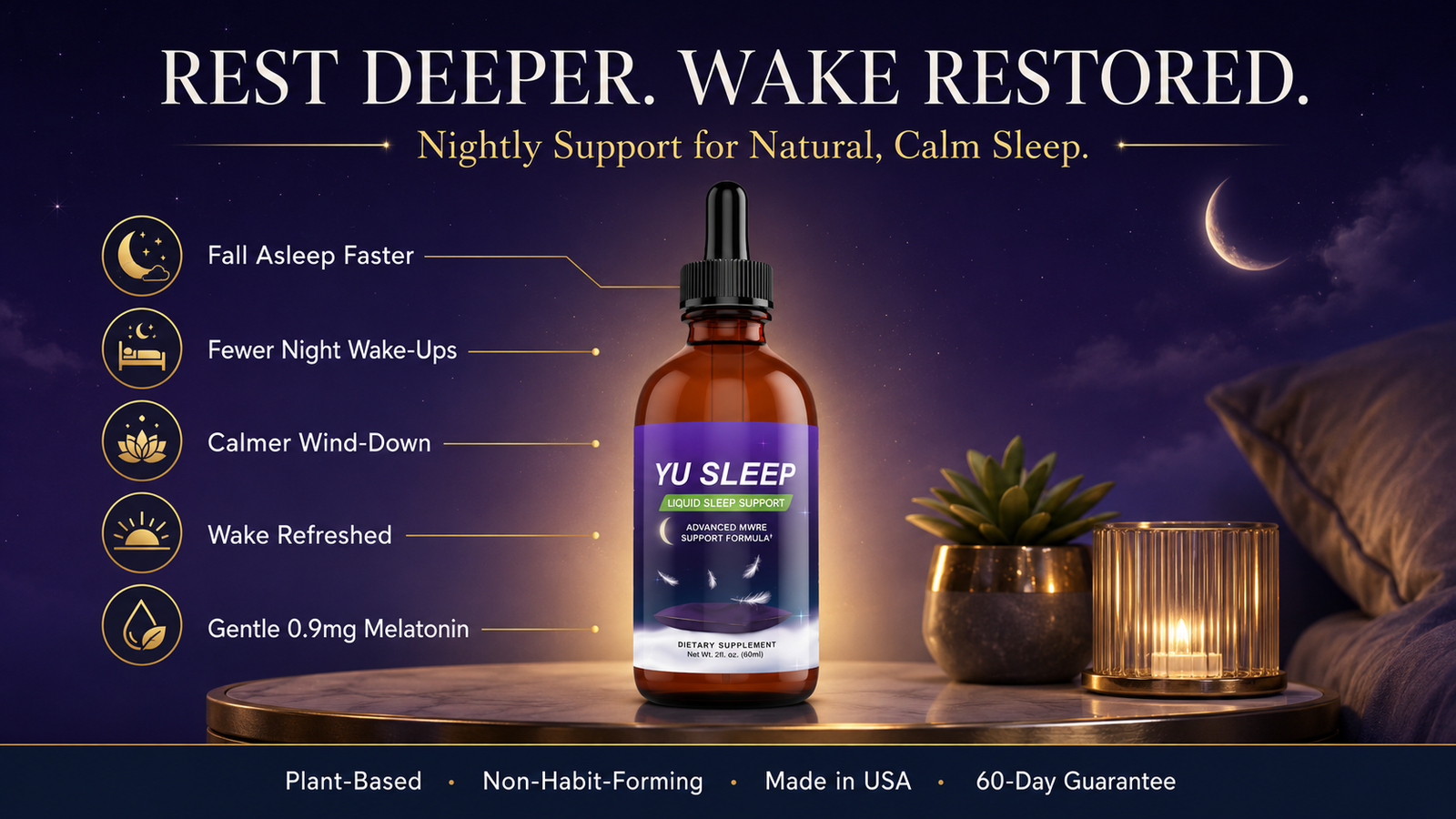
Yu Sleep is a 2 fl oz liquid taken as two droppers under the tongue about 30 minutes before bed.
Yu Sleep is a direct-to-consumer liquid sleep supplement sold through the seller’s own funnel, with checkout handled by a third-party retailer. It comes in a 2 fl oz (approximately 59 ml) bottle giving about 30 servings, and a serving is two droppers held under the tongue roughly half an hour before bed. That works out at close to 2 ml per dose — a number that turns out to matter a great deal, as we explain below.
The seller names ten ingredients: melatonin (0.9 mg), L-theanine, GABA, magnesium glycinate, apigenin, lemon balm, 5-HTP, red tart cherry extract, vitamin B6 and vitamin B2.
Only the melatonin has a number attached to it.
Key Facts
| Category | Liquid sublingual sleep support |
| Format | 2 fl oz bottle, ~30 servings, 2 droppers (~2 ml) sublingually before bed |
| Melatonin | 0.9 mg — a low, well-chosen dose (see below) |
| Other ingredients | L-theanine, GABA, magnesium glycinate, apigenin, lemon balm, 5-HTP, tart cherry, B6, B2 |
| Dose transparency | 1 of 10 disclosed. No Supplement Facts panel with amounts for the other nine |
| Main safety flag | 5-HTP interacts with SSRIs, SNRIs, MAOIs, triptans and tramadol |
| Company / returns address | Not stated — orders processed by an unnamed third-party retailer |
| Guarantee | 60 days, no questions asked, via the merchant’s support portal |
| Price (confirm at checkout) | $69/bottle (2, $138 + shipping) · $59/bottle (3, $177) · $49/bottle (6, $294, free US shipping) — as listed 4 Sep 2026 |
| Bonuses | Three digital guides with the 3- and 6-bottle orders |
| Our take | Mixed — one good decision, nine unknowns — a qualitative editorial opinion (not a lab test, and not a numeric score) |
The 0.9 mg Decision — Genuinely Good
We spend most of these reviews explaining what a product gets wrong, so it is worth being equally clear when something is right. The melatonin dose here is the best-judged thing we have seen in this category all year.
Melatonin is not a sedative. It is a circadian signal — it tells your body that night has started. Because it works as a signal rather than a knockout, more of it does not work better. The research is consistent on this: doses in the region of 0.5–1 mg shift sleep timing and shorten sleep onset about as effectively as 5 mg or 10 mg, while producing markedly less of the morning grogginess, headache and vivid-dream effect that makes people give up on melatonin altogether.
Despite that, the standard commercial dose sits at 5 or 10 mg, because a bigger number sells better on a label. Yu Sleep’s 0.9 mg is squarely in the range the evidence actually supports. Whoever formulated it read the research rather than the market.
What this means in practice: if melatonin has previously left you feeling hungover the next morning, that was probably a dose problem rather than a melatonin problem, and 0.9 mg is much less likely to do it. That is a real, usable benefit — and it is also available in a $6 bottle of 1 mg melatonin tablets, which is the point we come back to at the end.
⚠ Nine of the Ten Doses Are Not Published
Melatonin aside, the seller names ingredients without amounts. As of 4 September 2026 there is no Supplement Facts panel showing how much L-theanine, GABA, magnesium glycinate, apigenin, lemon balm, 5-HTP, tart cherry, B6 or B2 the formula contains.
Every one of those ingredients is dose-dependent. L-theanine below roughly 100 mg has no supporting evidence; at 200 mg it does. Lemon balm was studied at 300–600 mg. Magnesium matters only in the hundreds of milligrams. 5-HTP trials used 100–300 mg — and 5-HTP is also the ingredient with the drug interaction, so its amount is the one you would most want to know before combining it with anything.
Disclosing the melatonin and nothing else is a curious choice, because the melatonin is the part that reflects well on the formula. It reads as a label built to showcase one good number rather than to inform.
If you order, photograph the panel on the bottle the day it arrives and check it against the sections below while the 60-day window is still open.
The 2 ml Problem
Here is the part that no amount of disclosure would fix, and the reason this review lands where it does.
A 2 fl oz bottle is about 59 ml. At roughly 30 servings, one dose is close to 2 ml of liquid — two droppers. Everything in the formula has to dissolve into that 2 ml.
Now add up what the studied doses of these ingredients actually weigh, per day:
| Ingredient | Dose used in human research |
|---|---|
| L-theanine | 200 mg |
| Magnesium (elemental) | 200–320 mg — which is roughly 1,400–2,200 mg of magnesium glycinate by weight |
| Lemon balm extract | 300–600 mg |
| 5-HTP | 100–300 mg |
| Tart cherry | Studied as 30 ml of concentrate twice daily, or ~480 mg of powdered concentrate |
| Running total | Several grams |
You cannot dissolve several grams of solids into 2 ml of liquid. That is not a criticism of this particular product — it is a physical property of liquids. Even a very concentrated, stable consumer formulation is unlikely to carry much beyond a few hundred milligrams of total dissolved solids in that volume, and that total has to be shared across ten ingredients.
Which means the undisclosed doses are not merely unknown. They are knowably small. The magnesium in particular cannot be at anything approaching a meaningful amount, and the tart cherry is being asked to do in a fraction of a millilitre what the research did with 30 ml twice a day.
The honest reading of this formula: it is 0.9 mg of well-dosed melatonin plus a list of nine other things present in trace amounts. That is not worthless — the melatonin is the ingredient with the best evidence anyway — but it is a very different product from the ten-ingredient sleep complex the marketing describes.
Ingredient Evidence Audit
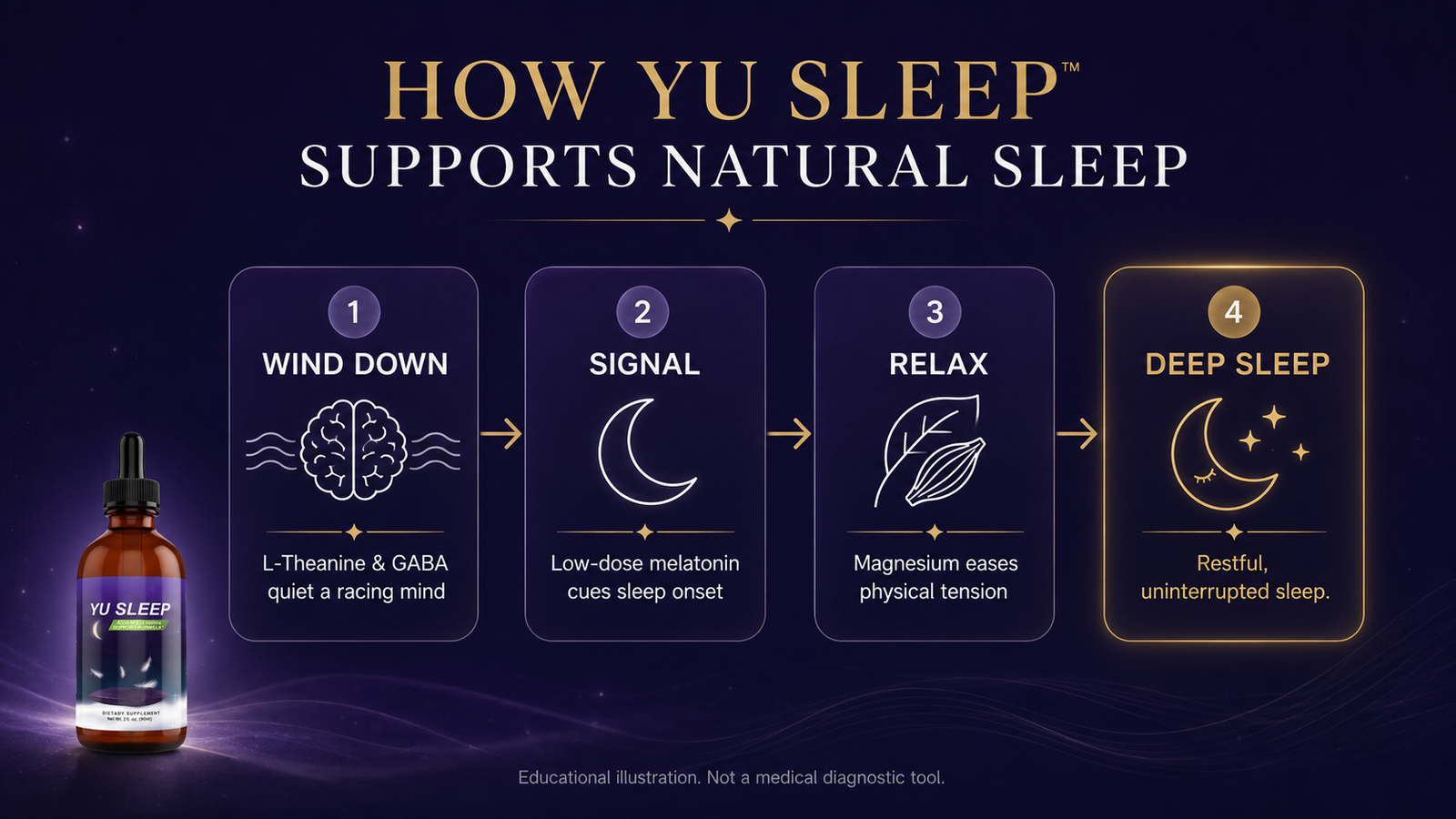
The seller’s described mechanism. Note that the mechanism is a claim, not a finding — no trial has tested the finished product.
| Ingredient (dose) | What the human evidence shows | Verdict |
|---|---|---|
| Melatonin (0.9 mg) | The best-evidenced sleep ingredient there is. Meta-analyses show it shortens time to fall asleep and modestly improves sleep quality. 0.5–1 mg performs as well as much larger doses with fewer next-day effects. This dose is well chosen. | Right ingredient, right dose |
| L-theanine (undisclosed) | Genuine but modest evidence for relaxation and sleep quality at 200 mg. Very well tolerated. Below ~100 mg the trials do not support it — and 200 mg is a large share of what 2 ml can carry. | Good ingredient, dose almost certainly low |
| Magnesium glycinate (undisclosed) | Helps mainly those who are deficient, at 200–320 mg elemental — which is 1.4–2.2 grams of the glycinate form. That quantity cannot dissolve in a 2 ml serving. Whatever is present is a token amount. | Format rules out a real dose |
| 5-HTP (undisclosed) | Thin, mostly older evidence for sleep onset at 100–300 mg. The safety point matters more than the efficacy: with SSRIs, SNRIs, MAOIs, triptans, tramadol or St John’s wort it risks serotonin syndrome. An undisclosed amount makes that risk impossible to weigh. | Interaction risk at an unknown dose |
| Lemon balm (undisclosed) | Small trials at 300–600 mg suggest mild anxiolytic and sleep-quality effects. Reasonable ingredient; same volume constraint applies. | Plausible, dose unknown |
| Tart cherry (undisclosed) | One of the more interesting sleep foods — small trials found modest increases in sleep time, using 30 ml of concentrate twice daily or equivalent. A share of a 2 ml dropper is orders of magnitude below that. | Studied dose is far beyond the format |
| GABA (undisclosed) | Poorly absorbed into the brain — oral GABA crosses the blood–brain barrier badly, and the human evidence for oral supplementation on sleep is weak and inconsistent regardless of dose. | Weak evidence at any dose |
| Apigenin (undisclosed) | The flavone in chamomile. Popular on podcasts, but essentially no controlled human trials of isolated apigenin for sleep at supplement doses. Interesting, not established. | No controlled human evidence |
| Vitamin B6 & B2 (undisclosed) | B6 is involved in melatonin synthesis, which is the rationale, but supplementing it does not improve sleep in people who are not deficient. High-dose B6 over long periods can cause peripheral neuropathy — another reason an undisclosed amount is unhelpful. | Only relevant if deficient |
No study has tested the finished product. On the evidence, the melatonin is doing essentially all of the work, and it is doing it at a sensible dose.
Does the Liquid/Sublingual Format Matter?
Sublingual delivery is the main selling point of the format, so it deserves a straight answer: partly, and less than the marketing implies.
Holding a liquid under the tongue can allow some absorption directly through the mucous membrane, bypassing first-pass metabolism in the liver. For melatonin specifically, sublingual and fast-dissolve forms do tend to raise blood levels somewhat faster than a swallowed tablet, which may mean falling asleep slightly sooner. That is a real, if small, advantage.
What it does not do is increase the amount of active ingredient. Absorption route does not create dose. A trace of magnesium absorbed efficiently is still a trace of magnesium. And in practice most of a 2 ml dropper gets swallowed rather than absorbed sublingually, so the distinction is smaller than the sales copy suggests.
Language such as “nano-enhanced” has no agreed technical meaning on a supplement label and no published testing behind it here. Treat it as marketing, not as a specification.
⚠ What is NOT known (read before buying)
• Nine of the ten doses, including the 5-HTP, which is the one carrying a drug interaction.
• The exact servings per bottle and therefore the exact volume per dose — “about 30” is what is published.
• Whether the lemon balm and tart cherry are standardized extracts or flavouring-level inclusions.
• Who makes and sells it. No company name and no returns address appear on the sales page; orders are described as processed by an unnamed third-party retailer.
• No certificate of analysis, no named third-party tester, and no trial on the finished product.
• Preservative system. A multi-ingredient botanical liquid needs one, and it is not disclosed.
Who Should Avoid It
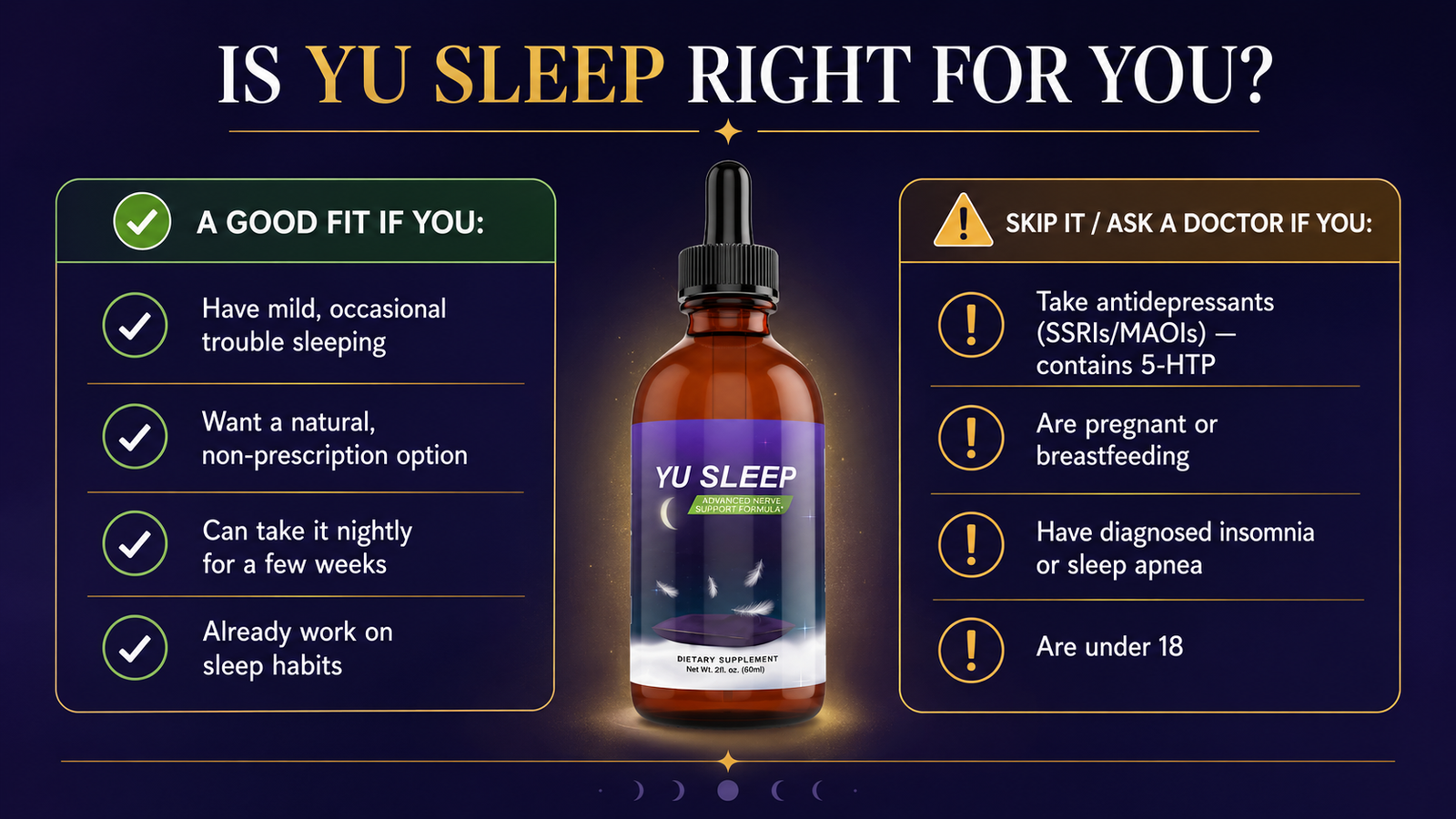
- Anyone taking an antidepressant or other serotonergic medication — SSRIs, SNRIs, MAOIs, triptans for migraine, tramadol, St John’s wort. The 5-HTP creates a serotonin syndrome risk, and the undisclosed dose means you cannot judge its size. This is the strongest reason to avoid this product.
- Anyone with suspected sleep apnoea — heavy snoring, witnessed breathing pauses, morning headaches, daytime sleepiness. Apnoea needs diagnosis; no supplement addresses it, and sedating through it is the wrong move.
- Shift workers and anyone driving early — melatonin at any dose shifts timing, and taken at the wrong hour it makes things worse rather than better.
- Anyone on blood-pressure, diabetes, anticoagulant or immunosuppressant medication — melatonin and several of these botanicals have documented interactions; ask a pharmacist first.
- Pregnant or breastfeeding women, and anyone under 18 — melatonin in children should be a doctor’s decision, not a purchase.
- Anyone with an autoimmune condition — melatonin is immune-modulating and is generally approached cautiously here.
This is not medical advice. Chronic insomnia — trouble sleeping at least three nights a week for three months or more — has a first-line treatment that is not a supplement: CBT-I, cognitive behavioural therapy for insomnia, which outperforms sleeping pills at twelve months and is what clinical guidelines recommend. If that describes you, a doctor is a better use of $138 than a bottle.
Price, Guarantee & Where to Buy
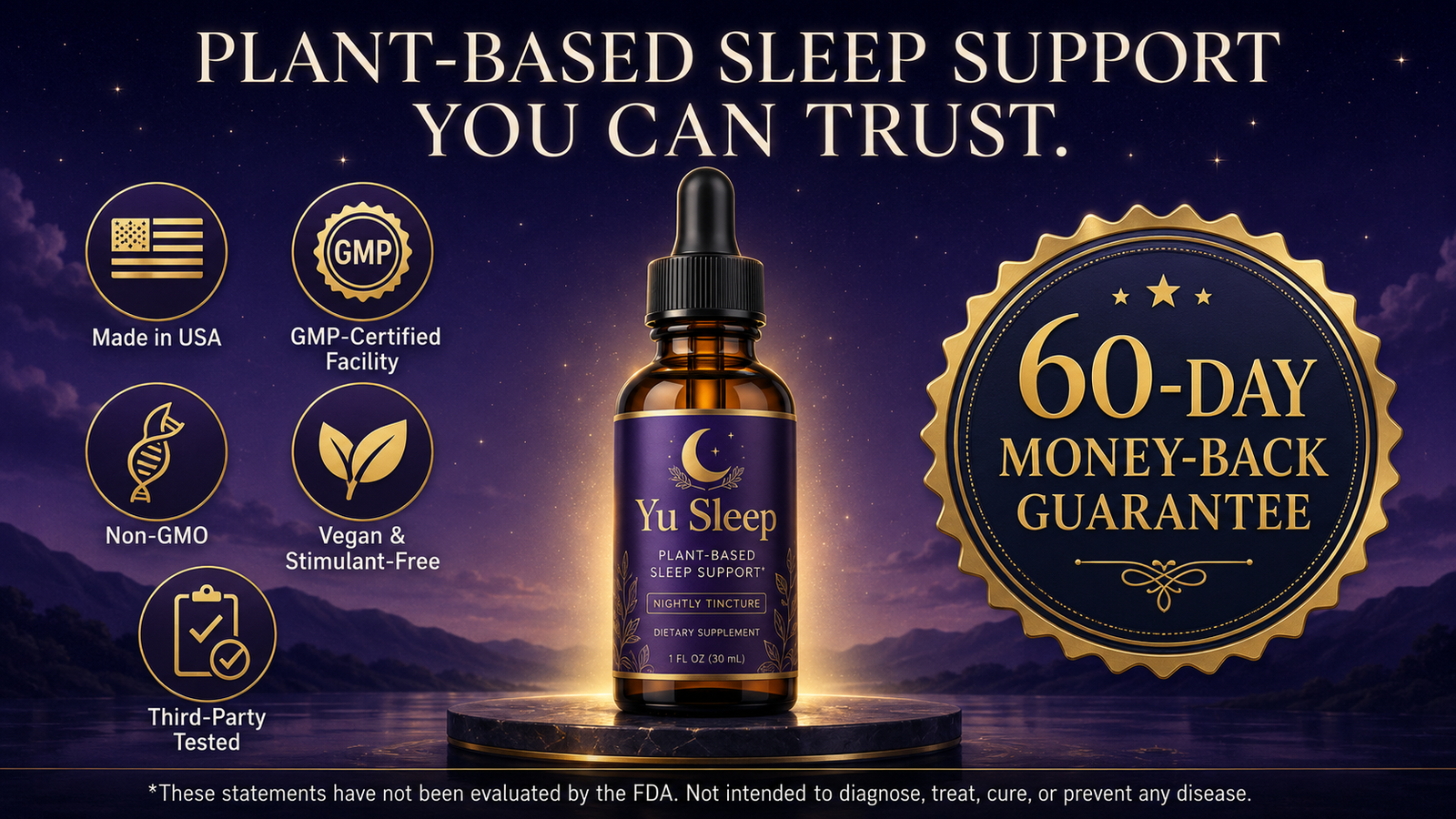
“Made in a GMP-certified, FDA-registered facility” describes a registration, not an inspection or approval of this product.
Yu Sleep is sold only through the seller’s own funnel; we could not verify authorized retail availability. Prices below are as listed on 4 September 2026 — confirm the current price, shipping and guarantee on the checkout page you actually use:
Cost per day: about $2.30 on the 2-pack, $1.97 on the 3-pack and $1.63 on the 6-pack. There is no single-bottle option, so the smallest commitment is $138 before shipping.
The comparison that matters: a bottle of 1 mg melatonin tablets — the ingredient doing the work here, at essentially the same dose — costs around $0.05–$0.10 a day. Add 200 mg of L-theanine at a real dose and you are still under $0.30. Yu Sleep is roughly six to thirty times that, and the premium buys the liquid format, the nine trace ingredients and the bonuses.
The guarantee. The seller advertises 60 days, no questions asked, handled through the merchant’s support portal. Sixty days is standard for this category. As always, you contact support for authorization and return at your own cost. Since the doses are undisclosed until the bottle is in your hand, read the panel on day one rather than day fifty-nine.
The 3- and 6-bottle orders include three digital guides. Digital bonuses cost the seller nothing to reproduce and exist to make the larger bundles feel better value — judge the offer on the product, not the PDFs.
See the seller’s current price & return terms
Confirm the current price, shipping, the 60-day guarantee and whether a full Supplement Facts panel with doses is shown before you order (checked 4 Sep 2026).
View the seller’s current offer →Honest Alternatives
- Low-dose melatonin on its own. If the 0.9 mg is what appeals to you — and it is the best thing about this product — buy 1 mg melatonin tablets. Same dose, same evidence, a few cents a night, and the amount is printed on the label.
- Add L-theanine separately at 200 mg if you want it, for roughly $0.15 a day. You will get more of it in one capsule than 2 ml of liquid can carry across ten ingredients.
- CBT-I for anything that has lasted more than a month. First-line in clinical guidelines, better than sleeping pills at twelve months, and available through low-cost apps or your doctor.
- Rule out sleep apnoea if you snore heavily or wake unrefreshed. Untreated apnoea is a cardiovascular risk that no supplement touches.
- The free measures: a fixed wake time, no alcohol within three hours of bed, no caffeine after mid-afternoon, morning daylight, a cool dark room. These outperform most bottles.
- Compare within the category: see our Renew review and SleepLean review, both of which have the same undisclosed-dose problem without the sensible melatonin choice.
Pros, Cons & Verdict
What we liked
- 0.9 mg melatonin — a genuinely well-judged dose, and rare in this market
- The melatonin amount is disclosed, which most competitors do not do
- Sensible ingredient selection — nothing exotic or hormone-adjacent
- Liquid may act slightly faster than a swallowed tablet
- 60-day guarantee; no stimulants; no fake testimonials on the seller’s page
What gives us pause
- Nine of ten doses undisclosed, including the 5-HTP that carries the drug interaction
- The 2 ml format physically caps the doses — magnesium and tart cherry cannot be near studied amounts
- GABA and apigenin have weak or no controlled human evidence at any dose
- Roughly 6–30× the cost of the melatonin doing the work
- No company name or returns address anywhere
- “Nano-enhanced” has no defined meaning and no testing behind it
- No single-bottle option — minimum $138
Editorial verdict — mixed, one good decision and nine unknowns: Yu Sleep is a more thoughtful product than most of what we review, and we want to be fair about that. Choosing 0.9 mg of melatonin over the usual 5 or 10 mg shows someone read the literature, and it is the choice most likely to leave you feeling normal in the morning. But that single good decision is wrapped in a formula whose other nine ingredients have no published amounts and whose format cannot physically carry meaningful doses of them. What you are buying is well-dosed melatonin, delivered in a liquid, at six to thirty times the price of well-dosed melatonin. If the format genuinely helps you take it consistently, that premium may be worth it to you. If it is the ingredient list that appeals, the list is mostly decorative.
Frequently Asked Questions
Melatonin for primary sleep disorders — meta-analysis of randomized controlled trials (PLoS One, 2013). PubMed 23691095
Low-dose versus high-dose melatonin and next-day effects — dose-response review. PubMed 26692007
L-theanine and stress-related symptoms and sleep quality — randomized controlled trial at 200 mg/day. PubMed 31623400
Tart cherry juice and sleep — randomized trial using 30 ml of concentrate twice daily. PubMed 22038497
Oral GABA and blood–brain barrier penetration — review of the human evidence. PubMed 33095597
Lemon balm (Melissa officinalis) for anxiety and sleep — controlled trials at 300–600 mg. PubMed 21178979
5-HTP and serotonin syndrome risk with serotonergic drugs — NIH National Center for Complementary and Integrative Health. nccih.nih.gov
Magnesium and sleep — NIH Office of Dietary Supplements magnesium fact sheet. ods.od.nih.gov
Vitamin B6 upper limit and peripheral neuropathy — NIH Office of Dietary Supplements B6 fact sheet. ods.od.nih.gov
CBT-I as first-line treatment for chronic insomnia — American College of Physicians clinical guideline. PubMed 27136449
Seller’s published ingredient list, serving size, pricing and guarantee wording — accessed 4 September 2026.