
Finessa is marketed as a daily gut-and-liver support drink — a flavourless powder you mix into water, built around liver-friendly botanicals (dandelion, milk thistle, artichoke, turmeric), probiotics and prebiotic fibre, with a single gentle botanical laxative, cascara sagrada, in the mix. This review sets the marketing aside and looks at what the real blend can plausibly do, and — importantly — the one ingredient (cascara) and one caution (licorice) that mean this is not something to take heavily forever.
Quick Takeaway: Finessa is a mix-with-water powder for digestion and liver support, containing Dandelion, Milk Thistle, Globe Artichoke, Turmeric, Licorice, targeted probiotic strains and inulin from dandelion, plus Cascara Sagrada — a mild stimulant laxative. Most of the blend is gentle daily-type support; the cascara is the reason to be mindful of duration. Pricing runs $59 for one bottle down to $39 a bottle on the six-pack, with a generous 180-day money-back guarantee. It is not a hardcore laxative, but it is also not a “take-forever, no-thought” powder either.
In this review
- What is Finessa?
- Key facts
- How it works — and what causes the effect
- Ingredients: what is in the scoop
- Ingredient evidence audit
- Benefits: what it can and cannot support
- The cascara sagrada problem
- Licorice and blood pressure
- Are there independent reviews?
- Where to buy the original
- Who it is for — and who should skip it
- Side effects and honest drawbacks
- How big is the discount, really?
- Pricing, guarantee and bonuses
- Honest alternatives
- Our independent verdict
- Pros and cons
- Sources and update history
- Frequently asked questions
Liver
Cascara
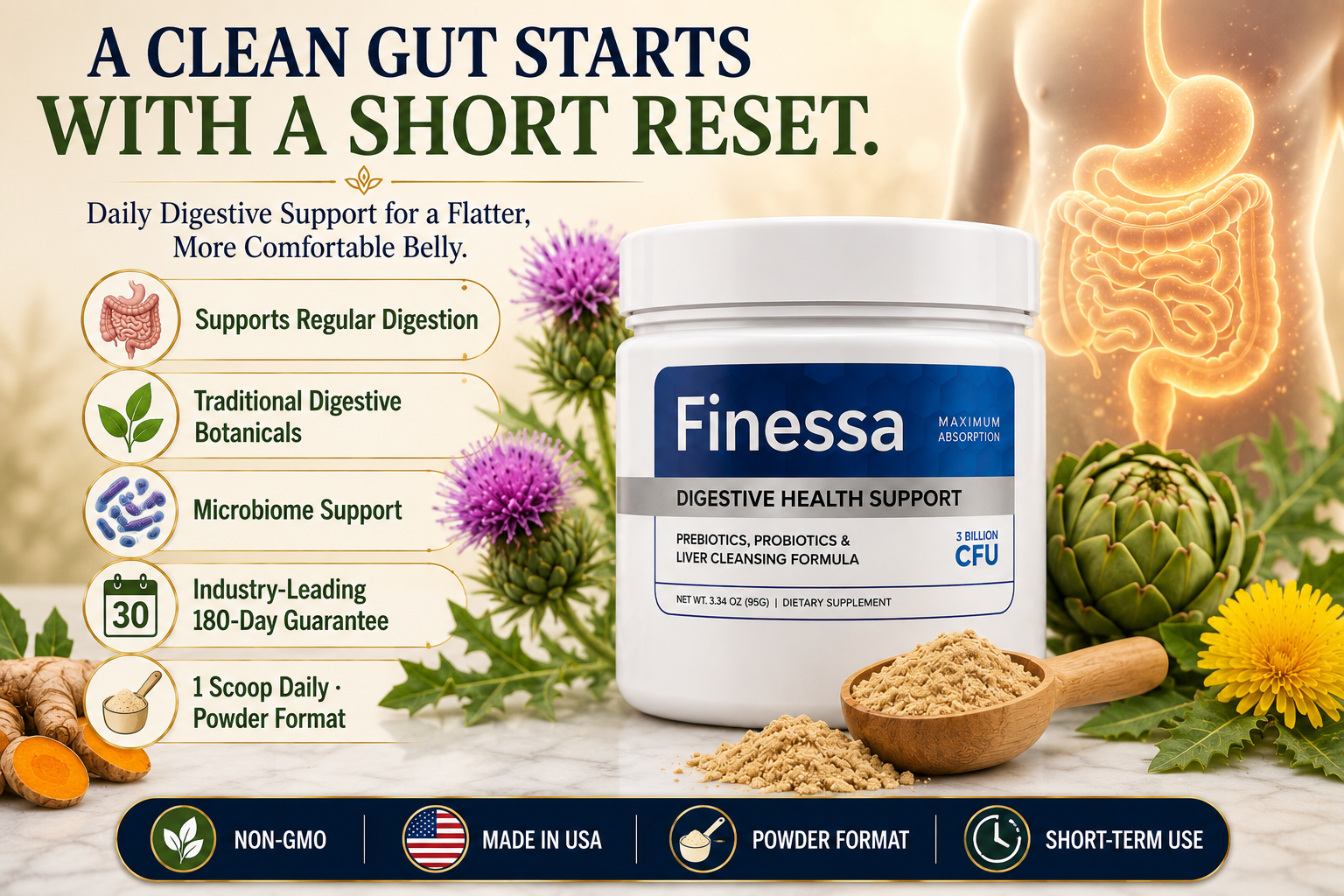
Finessa is a flavourless powder mixed into water — a gut-and-liver support blend rather than a capsule.
| Category | Gut & Liver Support Powder |
| Format | Flavourless powder — mix with water |
| Core Actives | Dandelion, Milk Thistle, Artichoke, Turmeric, Probiotics |
| Key Caveat | Contains cascara (stimulant laxative) & licorice — mind duration |
| Our Verdict | Mixed — reasonable blend, watch the cascara |
| Guarantee | 180-day money-back guarantee |
| Best Price | From $39 a bottle on the official website |
Editorial note: this page is our own opinion-based assessment. We did not run a clinical trial on Finessa and make no claim to have tracked any users. Any figures below refer to published research on individual ingredients, not to a study we conducted.
What Is Finessa?
Finessa is a flavourless powder you mix into water or another drink, marketed as daily support for digestion, regularity and liver function. It is sold direct-to-consumer through its official website. Despite some third-party pages describing it as a capsule, the actual product is a powder taken once daily.
The real, verified blend leans heavily on liver-and-digestion botanicals: Dandelion Root, Milk Thistle (silymarin), Globe Artichoke, Turmeric Root and Licorice, combined with targeted probiotic strains and inulin from dandelion (a prebiotic fibre), plus polyphenol-rich plant compounds. Within that mix sits one gentle botanical laxative, Cascara Sagrada. So the honest framing is: this is mostly a liver-support-and-gut-balance powder with a mild regularity nudge from cascara — not a heavy-duty stimulant-laxative product.
Individual ingredient doses are not clearly published for the powder, so as with any of these products, read the current Supplement Facts panel on the bottle you receive to see the amounts.
Key Facts
| Category | Digestive, liver and gut-support supplement |
| Format | Powder — one scoop mixed into water each morning; scoop supplied. One bottle = 30-day supply |
| Headline claim | Cleaner gut, smoother digestion, flatter belly, regularity via the “gut–liver axis” |
| Ingredients named | 8 — dandelion, milk thistle, cascara sagrada, globe artichoke, turmeric, licorice, probiotics, polyphenols |
| Per-ingredient doses | Not published. No supplement facts panel appears anywhere on the sales page |
| Key gap | Contains a stimulant laxative (cascara sagrada) at an undisclosed amount, sold for daily six-month use |
| Probiotic detail | No strain codes, no CFU count — only the word “probiotics” |
| Price | $59 (1) · $147 (3, $49 each) · $234 (6, $39 each, free US shipping) |
| Guarantee | 180 days — long enough to cover the full course the seller recommends |
| Manufacturer | Not named on any page we checked. Contact is a support email only |
| Independent reviews | No Trustpilot profile exists for the seller’s domain (checked 7 Sep 2026) |
| Our take | Mixed — a qualitative editorial judgement, not a score |
How Finessa Works — and What Actually Causes the Effect
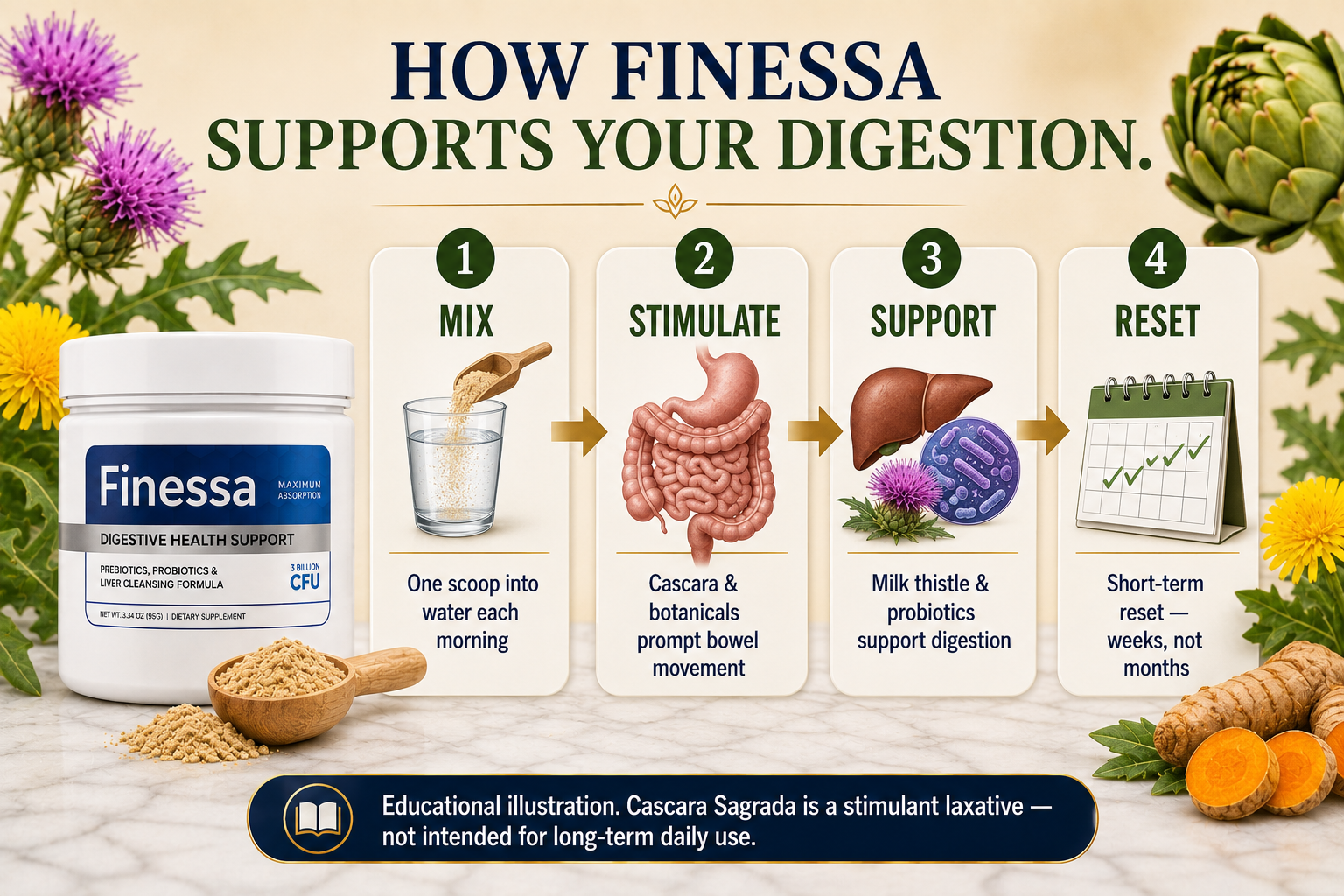
Finessa tries to work on digestion from a few gentle angles at once. The liver-support angle is the biggest part of the blend: milk thistle (silymarin), artichoke, dandelion and turmeric are the classic “liver and bile” botanicals, with some human evidence that artichoke and dandelion support bile flow and that silymarin has antioxidant activity in the liver. Better bile flow can translate into more comfortable digestion of fats.
The gut-balance angle comes from the probiotic strains plus inulin from dandelion, a prebiotic fibre that feeds beneficial bacteria and gently supports regularity and stool bulk. The regularity nudge comes from cascara sagrada, a botanical whose anthraquinone compounds are converted by gut bacteria into metabolites that stimulate the colon — the same general mechanism as senna and other stimulant laxatives, but here it is one ingredient within a broader blend rather than the whole product.
The honest caveat is twofold. First, doses aren’t disclosed, so how much of a regularity effect you get from the cascara is hard to predict. Second, because cascara is a stimulant laxative, this isn’t a powder to lean on heavily every day indefinitely — the liver and probiotic parts are fine for daily-type use, but the cascara is the reason to be mindful of duration (more in the safety section). Any benefit tends to build gradually over a few weeks, and response varies from person to person.
Finessa Ingredients: What Is Actually in the Scoop
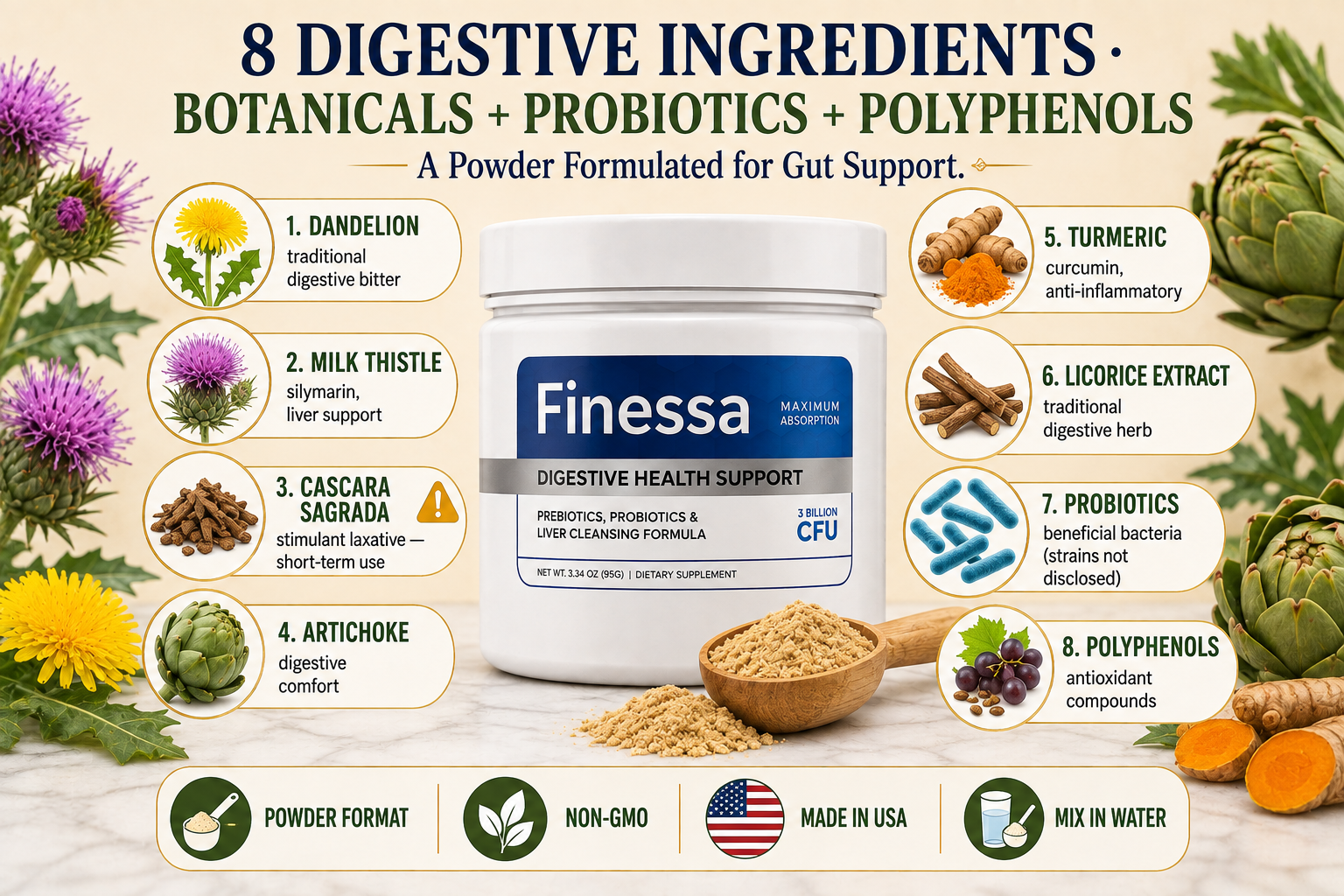
Assessment of the real Finessa ingredients, graded against the research. Doses are not clearly disclosed for the powder, so confirm amounts on the current label.
Milk Thistle (Silymarin)
Best-Studied Here
Globe Artichoke & Dandelion
Bile / Digestion
Turmeric Root
Absorption Caveat
Probiotic Strains + Prebiotic Fibre
Depends on Strain & Dose
Cascara Sagrada
Stimulant Laxative — Short-Term
Licorice Extract
Blood-Pressure Caution
Finessa Ingredient Evidence Audit
Eight ingredients are named and not one has a published amount. Here is what the research says about each for the claims Finessa makes — digestion, regularity, liver support and gut balance. Research on an isolated ingredient is not proof a finished blend works, and no trial of Finessa itself has been published.
| Ingredient | Evidence for the digestive / liver claim | Verdict |
| Cascara sagrada | This one unambiguously does something: it is a botanical stimulant laxative whose anthraquinones act directly on the colon. It is also the ingredient the FDA removed from over-the-counter laxative drug products in 2002 for want of established safety and effectiveness. If you notice an effect in the first days, this is almost certainly why. | Active — and the reason for caution |
| Milk thistle (silymarin) | The most-researched ingredient in the blend. Human data centre on liver-enzyme markers in liver disease, and even there systematic reviews have found the evidence inconsistent. Nothing supports “detox” or liver cleansing in healthy people. | Best-studied, modest |
| Globe artichoke (cynara) | Has the most relevant human data for the actual claim — small randomised trials of artichoke leaf extract report improvement in functional dyspepsia and IBS symptoms, at standardised doses this label does not disclose. | Plausible, dose unknown |
| Licorice extract | Deglycyrrhizinated licorice has some data for dyspepsia. Whether Finessa uses the deglycyrrhizinated form is not stated — and if it does not, the glycyrrhizin brings blood-pressure and potassium risk with no added digestive benefit. | Depends on a form not disclosed |
| Turmeric root | Some trials support curcumin for functional dyspepsia. The practical problem is absorption: curcumin is poorly bioavailable without piperine or a lipid carrier, and the label mentions neither. | Absorption caveat |
| Dandelion (inulin) | A genuine source of inulin, a prebiotic fibre that feeds gut bacteria. The effect is real but dose-dependent, and inulin in meaningful amounts commonly causes gas and bloating — the symptom the product promises to fix. | Real but dose-dependent |
| Probiotics | Probiotic benefits are strain-specific and dose-specific. Finessa names no strain and no CFU count — only the word “probiotics”. There is nothing here to match against the research. | Unassessable as labelled |
| Polyphenols | Listed as a category rather than an ingredient. Dietary polyphenols do interact with gut bacteria, but with no source plant and no amount given, this is a word on a label rather than a claim that can be checked. | Unassessable as labelled |
What is not known — read before buying
No trial of the finished product. No published study of Finessa exists, only research on individual ingredients at doses this label does not disclose.
No amounts at all. Eight ingredients, no supplement facts panel on the sales page. The cascara amount matters most and is the one you most need.
No probiotic identity. Without a strain code and a CFU count, the probiotic content cannot be compared with anything that has been studied.
No manufacturer. No company name or address is published anywhere — only a support email on the seller’s own domain.
Finessa Benefits: What the Formula Can and Cannot Support
The sales page promises a flatter belly, smoother skin, more energy, sharper focus, faster metabolism, healthy cholesterol and balanced blood sugar — from one scoop of powder. That is a very wide net for eight ingredients at undisclosed amounts. Here is the honest split.
The bowel effect is real, and it is the reason most people will feel something. Cascara sagrada is a stimulant laxative. If you take Finessa and your bathroom habits change within a day or two, that is the cascara doing what stimulant laxatives do — not evidence that your liver, metabolism or gut microbiome has been transformed. It is important to understand which ingredient is producing the effect you notice.
Reasonable, modest support: milk thistle for liver-enzyme markers and artichoke for digestive comfort and bile flow both have some human data, though not at doses this label discloses. Inulin from dandelion is a genuine prebiotic fibre.
Marketing, not evidence: radiant skin, sharper focus, a “revved-up metabolism” and balanced blood sugar. No trial of the finished Finessa formula exists, and none of these outcomes follows from the ingredient list at any dose you can verify.
The Cascara Sagrada Problem
What the 2002 FDA ruling did and did not cover
This is the finding that most changes how we would use this product, and it is worth stating precisely because the precise version matters.
In a final rule published on 9 May 2002 and effective 5 November 2002, the FDA determined that aloe and cascara sagrada are not generally recognised as safe and effective for use in over-the-counter laxative drug products. Manufacturers were given 180 days to remove them from OTC laxatives.
The important qualifier: that ruling covers OTC drug products. It does not cover dietary supplements, which are regulated under a different framework. Cascara sagrada in a supplement like Finessa is legal. But the reason the FDA acted was that the available data were not sufficient to establish safety and effectiveness — and that reasoning does not stop applying just because the same botanical is sold in a different aisle.
Practically, stimulant laxatives are intended for short-term use. Prolonged daily use is associated with dependence and electrolyte disturbance. Finessa’s own marketing pushes six-month bundles and tells buyers to take it every morning for at least six months. Those two facts sit badly together, and the label does not say how much cascara is in a scoop.
Licorice, Blood Pressure and Who Should Not Take Finessa
Who needs to be careful with licorice
The formula lists licorice extract. Unless it is deglycyrrhizinated — and the seller does not say — licorice contains glycyrrhizin, which causes potassium loss and sodium retention.
NCCIH states that glycyrrhizin “can cause serious adverse effects, such as irregular heartbeat and cardiac arrest, especially when consumed in large amounts or in the long term”, and that even small amounts have been linked to severe adverse effects in people who eat a lot of salt, people with high blood pressure, and people with heart or kidney conditions. Interactions with corticosteroids have been reported.
Do not take Finessa daily without asking a doctor if you: take blood-pressure medication or a diuretic; have heart, kidney or liver disease; take digoxin, warfarin or corticosteroids; are pregnant or breastfeeding; have inflammatory bowel disease, a bowel obstruction or undiagnosed abdominal pain; or are under 18. The licorice and the cascara each independently justify that conversation.
Does Finessa Have Independent Customer Reviews?
What we checked, and what we found
We checked for a third-party review profile on 7 September 2026. There is no Trustpilot page for myfinessa.com — the URL returns a 404, meaning the business is not listed. The sales page carries no dated, checkable customer reviews either.
The page does describe a manufacturing facility as GMP-certified. We have no way to verify that from outside, and we do not repeat manufacturing badges as fact on this site. No company name, address or manufacturer is published anywhere on the seller’s pages; the only contact point is a support email at the same domain.
Where to Buy the Original Finessa
Why the guarantee only exists on an official order
Finessa is sold through one funnel only, with ClickBank as the retailer of record at checkout. It is not stocked by Amazon, eBay, Walmart or any pharmacy chain, and the seller says so explicitly.
Why this matters more than usual here. Two things follow from buying anywhere other than the official checkout. First, the 180-day guarantee — the single best feature of this offer — only exists on an official order; a marketplace seller is not bound by it. Second, because the label publishes no amounts, you have no way to tell a genuine bottle from a repackaged one by reading it. With a formula containing a stimulant laxative and licorice, that is not a trivial gap.
If a listing elsewhere is cheaper, treat that as a reason for suspicion rather than a bargain. Nothing on this page is worth buying from a source that cannot honour the refund.
Who Finessa Is For — and Who Should Skip It
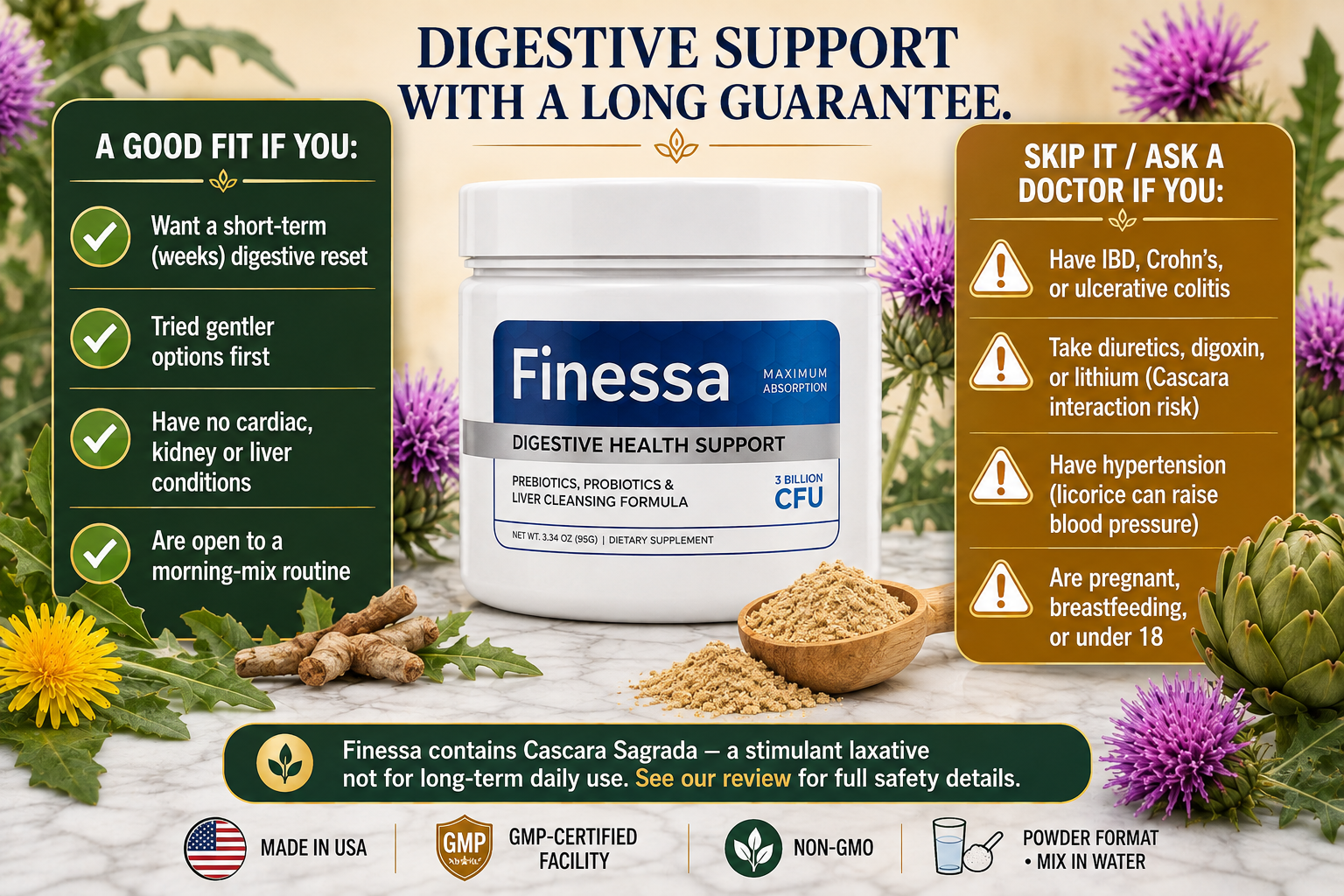
May Be a Reasonable Fit For:
- Adults wanting gentle daily digestion and liver-type support, with realistic expectations
- People who like the idea of a mix-with-water routine over swallowing pills
- Anyone wanting a probiotic-plus-prebiotic blend with a mild regularity nudge — used sensibly, not leaned on daily forever
⚠ Important: cascara & licorice — read before you buy
Finessa contains cascara sagrada, a stimulant laxative. Stimulant laxatives are meant for occasional or short-term use — relying on one daily for long stretches is associated with the bowel becoming dependent on stimulation and with potassium/electrolyte loss. It also contains licorice, which can raise blood pressure and lower potassium; the two together compound that risk. Do not use Finessa if you are pregnant or breastfeeding (cascara is contraindicated), and check with your doctor first if you have high blood pressure, a heart condition, inflammatory bowel disease, undiagnosed abdominal pain, or take diuretics, digoxin, corticosteroids or warfarin. If you feel you need it every day just to stay regular, the underlying issue is usually dietary/hydration-related and deserves a doctor’s input rather than ongoing laxative use.
Not the Right Product If:
- You are pregnant or breastfeeding — the cascara rules it out
- You have high blood pressure or take diuretics/heart medication — the licorice and cascara are a poor combination without medical sign-off
- You want a genuinely gentle, indefinitely-daily fibre product — a plain psyllium or a probiotic without a stimulant laxative is the cleaner choice
- You expect it to “detox” your liver — that’s a marketing idea, not a medical one; a healthy liver detoxes itself
Finessa Side Effects and Honest Drawbacks
What you are most likely to notice first
What to Realistically Weigh
- It contains a stimulant laxative. Cascara means this isn’t a “take forever without thinking” powder. Use it mindfully and don’t lean on it daily for months.
- Licorice adds a blood-pressure/potassium caution. Relevant if you’re hypertensive or on diuretics — and it compounds cascara’s potassium effect.
- Doses aren’t disclosed. The probiotic strains/CFU and the botanical amounts aren’t clearly published, so how much of each you’re getting is unknown — read the label.
- “Liver detox” framing oversells it. Milk thistle and artichoke are reasonable support botanicals, but a healthy liver doesn’t need detoxing, and this treats no liver disease.
- Turmeric absorption is uncertain. Without a stated absorption enhancer, the curcumin may contribute less than the label implies.
- Direct-only sales. No Amazon or retail; the (generous 180-day) guarantee applies only to direct orders.
How Big Is the Finessa Discount, Really?
Checked directly at the official checkout on 7 September 2026: one bottle $59 plus shipping, three bottles $147 ($49 each), six bottles $234 ($39 each) with free US shipping. Three bonus ebooks come with the three- and six-bottle packs. The guarantee is 180 days.
On the advertised saving: the page shows “You Save: $360” against a $594 list price for six bottles. No buyer is ever charged $99 a bottle. Measured against the real single-bottle price of $59, six bottles would be $354, so the actual saving on the six-pack is about 34% — a genuine discount, but roughly a third of the number on the page.
The 180-day guarantee is the strongest thing about this offer, and unlike most supplements in this category it does cover the full length of the six-bottle course. That is worth something. Read ClickBank’s refund terms before relying on it.
Finessa Pricing, Guarantee and Bonuses
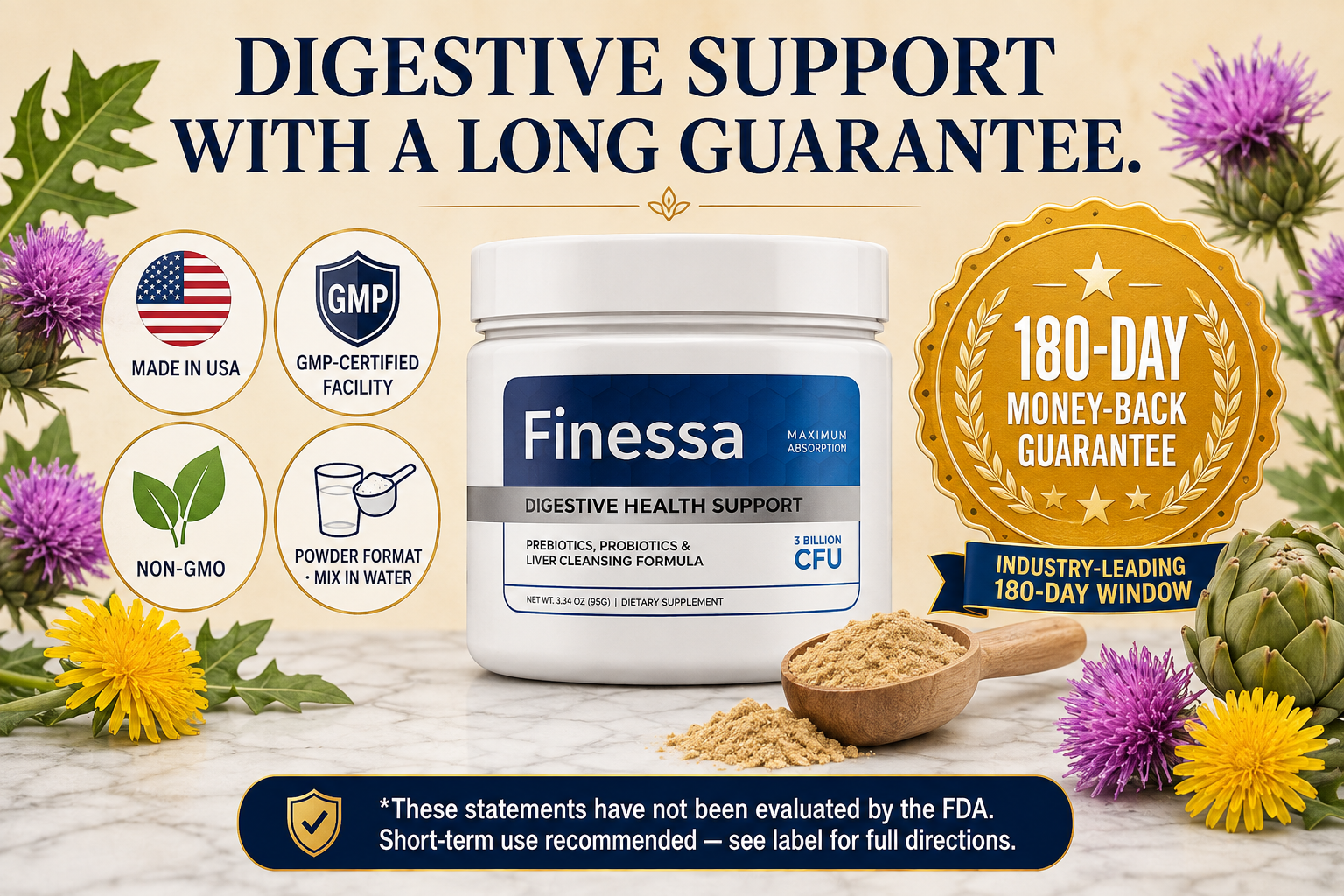
Finessa is sold exclusively through the official website. Pricing follows the standard tiered structure (confirm current pricing on the official site before ordering):
Our pricing take: because this powder contains a stimulant laxative, we’d be cautious about stockpiling six bottles up front. A single bottle is enough to see how you tolerate it, and the three-bottle bundle is a fair middle ground — and the long 180-day guarantee means you’re not rushed. Buy the amount that fits sensible, non-continuous use, not the biggest bundle by default.
The 180-Day Money-Back Guarantee
Finessa’s standout commercial feature is its 180-day money-back guarantee — one of the longest in the category, and genuinely generous. To claim it you contact customer service through the official site, request a return authorisation, and ship the bottle(s) back at your own cost; refunds process after the return is received. Six months is more than enough time to judge whether the product suits you. Confirm the current terms at checkout, since the official site is the authority on the exact policy.
Check the Official Finessa Website
Authentic product, current pricing, the full label, and the 180-day money-back guarantee — only direct from the manufacturer.
Honest Alternatives to Finessa
Cheaper options with better evidence
If what you actually want is regularity, the honest answer is that you do not need this product to get it, and the cheapest options have far better evidence behind them.
For constipation: psyllium husk and other bulk-forming fibres are the first-line option in clinical guidance, cost a few dollars a month, and carry none of the dependence concerns attached to stimulant laxatives. Adequate fluid and dietary fibre do most of the work. A pharmacist can point you at the right one in two minutes.
For gut balance: a probiotic that publishes its strains and CFU count is worth more than one that says only “probiotics”. Strain and dose are what the research is done on; without them there is nothing to check.
For liver support: milk thistle is available as a standardised single-ingredient supplement with the silymarin content stated on the label, usually for less than Finessa costs.
Finessa’s appeal is convenience — one scoop instead of several products — plus a genuinely long guarantee. Those are real, but they are what you are paying for, not superior ingredients.
Our Independent Verdict
Finessa is a reasonable gut-and-liver support powder with a sensible core (milk thistle, artichoke, dandelion, turmeric, probiotics + inulin) and an unusually long 180-day guarantee. The catch is the cascara: it’s a stimulant laxative, so this isn’t a “take-forever without thinking” product, and the licorice adds a blood-pressure caution. Used sensibly by the right person — and not by anyone pregnant or with high blood pressure — it’s a fair, low-pressure trial thanks to that guarantee. *Safety scored for the appropriate, non-pregnant user without hypertension.
Finessa — Pros and Cons
What We Liked
- Sensible liver-and-digestion core (milk thistle, artichoke, dandelion, turmeric)
- Probiotic + prebiotic (inulin) synbiotic pairing for gut balance
- Mix-with-water format some people prefer to pills
- Exceptionally long 180-day money-back guarantee
- Multi-bottle bundles lower the per-bottle cost
What Could Be Better
- Contains cascara (a stimulant laxative) — not for indefinite daily use
- Licorice adds a blood-pressure / potassium caution
- Probiotic strains/CFU and botanical doses not clearly disclosed
- Not safe in pregnancy or breastfeeding
- “Liver detox” framing oversells the evidence
- Direct-only sales
Sources and Update History
Primary sources used on this page
Cascara sagrada — FDA final rule, “Status of Certain Additional Over-the-Counter Drug Category II and III Active Ingredients”, Federal Register vol. 67 no. 90, 9 May 2002; effective 5 November 2002. Establishes that aloe and cascara sagrada are not generally recognised as safe and effective for OTC laxative drug products. Does not apply to dietary supplements.
Licorice and glycyrrhizin — National Center for Complementary and Integrative Health, licorice root fact sheet, on adverse cardiac effects, potassium loss and corticosteroid interactions.
Product facts — the official Finessa sales page and ClickBank checkout, read directly on 7 September 2026: format, ingredient list, package pricing, bonuses and guarantee terms.
Independent reviews — Trustpilot searched for the seller’s domain on 7 September 2026; no profile exists.
Update log: 7 September 2026 — full evidence-led rebuild. Ingredient list, format, package pricing and the 180-day guarantee re-verified against the official checkout on this date; previously published pricing was corrected. We will re-check the formula and price on the next material change.
Frequently Asked Questions
What is Finessa and how do you take it?
Finessa is a powdered dietary supplement marketed for digestion, bile flow, gut balance and regularity. The seller says to mix one scoop into water or another drink each morning; a scoop is supplied. One bottle is a 30-day supply.
What are the ingredients in Finessa?
Eight are named on the official page: dandelion (taraxacum), milk thistle (silymarin), cascara sagrada, globe artichoke (cynara scolymus), turmeric, licorice extract, probiotics and polyphenols. No amounts are published for any of them and there is no supplement facts panel on the sales page.
Does Finessa contain a laxative?
Yes. Cascara sagrada is a botanical stimulant laxative. This is the ingredient most likely to be responsible for a noticeable change in bowel habit in the first days of use, and it is the reason we would not treat Finessa as an open-ended daily product.
Is cascara sagrada banned by the FDA?
Not in supplements. In a 2002 final rule the FDA determined that cascara sagrada is not generally recognised as safe and effective for over-the-counter laxative drug products, and gave manufacturers 180 days to remove it from those. Dietary supplements fall under a separate framework, so its use in Finessa is legal — but the safety reasoning behind the ruling is still worth knowing.
How long can I safely take Finessa?
The seller recommends at least six months. Stimulant laxatives are generally intended for short-term use, and prolonged daily use is associated with dependence and electrolyte disturbance. Because the cascara amount is not disclosed, we would treat extended daily use as something to clear with a doctor rather than assume.
Who should not take Finessa?
Anyone taking blood-pressure medication, diuretics, digoxin, warfarin or corticosteroids; anyone with heart, kidney or liver disease, inflammatory bowel disease, a bowel obstruction or undiagnosed abdominal pain; anyone pregnant or breastfeeding; and anyone under 18. The licorice and the cascara each give reason for caution.
Does Finessa raise blood pressure?
It may, if the licorice extract is not deglycyrrhizinated — and the seller does not say whether it is. Glycyrrhizin causes potassium loss and sodium retention. NCCIH notes serious effects including irregular heartbeat, particularly with large amounts, long-term use, high salt intake, or existing high blood pressure or heart or kidney conditions.
What are the side effects of Finessa?
The most likely are digestive: loose stools, urgency or cramping from the cascara, especially in the first week. Longer-term concerns are laxative dependence and, from the licorice, low potassium and raised blood pressure. Turmeric can cause stomach upset in some people and may interact with blood thinners.
How much does Finessa cost?
Checked at the official checkout on 7 September 2026: one bottle $59 plus shipping, three bottles $147 ($49 each), six bottles $234 ($39 each) with free US shipping. The three- and six-bottle packs include three bonus ebooks.
Is the “save $360” discount real?
Not as advertised. The saving is calculated against $594, a price no buyer is charged. Against the real single-bottle price of $59, six bottles at $234 is about 34% off — a real discount, but around a third of the advertised figure.
What is the Finessa refund policy?
One hundred and eighty days from purchase, handled through ClickBank as retailer of record. This is unusually long for this category and, unlike most competitors, it does cover the full six-month course the seller recommends.
Does Finessa have Trustpilot reviews?
No. There is no Trustpilot profile for myfinessa.com — the page returned a 404 when we checked on 7 September 2026. The sales page carries no dated, independently checkable customer reviews.
Who makes Finessa?
No company name, manufacturer or business address is published anywhere on the official site. The only contact point is a support email at the seller’s own domain. The page describes a GMP-certified facility, which we cannot verify from outside and do not repeat as fact.
Can I buy Finessa on Amazon?
The seller states it is sold only through its own site. Buying elsewhere means you are not covered by the 180-day guarantee, and you cannot confirm what you have received. If you buy it, buy it from the official checkout.
Is Finessa FDA approved?
No, and no dietary supplement is. The FDA does not approve dietary supplements for safety or effectiveness before they are sold.
Will Finessa help me lose weight?
There is no evidence that it does. The sales page bundles a weight-loss ebook and mentions metabolism, but no trial of the formula exists, and the short-term drop some people notice after a stimulant laxative is not fat loss.
Gillessen A, Schmidt HH. (2020). Silymarin as supportive treatment in liver diseases: a narrative review. Advances in Therapy. PubMed: 32065387
Wider B, et al. (2013). Artichoke leaf extract for treating hypercholesterolaemia / dyspepsia (Cochrane / review context). PubMed: 23543518
Morales MA, et al. (2009). Is senna/anthraquinone laxative use associated with cathartic colon, genotoxicity, or carcinogenicity? Journal of Toxicology. PubMed: 19606209
Omar HR, et al. (2012). Licorice abuse: time to send a warning message (glycyrrhizin, hypertension, hypokalemia). Therapeutic Advances in Endocrinology and Metabolism. PubMed: 23148186
NIH NIDDK — Digestive disease statistics & constipation guidance. niddk.nih.gov
Ready to Check Finessa?
Current pricing, the full label, and the 180-day money-back guarantee — only through the official site.
Affiliate Disclosure: Men’s Health Authority participates in affiliate marketing programmes and may earn a commission when readers purchase through links on this page, at no additional cost to the reader. This does not influence our editorial assessment.
Medical Disclaimer: This review is for informational and educational purposes only and is not medical advice. Finessa contains cascara sagrada, a stimulant laxative, and licorice; it is not appropriate for use in pregnancy or breastfeeding and should not be relied on for continuous long-term daily use. Always consult a qualified healthcare provider before starting any new supplement, especially if you are pregnant or breastfeeding, have high blood pressure or a heart, kidney or bowel condition, or take prescription medication. Statements have not been evaluated by the FDA; this product is not intended to diagnose, treat, cure or prevent any disease.
1 thought on “Finessa Review: Ingredients, Evidence, Price & Safety (2026)”
Comments are closed.