
A label-first analysis of what is in the current ProstaVive powder, which ingredients have relevant research and where marketing exceeds the evidence.
Amounts listed clearly
No finished-product proof claimed
Independent-publisher and affiliate disclosure: Men’s Health Authority is not the manufacturer, seller or official ProstaVive website. This supporting article contains an affiliate link. If you purchase through a qualifying link, we may earn a commission at no additional cost to you. That does not alter our ingredient conclusions.
Short answer: The current ProstaVive label describes a powder—not capsules—with vitamins, minerals and botanicals including fenugreek, artichoke, ashwagandha, cordyceps, maca, stinging nettle, tongkat ali and Panax ginseng. Most individual amounts are disclosed, but a 200 mg proprietary blend does not reveal how much of each component it contains. Stinging nettle has the most direct ingredient-level relevance to urinary symptoms, but research on one ingredient does not prove that the complete ProstaVive formula treats benign prostatic hyperplasia or another condition.
ProstaVive formula summary
| Product form | Powder mixed with water or another beverage |
|---|---|
| Serving listed by seller | 1 scoop (approximately 4.93 g); 30 servings per container |
| Main ingredient groups | Vitamins, minerals, botanical powders and extracts |
| Most prostate-relevant listed botanical | Stinging nettle extract, based on ingredient-specific research |
| Largest transparency limitation | A 200 mg proprietary blend lists six components without individual amounts |
| Finished-product clinical trial | We did not identify a published randomized clinical trial of the exact current formula |
Current ProstaVive ingredients and listed amounts
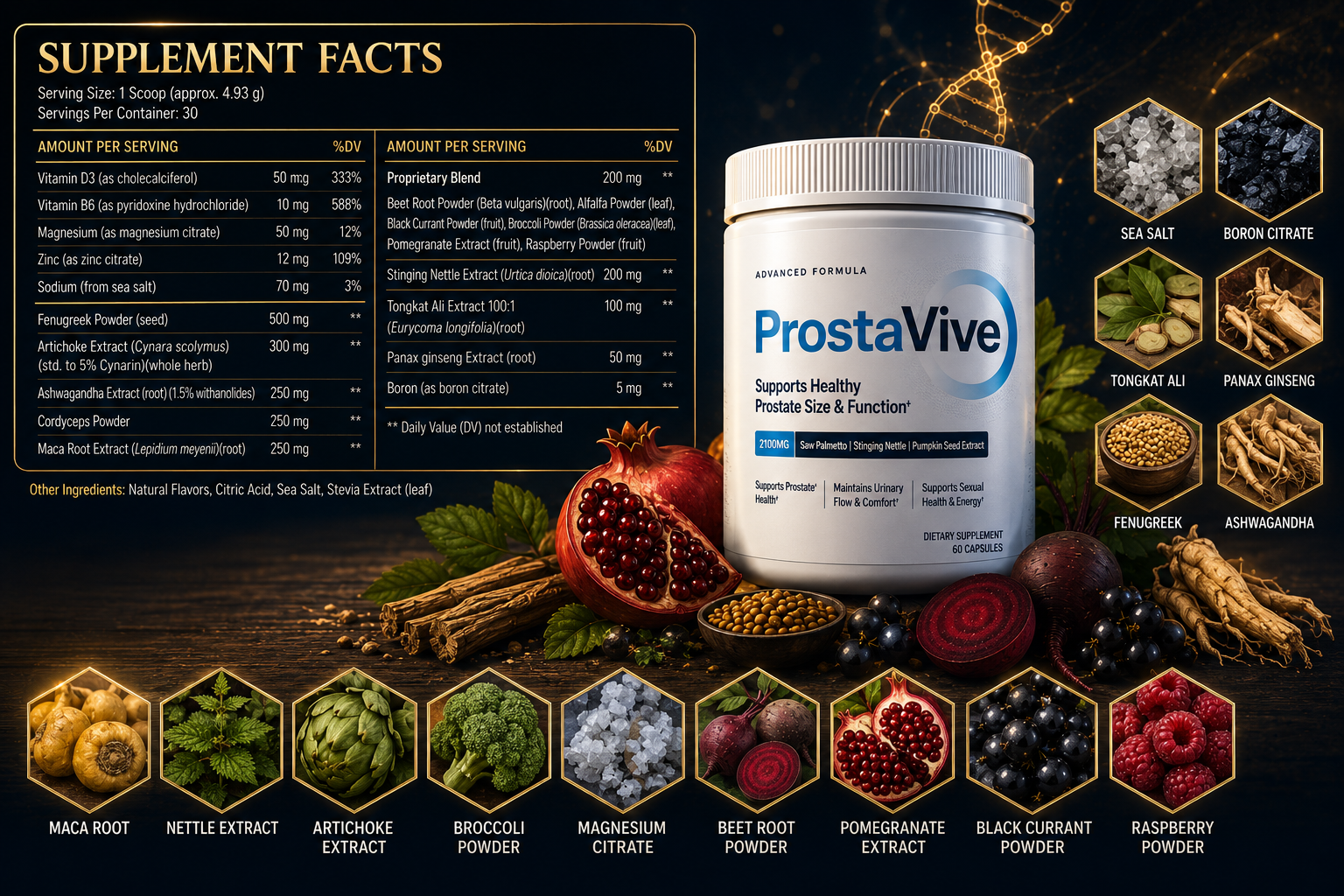
The formula below comes from the seller-hosted Supplement Facts image checked on . It replaces older capsule descriptions and incomplete ingredient tables.
| Ingredient | Listed amount per scoop | Evidence relevance |
|---|---|---|
| Vitamin D3 | 50 mcg (2,000 IU) | Essential nutrient; not established as a treatment for urinary symptoms |
| Vitamin B6 | 10 mg | Essential nutrient; no established role in treating BPH |
| Magnesium | 50 mg | Essential mineral; not prostate-specific |
| Zinc | 12 mg | Essential mineral; adequate intake matters, but supplementation is not an established BPH therapy |
| Sodium | 70 mg | Labelled mineral amount; not a prostate-active ingredient |
| Fenugreek powder | 500 mg | Promoted for metabolic or male-health outcomes; not an established BPH treatment |
| Artichoke extract | 300 mg | Studied mainly in digestive or cardiometabolic contexts; not prostate-specific |
| Ashwagandha extract | 250 mg | Some research on stress and sleep with specific preparations; not prostate-specific |
| Cordyceps powder | 250 mg | Preparation-dependent research; no established role in treating BPH |
| Maca root extract | 250 mg | Limited research on sexual function; not prostate-specific |
| Proprietary fruit-and-vegetable blend | 200 mg total | Individual component amounts are not disclosed |
| Stinging nettle extract | 200 mg | Some ingredient-specific research on lower urinary tract symptoms; finished-product benefit remains unproven |
| Tongkat ali extract 100:1 | 100 mg | Limited male-health research; not a validated BPH treatment |
| Panax ginseng extract | 50 mg | Some research on fatigue or sexual function; not evidence for ProstaVive or BPH |
| Boron | 5 mg | No established role in treating prostate symptoms |
The proprietary blend contains beet root, alfalfa, black currant, broccoli, pomegranate and raspberry. The label lists the blend’s combined weight but not the amount of each component. Other ingredients shown include natural flavors, citric acid, sea salt and stevia extract.
Label-verification limit: We transcribed the seller-hosted image but have not authenticated a physical container or laboratory tested the powder. Formulas can change. Compare this table with the Supplement Facts and “other ingredients” panels on the product you receive.
Read the Full ProstaVive Review →
How we evaluated the ProstaVive ingredient list
We separated three questions that product marketing often blends together:
- What does the seller-hosted label list? This establishes the marketed formula and amounts at the time checked.
- What has been studied independently? Ingredient research may show biological plausibility or safety questions.
- Has the exact finished product been tested? This is necessary before calling the complete formula clinically proven.
We did not identify a published randomized clinical trial of the exact current ProstaVive formula. Ingredient studies therefore cannot establish the product’s effectiveness, incidence of side effects or expected timeline.
What does the evidence say about ProstaVive ingredients?
Stinging nettle extract — 200 mg
A randomized trial of a particular stinging nettle preparation reported improvements in men with symptomatic BPH. That study did not test ProstaVive, and extract details, dose and combination differ. It supports interest in nettle—not a claim that this product treats urinary symptoms.
Zinc — 12 mg
Zinc is essential. The listed 12 mg is slightly above the adult male RDA of 11 mg and below the adult upper limit of 40 mg from all sources. Nutritional adequacy is different from evidence that extra zinc treats BPH. See the NIH zinc fact sheet.
Ashwagandha extract — 250 mg
NCCIH reports that some preparations may help with stress or insomnia, but trials use different extracts and many are small. This is not evidence of prostate benefit. Safety issues include drowsiness, digestive effects, rare liver injury and potential medication interactions.
Tongkat ali extract — 100 mg
Human research has examined stress, sexual function and hormone-related outcomes, but preparations are not interchangeable. A “100:1” extraction ratio does not by itself establish active-compound content, purity, clinical equivalence or superior potency. See the systematic review of tongkat ali.
Fenugreek powder — 500 mg
NCCIH finds limited evidence for most promoted uses. Studies of standardized proprietary extracts cannot automatically be transferred to an unspecified powder. Fenugreek is not an established treatment for prostate enlargement.
Panax ginseng extract — 50 mg
NCCIH describes limited or conflicting evidence across many promoted uses. Research on fatigue or erectile function does not establish that Panax ginseng improves BPH or that the ProstaVive amount matches a studied preparation.
Vitamin D3 — 50 mcg
Vitamin D supports calcium and bone metabolism. The listed 2,000 IU is below the adult upper limit of 4,000 IU, but total intake from every supplement matters. Correcting deficiency is not evidence that ProstaVive treats prostate symptoms. See the NIH vitamin D fact sheet.
Vitamin B6 — 10 mg
Vitamin B6 is an essential nutrient involved in many enzyme reactions. Its nutritional role does not establish prostate benefit. Very high or prolonged supplemental intake can cause sensory neuropathy, so people using several B-complex products should count their total. See the NIH vitamin B6 fact sheet.
Magnesium — 50 mg
Magnesium is essential for muscle, nerve and metabolic functions. The listed 50 mg is a modest supplemental amount, but it is not prostate-specific evidence. Magnesium can cause digestive effects and interact with certain antibiotics and bisphosphonates. See the NIH magnesium fact sheet.
Boron — 5 mg
NIH describes boron as a trace element but has not established an RDA or Adequate Intake. Small studies have explored biological or hormone-related effects, but 5 mg should not be presented as a clinically proven prostate or testosterone dose. See the NIH boron fact sheet.
Artichoke, maca and cordyceps
These ingredients fit broader digestive, sexual-function or vitality marketing more than a focused prostate formula. Their listed amounts are 300 mg, 250 mg and 250 mg respectively, but species, preparation and standardization details determine whether research is comparable. None is an established BPH treatment.
Proprietary blend — 200 mg
The label names six fruit-and-vegetable components but does not disclose each amount. That prevents ingredient-specific dose comparisons and makes the blend the formula’s clearest transparency limitation. A long ingredient list is not the same as a clinically meaningful dose.
Does the complete formula have strong prostate evidence?
No product-specific clinical proof was identified. Stinging nettle has relevant ingredient-level research, while many other ingredients relate more to nutrition, stress, energy or sexual-function marketing. A broad men’s-health concept may be commercially appealing, but it is not the same as evidence that the finished powder improves urinary flow, nighttime urination, prostate size or another clinical outcome.
Evidence hierarchy: A seller label can establish what is marketed. Ingredient studies can suggest plausibility or safety concerns. Only a well-designed trial of the exact finished formula can establish product-specific effectiveness—and none was identified for the current ProstaVive powder.
Persistent urinary symptoms need medical assessment because benign prostatic hyperplasia is only one possible cause. Infection, bladder disorders, medication effects, diabetes, neurological disease and prostate cancer can also produce urinary changes.
How transparent is the ProstaVive formula?
The seller-hosted Supplement Facts image is more useful than a marketing page that lists names without amounts. It provides amounts for vitamins, minerals and most botanicals. However, transparency remains incomplete because:
- The proprietary blend does not disclose each component amount
- Several botanicals lack clear marker-compound standardization
- An extraction ratio does not establish active-compound content
- The online image has not been authenticated against a physical container by our team
- No independent certificate of analysis or finished-product laboratory report was reviewed
- No randomized trial of the exact complete formula was identified
These limitations do not prove the product is ineffective or unsafe. They define what can and cannot be responsibly concluded from the available information.
What safety questions do the ingredients raise?
A multi-ingredient supplement creates more interaction questions than a single nutrient. Ask a clinician or pharmacist to review the complete current label if you take medication, use several supplements, are preparing for surgery or manage a medical condition.
- Ashwagandha: potential drowsiness, digestive effects, rare liver injury and interactions involving thyroid medicine, sedatives, diabetes treatment, blood-pressure medicines and immunosuppressants
- Fenugreek and Panax ginseng: potential blood-sugar effects and interaction concerns
- Magnesium and zinc: can interfere with absorption of certain antibiotics; magnesium can also interact with oral bisphosphonates
- Vitamin D, vitamin B6 and zinc: total intake from all supplements matters
- Hormone-sensitive prostate cancer: NCCIH says people with this condition should avoid ashwagandha because it may increase testosterone
Important: Do not stop finasteride, dutasteride, tamsulosin or another prescribed medicine in order to try a supplement unless the prescribing clinician directs you to do so.
Read the dedicated ProstaVive side effects and interactions guide for a more complete safety analysis.
Our ProstaVive ingredient verdict
ProstaVive combines one clearly prostate-relevant botanical—stinging nettle—with nutrients and a wider group of botanicals associated with stress, energy, sexual function or general male-health marketing.
The current label is more transparent than the earlier incomplete description because it lists magnesium, maca and cordyceps amounts. The principal remaining transparency weakness is the 200 mg proprietary blend and the limited standardization detail for several extracts.
Our conclusion is cautious: the ingredient concept is broad and biologically plausible in places, but available research does not establish that the complete ProstaVive powder treats BPH or produces the same results as separately studied preparations.
Read the complete ProstaVive review
Frequently asked questions
What are the main ProstaVive ingredients?
The current powder label lists vitamin D3, vitamin B6, magnesium, zinc, sodium, fenugreek, artichoke, ashwagandha, cordyceps, maca, a proprietary fruit-and-vegetable blend, stinging nettle, tongkat ali, Panax ginseng and boron.
Is ProstaVive a powder or capsule?
The current seller-hosted label describes ProstaVive as a powder. It lists one scoop (approximately 4.93 g) per serving and 30 servings per container.
Does ProstaVive contain saw palmetto?
Saw palmetto does not appear on the current seller-hosted ingredient label reviewed for this article. Formulas can change, so the delivered container should control.
Is 12 mg of zinc a high dose?
It is slightly above the adult male RDA of 11 mg and below the adult upper limit of 40 mg per day from all sources. Count zinc from food, multivitamins and other supplements when evaluating total intake.
Does a 100:1 tongkat ali extract guarantee potency?
No. The ratio describes the relationship between starting plant material and produced extract. It does not by itself prove active-compound content, purity, clinical equivalence or effectiveness.
Are ProstaVive ingredients FDA-approved?
Dietary supplements are not FDA-approved for safety and effectiveness before sale. Manufacturers and distributors are responsible for lawful labeling and product safety, while the FDA can act against adulterated or misbranded supplements.
Is ProstaVive clinically proven?
We did not identify a published randomized clinical trial of the complete current formula. Research involving individual ingredients does not prove that the finished product has the same effects.
Sources and further reading
- ProstaVive seller page and seller-hosted Supplement Facts panel. Accessed July 30, 2026. Commercial source used for product form, listed ingredients, amounts and serving information.
- National Institute of Diabetes and Digestive and Kidney Diseases. Enlarged prostate (benign prostatic hyperplasia).
- Safarinejad MR. Urtica dioica for treatment of benign prostatic hyperplasia: a randomized, double-blind, placebo-controlled crossover study. Journal of Herbal Pharmacotherapy. 2005.
- NIH Office of Dietary Supplements. Zinc: Fact Sheet for Health Professionals.
- National Center for Complementary and Integrative Health. Ashwagandha: usefulness and safety.
- Ulbricht C, et al. An evidence-based systematic review of tongkat ali (Eurycoma longifolia). Journal of Dietary Supplements. 2013.
- National Center for Complementary and Integrative Health. Fenugreek: usefulness and safety.
- National Center for Complementary and Integrative Health. Asian ginseng: usefulness and safety.
- NIH Office of Dietary Supplements. Vitamin D: Fact Sheet for Health Professionals.
- NIH Office of Dietary Supplements. Vitamin B6: Fact Sheet for Health Professionals.
- NIH Office of Dietary Supplements. Magnesium: Fact Sheet for Health Professionals.
- NIH Office of Dietary Supplements. Boron: Fact Sheet for Health Professionals.
- Shin BC, et al. Maca for improving sexual function: a systematic review. BMC Complementary and Alternative Medicine. 2010.
- U.S. Food and Drug Administration. FDA 101: Dietary supplements.
Medical disclaimer: This article provides general educational information and is not medical advice. It does not diagnose, treat or prevent any condition. Consult a qualified healthcare professional about urinary symptoms and before using a supplement, especially if you take medication or have a medical condition.