
ProstaVive is a once-daily powder marketed for prostate and urinary support in older men. The honest catch: its formula is mostly a male-vitality blend (Tongkat Ali, Ashwagandha, Maca, Fenugreek, Boron, Zinc) — it contains no saw palmetto, beta-sitosterol, or pygeum, the ingredients with the most actual prostate/urinary-flow evidence. Only nettle root has real prostate relevance. So it may support energy and general male vitality, but the match between the formula and its headline “urinary flow” claim is weak, and part of the blend is a proprietary mix with undisclosed doses. Its genuinely strong point is a 180-day money-back guarantee. Before buying, confirm the current Supplement Facts panel and price on the official site, and discuss urinary symptoms with a doctor first — they can signal conditions a supplement won’t fix.
IN THIS REVIEW
What Is ProstaVive?
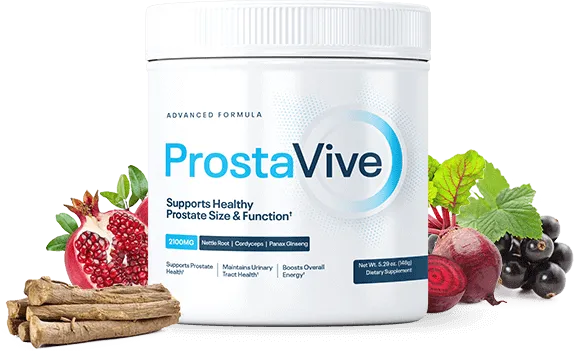
ProstaVive is sold as a once-daily powder for prostate support and male vitality.
ProstaVive is a direct-to-consumer supplement sold as a flavoured powder — one scoop (about 4.9 g) mixed into water once a day, 30 servings per container. It is marketed to men dealing with the classic ageing-prostate complaints: frequent nighttime bathroom trips, weak or hesitant urinary flow, and bladder discomfort, with secondary promises around energy, hormones and sexual vitality.
It is sold only through its official website, which is standard for this category. The important thing to understand up front is the difference between what it is marketed as and what the formula actually contains — which is where most of the value of this review sits (see the evidence audit below).
Key Facts
| Category | Prostate and male-vitality support supplement |
| Format | Powder — one scoop (4.93 g) daily, 30 servings per container |
| Headline claim | Urinary flow, bladder comfort, prostate wellness, daily vitality |
| Per-ingredient doses | Published on the label panel — full table below. Not published by the seller on its sales page. |
| Key gap | No saw palmetto, beta-sitosterol or pygeum — the three best-evidenced BPH botanicals |
| Guarantee | 180-day money-back guarantee — all three sources agree |
| Price | $79 single · $177 (three) · $234 (six), per the verified seller page |
| Manufacturer | Not named on any page we checked |
| Our take | Mixed — a qualitative editorial opinion, not a lab test and not a numeric score |
Where to Buy the Original ProstaVive
Buy it from the seller’s own page. On 6 September 2026 we followed the order buttons on the page our link points to and confirmed they resolve to a ClickBank checkout — ClickBank is the authorised retailer, and it is ClickBank that processes the refund if you want one. That is the version of this product we can stand behind pointing you at.
| Format | Powder — one scoop (4.93 g) daily, 30 servings per container |
| Price | $79 one · $177 three ($59 each) · $234 six ($39 each) |
| Free bonuses | Two digital guides, included with the three- and six-bottle packs only |
| Guarantee | 180-day money-back guarantee, handled through ClickBank |
| Checkout | Verified 6 Sep 2026 as resolving to a ClickBank order form |
One practical warning. Searching for the ProstaVive official website returns a number of near-identical domains, most of them misspellings of one another, all describing themselves as official. Some of them list a different formula from the one the real seller sells — saw palmetto and pygeum, for instance, are advertised on at least one of those pages and are not in this product. Use the link on this page, or check that the checkout you reach is a ClickBank order form before you enter card details.
ProstaVive Ingredients and Doses: The Full Supplement Facts
One scoop is 4.93 g and there are 30 servings per container. The amounts below come from a Supplement Facts label image published by a third-party review site, checked 6 September 2026. The seller does not publish the panel on its own sales page, so we could not confirm these figures against the manufacturer — but they are internally consistent with the scoop weight, and every vitamin and mineral in them matches the seller’s own published ingredient list.
| Ingredient | Per scoop | What it is there for |
|---|---|---|
| Fenugreek powder (seed) | 500 mg | Libido and hormone-support herb |
| Artichoke extract | 300 mg | Liver and antioxidant support |
| Ashwagandha extract | 250 mg | Adaptogen — stress and cortisol |
| Cordyceps powder | 250 mg | Traditional stamina mushroom |
| Maca root extract | 250 mg | Libido and energy |
| Stinging nettle extract | 200 mg | The one directly prostate-relevant ingredient |
| Proprietary blend | 200 mg | Beet root, alfalfa, black currant, broccoli, pomegranate, raspberry — not itemised individually |
| Tongkat ali extract 100:1 | 100 mg | Testosterone and vitality herb |
| Sodium | 70 mg | From the formulation base |
| Panax ginseng extract | 50 mg | Energy and circulation |
| Magnesium | 50 mg | Muscle and nerve function |
| Zinc | 12 mg | Prostate tissue holds high zinc concentrations |
| Vitamin B6 | 10 mg | Hormone metabolism cofactor |
| Boron | 5 mg | Free-testosterone support |
| Vitamin D3 | 50 mcg (2000 IU) | Hormone and immune support |
How these doses compare to the research
This is the part a dose table on its own does not tell you. Comparing each amount against the doses used in published studies of that ingredient:
| Ingredient | Here | Typical study dose | Verdict |
|---|---|---|---|
| Nettle root | 200 mg | 300–600 mg daily in BPH trials | Below the researched range |
| Ashwagandha | 250 mg | 250–600 mg daily | At the bottom of the range, but within it |
| Fenugreek | 500 mg | 500–600 mg daily | In range — the best-dosed item here |
| Tongkat ali | 100 mg | 200–400 mg daily | Below the researched range |
| Panax ginseng | 50 mg | 200–400 mg daily | Well below — token amount |
| Zinc | 12 mg | 11 mg is the adult male RDA | Sensible everyday amount |
| Boron | 5 mg | 3–10 mg in testosterone studies | In range |
| Vitamin D3 | 2000 IU | 1000–4000 IU maintenance | In range |
What the numbers actually say
The vitamins and minerals are sensibly dosed. The botanicals are the problem. Nettle root — the only ingredient here with direct prostate evidence — comes in below the range used in BPH trials. Tongkat ali is at half the studied dose and panax ginseng at roughly a quarter. Fenugreek, boron and vitamin D3 are the three genuinely well-dosed items, and fenugreek is a libido herb rather than a prostate one.
Read the panel and you can see what this formula is built for: it is weighted toward energy, libido and stress, with a modest amount of the one prostate ingredient. If urinary symptoms are your reason for buying, that ordering matters.
Note also that saw palmetto, beta-sitosterol and pygeum — the three best-evidenced botanicals for BPH — are not in this product at all. That is the single biggest gap in the formula, and it is why we point readers who want those to a standalone saw palmetto or beta-sitosterol supplement, which costs a fraction of this.
One honest limitation: these amounts come from a published label image rather than from the seller, and we did not identify a published clinical trial of the finished ProstaVive formula. Everything above is ingredient-level reasoning — it tells you whether each component reaches a researched dose, not that the finished product produces a result. Formula, price and terms may change; read the panel on the jar that arrives.
How ProstaVive Is Supposed to Work — and What the Evidence Shows
The seller’s stated mechanism is blood flow. The sales page argues that nitric oxide drives nutrient-rich blood to the prostate, that this supports cellular activity there, and that urinary comfort follows. One scoop a day, mixed into a drink.
That is a clean story. Here is the problem with it as a reason to buy.
Blood flow is not the established driver of urinary symptoms
Benign prostatic hyperplasia — the usual cause of urinary symptoms in men over 50 — is primarily a matter of prostate tissue enlargement and smooth-muscle tone in the prostate and bladder neck. That is why the two drug classes with the strongest evidence work the way they do: alpha-blockers relax that smooth muscle, and 5-alpha reductase inhibitors reduce the hormonal signal driving tissue growth. Neither works by increasing blood flow.
There is genuine research interest in pelvic blood supply and lower urinary tract symptoms, so the idea is not invented from nothing. But it is a hypothesis under investigation, not the accepted mechanism, and treating it as settled is a marketing choice rather than a scientific one.
And the mechanism has not been tested on this product
Even taking the blood-flow theory at its best, the chain has three links: the ingredients raise nitric oxide, the raised nitric oxide changes prostate blood flow, and that change improves symptoms. We did not identify a published clinical trial of the finished ProstaVive formula testing any link in that chain. No measurement of nitric oxide, no measurement of prostate perfusion, no symptom score.
What that leaves is a plausible-sounding story attached to a formula whose per-ingredient amounts are not published. This is ingredient-level reasoning, not evidence that the complete product works. Read the section below for what each ingredient does and does not have behind it.
What Are the Benefits of ProstaVive?
The seller advertises five: prostate and urinary support, healthy blood flow, better sleep, more daily energy, and an improved sex drive. Now that you have seen the actual per-scoop amounts, each of those claims can be checked against the dose that ingredient is researched at. That is what the table below does.
| Claimed benefit | What in the formula is meant to deliver it | Honest read |
|---|---|---|
| Prostate and urinary support | Nettle root, 200 mg | Weak. The only directly prostate-relevant ingredient, and it comes in below the 300–600 mg used in BPH trials. No saw palmetto, beta-sitosterol or pygeum at all. |
| Healthy blood flow | Beet root — inside a 200 mg proprietary blend shared with five other ingredients | Very weak. See below. This is the biggest problem in the formula. |
| Sex drive | Fenugreek 500 mg, tongkat ali 100 mg, maca 250 mg | The strongest part. Fenugreek is at a researched dose and has the best libido evidence here. Tongkat ali is at half its studied dose; maca is far below the 1500–3000 mg used in studies. |
| Energy | Cordyceps 250 mg, panax ginseng 50 mg, B6 10 mg | Weak. Cordyceps studies typically use 1000–3000 mg; ginseng 200–400 mg. Both are at token amounts here. |
| Sleep | Ashwagandha 250 mg | Plausible. At the bottom of the 250–600 mg range, but within it, and ashwagandha has reasonable sleep and stress data. |
The blood-flow claim does not survive the label
This is the finding that matters most on this page, and you can verify it yourself from the panel above.
The seller’s entire explanation of how the product works is nitric oxide driving blood flow to the prostate. But the formula contains no meaningful nitric-oxide ingredient. There is no L-citrulline, no L-arginine, and no standalone beet root. The only nitric-oxide-relevant item is beet root buried inside a 200 mg proprietary blend that it shares with alfalfa, black currant, broccoli, pomegranate and raspberry — so at an even split it would be somewhere near 33 mg.
For comparison, beetroot studies that actually move nitric oxide use several hundred milligrams of a nitrate-rich extract, or roughly 70–140 ml of juice. The mechanism the product is sold on is the one the formula is least equipped to deliver.
What the formula is actually built for
Read the amounts in order and the picture is clear. The best-dosed items are fenugreek, boron and vitamin D3 — a libido herb and two hormone-support nutrients. The prostate ingredient is under-dosed and the blood-flow ingredient is barely present.
This is a male-vitality formula with a modest amount of prostate support attached, marketed as a prostate product. If your reason for buying is energy, libido and general vitality, it is a defensible if expensive choice. If your reason is urinary symptoms, the formula is not built around that, and a standalone saw palmetto or beta-sitosterol supplement gives you the better-evidenced ingredients for a fraction of the price.
All of the above is ingredient-level reasoning against published study doses. We did not identify a published clinical trial of the finished ProstaVive formula, so none of it is evidence about what the complete product does — only about whether each component reaches an amount research has tested.
Ingredient Evidence Audit
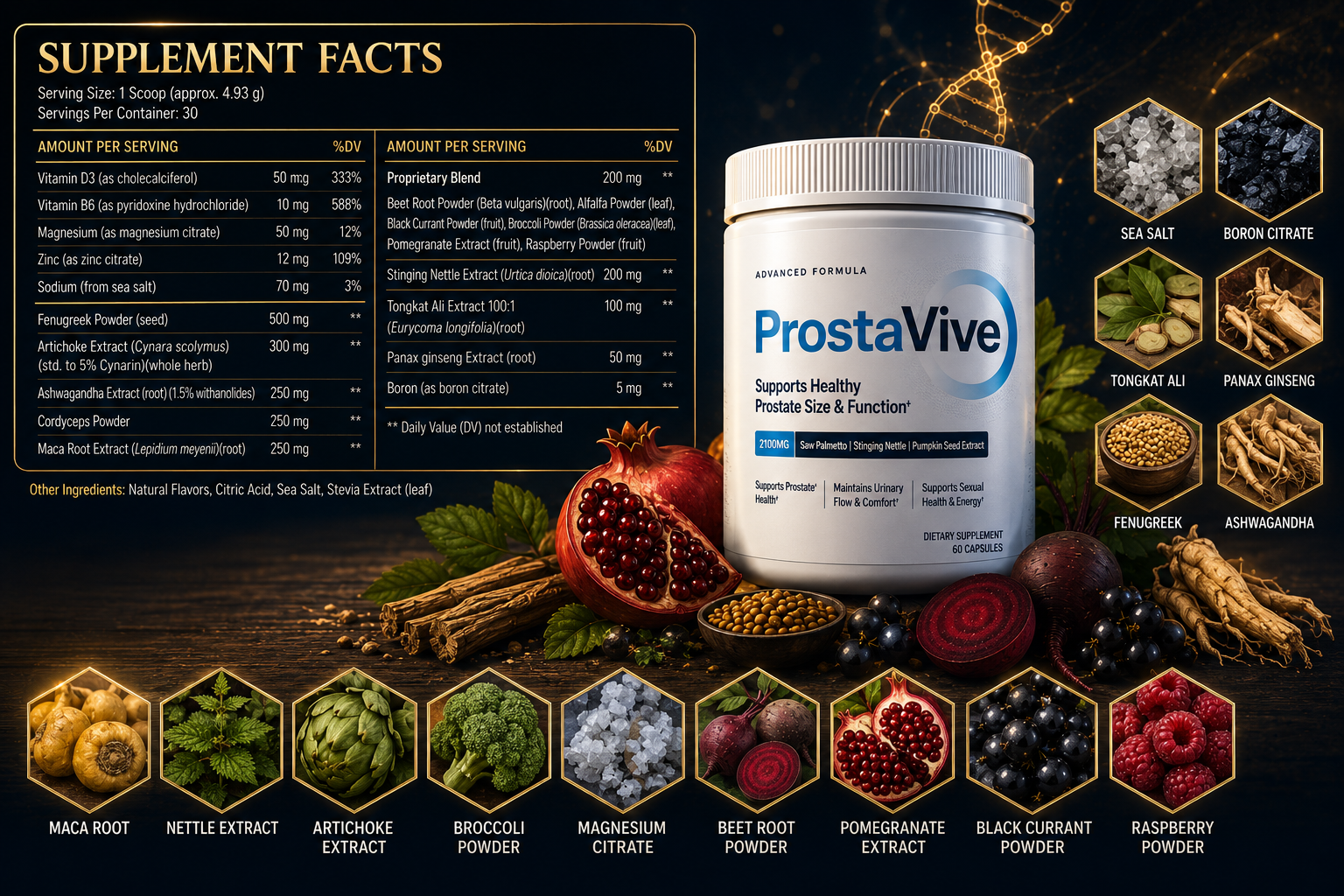
ProstaVive’s disclosed botanicals and minerals — only nettle root is directly prostate-relevant.
How each main ingredient actually stacks up — graded on the research for the ingredient, with the honest caveat that a study on an isolated ingredient is not proof the finished product works.
| Ingredient | Evidence for the prostate/urinary claim | Verdict |
|---|---|---|
| Nettle root | The one with real relevance — some human trials suggest modest help with lower-urinary-tract symptoms of BPH, often studied alongside saw palmetto (which isn’t here). | Relevant |
| Tongkat Ali / Ashwagandha / Maca / Fenugreek | Studied mainly for libido, stress and male vitality — not for urinary flow or prostate size. May support energy/drive, which is a secondary claim. | Vitality, not prostate |
| Zinc / Boron / Magnesium / Vitamin D | Involved in normal testosterone metabolism; helpful mainly if you’re deficient. No direct urinary-flow benefit. | Cofactors |
| Panax ginseng / Cordyceps / Artichoke | Adaptogen / antioxidant / liver-support roles. Reasonable inclusions for general wellness; no prostate-specific evidence. | Supporting |
| Proprietary botanical blend | Antioxidant fruits/vegetables at an undisclosed split of ~200 mg — too little, too vague to judge. | Unverifiable |
⚠ What is NOT known (read before buying)
• No trial on the finished product. There is no published clinical study of ProstaVive itself — only research on some of its individual ingredients.
• Hidden doses. The ~200 mg botanical blend isn’t itemised, and exact amounts differ between label sources, so you can’t fully verify what you’re getting.
• Formula-vs-claim gap. It’s sold for urinary flow but lacks the ingredients with the most urinary-flow evidence.
• Symptoms need a diagnosis. Nighttime urination and weak flow can signal BPH, infection, or (rarely) prostate cancer — a supplement can’t rule those out.
ProstaVive User Reviews: What Buyers Actually Report
We do not publish customer testimonials we cannot trace to a checkable source, and we do not reproduce the quotes on the seller’s sales page — those carry no order records, no dates, and no way to confirm the people exist. What we can do is point you at review data you can audit yourself, and tell you what is in it.
The one verifiable source we found
The verified seller domain has a Trustpilot profile, claimed by the company in March 2026. Checked 6 September 2026:
| TrustScore | 3.5 out of 5 |
| Total reviews | 12 |
| Five star | 67% |
| Three star | 8% |
| One star | 25% |
| Date range | September 2025 – August 2026 |
| Seller replies to negative reviews | Roughly two-thirds of them |
Read that sample size before you read the score
Twelve reviews is not enough to conclude anything. A product with genuine broad satisfaction usually accumulates hundreds; a genuine disaster usually accumulates hundreds of angry ones. Twelve tells you the product is not widely reviewed, and nothing more. Treat a page that presents dozens of glowing ProstaVive testimonials as having invented most of them — the verifiable public record is twelve entries.
The split is also polarised: two-thirds at the top, a quarter at the bottom, almost nothing in between. That pattern is common where a product works for some people and does nothing for others, and it is also common where a small number of reviews are not organic. We cannot tell which from twelve.
What the positive reviews say
Reviewers who rated it highly describe improvement in urinary symptoms, including one long-term user who reports getting up at most once a night. Several describe using it for a year or more and intending to continue. These are self-reported experiences from a handful of people, not measured outcomes, and no clinical trial of the finished formula exists to test them.
What the negative reviews say
The one-star reviews cluster on three complaints:
- No effect after extended use. More than one reviewer reports six months of consistent daily use with no change, and one calls the product snake oil.
- Container fill. At least one reviewer says the jar arrived with noticeably less powder than the stated weight suggested.
- A PSA increase. One reviewer reports their PSA level rose over six months of use.
On that last point, in fairness to the seller and in the interest of accuracy: a single review is not evidence the product raised anyone’s PSA. PSA rises for many reasons — prostate enlargement progressing on its own, infection, inflammation, recent ejaculation or cycling, and age. But it is a useful reminder that taking a supplement does not substitute for PSA monitoring, and that a product which does nothing can allow a real problem to progress unnoticed. If you are taking anything for urinary symptoms, keep the blood tests going.
The seller replying to roughly two-thirds of its negative reviews is a point in its favour. A merchant that answers complaints publicly and points people to the guarantee is behaving better than one that ignores them.
Where to check for yourself
Search the seller’s domain on Trustpilot and read the twelve entries directly, including the dates and the company’s replies. That takes two minutes and it beats any summary, including ours. If a review page shows you customer quotes but will not tell you where they came from, that is the answer to your question about the review page.
Who Should Avoid It
- Men with new, worsening, or severe urinary symptoms, blood in urine, or pain — see a doctor to rule out infection, BPH progression, or prostate cancer before trying any supplement.
- Men with prostate cancer or an elevated PSA — testosterone-adjacent herbs (tongkat ali, fenugreek) are a poor fit; get medical guidance.
- Anyone on blood-pressure, blood-sugar, blood-thinning, or hormone medication — ginseng, ashwagandha and others can interact; clear it with a pharmacist.
- Men with thyroid or autoimmune conditions — ashwagandha can affect thyroid function.
This is not medical advice. Urinary symptoms in men over 50 deserve a proper check-up. Use any supplement as an optional add-on after that, not instead of it.
Price, Guarantee & Where to Buy
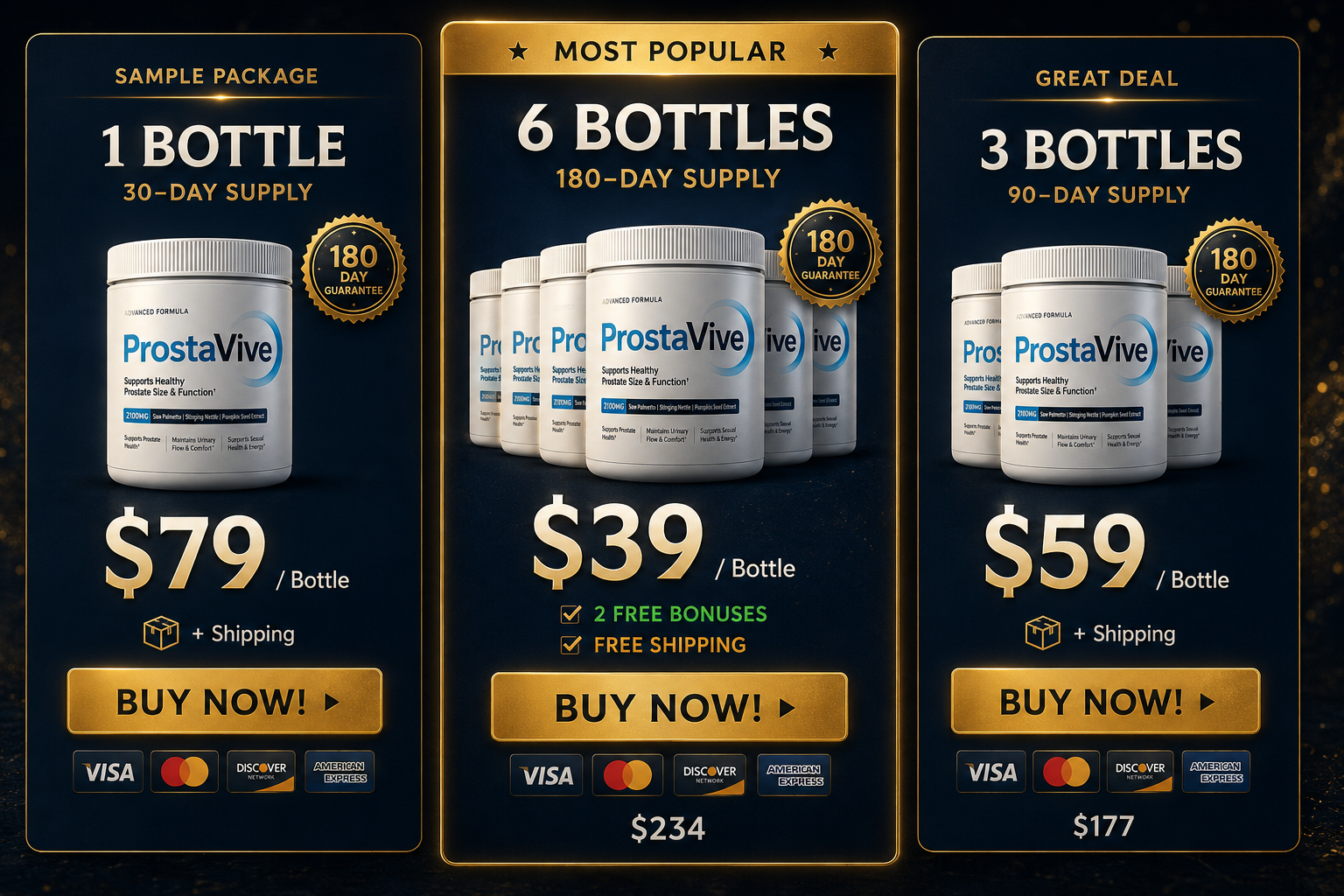
ProstaVive’s pricing tiers and 180-day guarantee — confirm current prices at the seller’s checkout.
The seller’s own website was the only purchasing channel we could verify on 6 Sep 2026; we could not confirm any authorized retail availability. Listed prices also vary between sources, so confirm the current price and terms at the seller’s checkout before ordering (indicative pricing checked 6 Sep 2026 — prices, promotions and terms can change):
Lowest per-bottle6 Bottles (180 days)~$39/btlFree shippingView seller price →
3 Bottles (90 days)~$59/btlFree shippingView seller price →
The guarantee is the strongest part of the offer. ProstaVive states a 180-day money-back guarantee — a longer refund window than many supplement offers, though it is subject to the seller’s current return terms: you contact customer service for a return authorization, ship the bottles back at your own cost, and the refund posts after the return is received. A long window lowers your financial risk if you follow the terms — it does not make the product more likely to work, and it is not a substitute for medical advice on urinary symptoms.
If you have already decided and just want the buying details — every package, the per-day cost, and exactly how the refund window works — we keep those on one page: ProstaVive official website, price and where to buy.
Honest Alternatives
Because ProstaVive is a weak match for its own urinary claim, it’s worth knowing the honest options:
- If your goal is genuinely urinary/prostate (BPH) support: look for a product built on saw palmetto, beta-sitosterol, or pygeum — the ingredients with the most human evidence for flow and nighttime urination. ProstaVive doesn’t contain them.
- If your goal is energy / libido / vitality: ProstaVive’s blend is a reasonable fit — but so are cheaper single-ingredient Tongkat Ali or ashwagandha products with disclosed doses.
- The no-purchase option: for mild symptoms, a doctor may first suggest fluid timing, reducing evening caffeine/alcohol, and simple lifestyle changes — free, and sometimes as effective as a supplement.
Pros, Cons & Verdict
What we liked
- Exceptionally long 180-day money-back guarantee
- Most actives are disclosed (only one small proprietary blend)
- A reasonable male-vitality / energy blend on its own terms
- Powder format some men prefer to capsules
What gives us pause
- Marketed for urinary flow, but missing the ingredients with that evidence
- No saw palmetto, beta-sitosterol or pygeum; only nettle root is prostate-relevant
- No study on the finished product; proprietary-blend doses hidden
- Prices vary by source; single-bottle price is steep
- Testosterone-adjacent herbs are a poor fit for men with prostate/PSA concerns
Editorial verdict — mixed: ProstaVive is an honestly-decent vitality blend wearing a prostate label. If you mainly want general male energy support and value a long refund window, it may be worth a low-commitment trial. But if your real problem is urinary flow or nighttime trips, the formula doesn’t line up with the best evidence, there’s no trial on the finished product, and some doses can’t be verified — so see a doctor first, and consider a saw-palmetto/beta-sitosterol product if targeted urinary support is the goal.
Free — from this review
The 4 prostate ingredients with real trial evidence — and the 9 that don’t
A one-page reference you can take to the pharmacy or your doctor: which ingredients improved urinary symptoms in randomised trials, the dose each one needed, and the popular ones that failed when they were properly tested. No product pitch — just the doses.
One email. Unsubscribe any time. We never sell your address.
Frequently Asked Questions
Does ProstaVive actually work for prostate/urinary symptoms?
What’s actually in it?
How much does it cost and is there a guarantee?
Is it safe with my medications?
Where should I buy it?
Is ProstaVive safe?
What if ProstaVive doesn’t work for me?
How many bottles should I order?
How quickly will ProstaVive arrive?
What is the best way to take ProstaVive?
What are the free bonuses, and are they worth anything?
What are the benefits of ProstaVive?
Is ProstaVive right for me?
Is ProstaVive made with natural ingredients?
Is there a ProstaVive discount or coupon code?
Are the ProstaVive reviews on the seller’s website real?
Does ProstaVive have any side effects?
Nettle root / BPH symptoms — systematic reviews of Urtica dioica for lower-urinary-tract symptoms. PubMed: 17509841
Saw palmetto & beta-sitosterol for BPH (the class ProstaVive omits). Cochrane / PubMed: 12137626
Tongkat Ali & male vitality/stress. J Int Soc Sports Nutr. PubMed: 23724150
Ashwagandha, stress & male vitality. Am J Mens Health. PubMed: 30854916
NIH Office of Dietary Supplements — zinc, magnesium, vitamin D fact sheets. ods.od.nih.gov
Seller pages compared 6 September 2026 — the ProstaVive seller page whose order buttons resolve to a ClickBank checkout, plus two look-alike pages also presenting themselves as official. Ingredient lists, format, pricing and guarantee terms were read directly from each on that date. Look-alike domains are deliberately not named, to avoid sending readers to unverified checkouts.
Trustpilot profile for the verified seller domain, checked 6 September 2026 — TrustScore 3.5 out of 5 from 12 reviews dated September 2025 to August 2026; profile claimed by the company March 2026.
Clinical trial search — we did not identify a published clinical trial of the finished ProstaVive formula. Evidence cited on this page is for individual ingredients at doses used in their own studies, not for this product.
6 Sep 2026 — Removed an estimated per-ingredient milligram table that could not be traced to any current seller panel. Identified the seller page whose checkout resolves to ClickBank, corrected the ingredient list and format to match it, and added a reader-usable test for spotting look-alike pages without naming their domains. Added “What we could not verify”. Confirmed no published clinical trial of the finished formula. Re-verified the 180-day guarantee and the three-and six-bottle pricing against all three sources on this date.
>
4 thoughts on “ProstaVive Review: Ingredients, Evidence, Price & Safety (2026)”
Comments are closed.