
Prices and bundle options change often, and the seller’s own page is the only place we can confirm what is actually on offer today.
Check the current ProtoFlow price →
Official site · affiliate link — we may earn a commission at no extra cost to you. It does not change our verdict.
ProtoFlow is a twice-daily capsule from PhytoThrive Labs sold for prostate health and urinary flow. Its full panel is disclosed, which is a genuine point in its favour — and reading that panel is what settles the review. Saw palmetto, the ingredient the marketing leans on, is present at 84.5 mg per serving: about a quarter of the 320 mg used in the trials, and even at 320 mg the two largest, best-designed trials found saw palmetto no better than placebo for urinary symptoms. Everything above it in the list — hawthorn 250 mg, epimedium 250 mg, damiana 200 mg, muira puama 200 mg, ginkgo 120 mg, tribulus 120 mg, catuaba 84.5 mg — is a libido-and-circulation formula, not a prostate one. There is no beta-sitosterol, no pygeum, no nettle root: the three ingredients with the best urinary-flow evidence are all absent. Add 75 mg of niacin (enough to cause flushing), bleeding-risk interactions from ginkgo and hawthorn, and the fact that different ProtoFlow ingredient lists appear on different “official” sites, and the picture is clear. The 60-day guarantee accepts empty bottles.
IN THIS REVIEW
What ProtoFlow Is (and What It Claims)
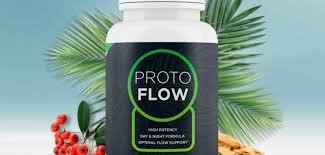
ProtoFlow is sold as a twice-daily capsule for prostate health and urinary comfort.
ProtoFlow is a direct-to-consumer supplement from PhytoThrive Labs, with a returns address in Aurora, Colorado. It comes as capsules taken twice a day, 60 to a bottle, and is marketed to men over 40 with the familiar prostate complaints: waking at night to urinate, weak or hesitant flow, and the feeling of not emptying the bladder. The sales pages describe it as “day and night prostate support.”
It is sold only through the seller’s own funnels, with checkout processed by ClickBank.
The useful thing about ProtoFlow — and the reason this review can be more definite than most — is that a full Supplement Facts panel with fourteen itemised doses and no proprietary blend is published for it. Most products in this category hide behind a blend. ProtoFlow does not, and the numbers tell a clear story: the marketing says prostate; the label says libido.
Key Facts
| Category | Marketed as prostate/urinary support; formulated as male vitality & circulation |
| Format | 2 capsules daily, 60 per bottle (30-day supply) |
| Headline claim | Day-and-night prostate support, better urinary flow, fewer night-time trips |
| Saw palmetto dose | 84.5 mg per serving — the studied dose is 320 mg |
| Notable omissions | No beta-sitosterol, no pygeum, no nettle root (the best-evidenced urinary ingredients) |
| Dose transparency | Good on the PhytoThrive panel — all 14 amounts itemised, no blend |
| Formula conflict | At least three different ingredient lists circulate under this name — see the warning below |
| Guarantee | 60 days, no questions asked; empty bottles accepted per the seller |
| Price (confirm at checkout) | $79/bottle (2) · $59/bottle (3, free shipping) · $49/bottle (6, free shipping) — as listed 4 Sep 2026 |
| Our take | Weak — poor match for its own claim — a qualitative editorial opinion (not a lab test, and not a numeric score) |
⚠ Warning: Three Different ProtoFlow Formulas
Check the label before you swallow anything
While verifying this review on 4 Sep 2026 we found three materially different ingredient lists published under the ProtoFlow name:
1. The PhytoThrive Labs formula (the one reviewed here): hawthorn, epimedium, damiana, muira puama, ginkgo, Chinese ginseng, tribulus, catuaba, saw palmetto 84.5 mg, inosine, oat straw, cayenne, niacin, vitamin E. A male-vitality blend.
2. A “mushroom” version listed elsewhere: saw palmetto with reishi, maitake and shiitake, cat’s claw, zinc and selenium.
3. A “classic prostate” version on another site: saw palmetto, pygeum, nettle root, pumpkin seed, lycopene, beta-sitosterol, zinc, vitamin D3.
These are not the same product. Version 3 would be a far better match for urinary symptoms than version 1 — but we could not verify doses for it, and we cannot tell you which bottle any given checkout will ship. Read the Supplement Facts panel on the bottle that arrives, and if it does not match what you were sold, use the refund window immediately.
What the Label Says

A ProtoFlow Supplement Facts panel as published. Versions differ — check the panel on your own bottle.
The PhytoThrive Labs panel, per two-capsule serving (checked 4 Sep 2026). Ingredients are listed in descending order of amount — which is the fastest way to see what a formula is really built around.
| Ingredient | Per serving | What it is actually for |
|---|---|---|
| Hawthorn (fruit) | 250 mg | Circulation / heart tonic |
| Epimedium sagittatum (horny goat weed) | 250 mg | Libido herb (icariin) |
| Damiana (leaf) | 200 mg | Traditional libido herb |
| Muira puama (root) | 200 mg | Traditional libido herb |
| Ginkgo biloba (leaf) | 120 mg | Circulation; bleeding-risk herb |
| Chinese ginseng (root) | 120 mg | Adaptogen / energy |
| Tribulus (fruit) | 120 mg | Libido herb; weak testosterone evidence |
| Catuaba (bark) | 84.5 mg | Traditional libido herb |
| Saw palmetto (fruit) | 84.5 mg | The only prostate-relevant ingredient — at ~26% of the studied dose |
| Niacin (B3) | 75 mg | Vasodilator — enough to cause flushing |
| Inosine | 50 mg | Nucleoside marketed for energy |
| Oat straw (stalks) | 32 mg | Traditional tonic |
| Cayenne (fruit) | 20 mg | Circulation / warming herb |
| Vitamin E | 13 mg | Antioxidant |
Read the formula honestly: eight of the top nine ingredients by weight are libido, circulation or energy herbs. Saw palmetto is ninth. If you renamed this product “male vitality complex” and never mentioned the prostate, nothing on the label would look out of place — and the marketing would be more accurate.
Ingredient Evidence Audit
For each meaningful ingredient: what human research shows for prostate or urinary symptoms specifically, the dose that research used, and how ProtoFlow compares.
| Ingredient (dose) | What the human evidence shows for urinary/prostate symptoms | Verdict |
|---|---|---|
| Saw palmetto (84.5 mg) | The classic BPH herb, studied at 320 mg/day of a lipidosterolic extract. Early small trials were positive, but the two largest, best-designed randomized trials (STEP, 2006 and CAMUS, 2011) found no benefit over placebo for urinary symptoms, even at double and triple doses. A Cochrane review reached the same conclusion. At 84.5 mg this is roughly a quarter of a dose that itself failed the best trials. | Far below a dose that already failed |
| Epimedium 250 mg, damiana 200 mg, muira puama 200 mg, catuaba 84.5 mg, tribulus 120 mg | Traditional libido herbs. Epimedium’s icariin inhibits PDE5 in laboratory studies; damiana, muira puama and catuaba have essentially no controlled human trials; tribulus has repeatedly failed to raise testosterone in controlled trials. None has evidence for urinary flow or prostate size. | Not prostate-relevant |
| Hawthorn (250 mg) | Studied for mild heart failure and blood pressure at 300–1,800 mg/day. No urinary or prostate evidence. Can interact with heart and blood-pressure medication. | Not prostate-relevant |
| Ginkgo biloba (120 mg) | 120 mg is a real dose for circulation studies, but ginkgo has no prostate evidence and a well-documented bleeding-risk interaction with anticoagulants and antiplatelet drugs. | Risk without prostate benefit |
| Chinese ginseng (120 mg) | Adaptogen with some erectile-function evidence at higher doses (typically 600–1,000 mg+/day of Korean red ginseng). No prostate evidence; interacts with blood thinners and diabetes medication. | Below dose, wrong target |
| Niacin (75 mg) | At this amount, immediate-release niacin commonly causes flushing — hot, red, itchy skin for 15–30 minutes. Harmless but alarming if unexpected. No urinary benefit. | Side-effect driver |
| Missing: beta-sitosterol, pygeum, nettle root | These are the plant ingredients with the best evidence for lower-urinary-tract symptoms — beta-sitosterol in particular improved flow and symptom scores in randomized trials at 60–130 mg/day. None of them is in this formula. | Absent |
The pattern is unambiguous: this is a libido and circulation formula with a token amount of saw palmetto, sold to men with urinary complaints. No study has tested the finished product. If it does anything noticeable for you, the most likely candidates are the niacin flush and a mild energy or libido effect from the botanicals — not a change in urinary flow.
The Saw Palmetto Question
Saw palmetto deserves its own note, because it is the ingredient nearly every prostate supplement is sold on. The honest position from the research: it was promising in the 1990s and early 2000s, when trials were small and often industry-funded. Then two large, well-conducted, NIH-funded randomized trials tested it properly. The STEP trial (2006) gave 320 mg daily for a year; the CAMUS trial (2011) escalated to 960 mg daily. Neither found any advantage over placebo for urinary symptom scores or flow rate. A Cochrane systematic review concluded the same. Saw palmetto is generally safe and well tolerated — it is simply not an effective treatment for BPH symptoms at any dose tested. So a product containing 84.5 mg is not just under-dosed; it is under-dosing an ingredient that failed at full strength. Any supplement leaning on saw palmetto for its prostate claim — including this one — is standing on a foundation the best evidence has already removed.
⚠ What is NOT known (read before buying)
• Which formula you will receive. Three different ingredient lists circulate under this name. This is the biggest unknown and the main reason for caution.
• Extract strengths. The panel gives raw amounts but not standardization (for example, saw palmetto’s fatty-acid content, or epimedium’s icariin percentage).
• No trial on the finished product, and no certificate of analysis or named third-party tester.
• Niacin form. Whether the 75 mg is flush-free (inositol hexanicotinate) or immediate-release is not stated — it determines whether you will flush.
• Long-term safety of daily muira puama, catuaba and damiana has very little human data at any dose.
Who Should Avoid It
- Any man with new, worsening or severe urinary symptoms, blood in the urine, pain, fever, or inability to pass urine — these need urgent medical assessment, not a supplement. Retention is a medical emergency.
- Anyone on blood thinners or antiplatelet drugs, or with surgery scheduled — ginkgo, ginseng and hawthorn all affect bleeding risk; stop at least two weeks before any operation.
- Anyone on heart or blood-pressure medication — hawthorn interacts with digoxin, beta-blockers and nitrates; niacin and cayenne add vasodilation.
- Anyone on diabetes medication — ginseng can lower blood sugar.
- Men with prostate cancer or a raised PSA — several of these herbs are hormone-adjacent, and no supplement should delay a proper urological work-up.
- Anyone who dislikes flushing — 75 mg of immediate-release niacin will produce it in many people.
- Anyone under 18, and anyone with a known allergy to any listed botanical.
This is not medical advice. Urinary symptoms in men over 50 have specific, treatable causes, and the treatments that work — alpha-blockers such as tamsulosin, 5-alpha-reductase inhibitors, and in some cases surgery — are prescribed after an examination, a PSA test and a flow assessment. A supplement cannot substitute for that, and a “prostate formula” that delays it can do real harm.
Price, Guarantee & Where to Buy
The seller’s own funnels were the only purchasing channel we could verify on 4 Sep 2026; we could not confirm any authorized retail availability, and multiple domains use the ProtoFlow name with different formulas and prices. Prices below are as listed on that date — confirm the current price, shipping, guarantee and the ingredient panel on the checkout page you actually use:
Cost per day: about $2.63 on the 2-pack, $1.97 on the 3-pack and $1.63 on the 6-pack. For comparison, a beta-sitosterol supplement at the studied 60–130 mg/day — the plant ingredient with the best urinary evidence, and one this formula omits — typically costs $0.15–$0.30 a day.
The guarantee, read carefully. The seller advertises a 60-day, no-questions-asked money-back guarantee that covers empty bottles. You contact support for authorization, return the bottles at your own cost, and the refund is issued after receipt. Sixty days is on the short side for this category (several rivals offer 180), and it is worth noting that the panel-versus-marketing mismatch described above is itself a reason to check the bottle on day one, while the window is wide open.
See the seller’s current price & return terms
Confirm the current price, shipping, 60-day guarantee and — most importantly — the ingredient panel directly with the seller before ordering (checked 4 Sep 2026; formulas and terms vary between ProtoFlow sites).
View the seller’s current offer →Honest Alternatives
If your actual goal is urinary comfort, here is what the evidence supports:
- See a doctor first. An examination, a PSA test and a flow assessment separate benign enlargement from infection, bladder problems and prostate cancer. Prescription alpha-blockers work within days for many men — far better than anything in this bottle.
- If you want a supplement with the best plant evidence: beta-sitosterol at 60–130 mg/day improved symptom scores and flow in randomized trials — ProtoFlow contains none. Pygeum and nettle root have modest supporting data.
- Compare within the category: our prostate supplement comparison ranks the formulas by whether their ingredients actually match urinary symptoms, and our ProstaVive review covers another product with the same vitality-blend-sold-as-prostate problem.
- If vitality is what you actually want: be honest with yourself about that and buy accordingly — a libido formula bought as a libido formula at least gets judged on the right terms. See our testosterone-support guide.
- Free measures that help: reducing evening fluids, caffeine and alcohol, double-voiding, and treating constipation all reduce night-time trips, and a doctor will suggest them before anything else.
Pros, Cons & Verdict
What we liked
- Fully itemised panel with 14 disclosed doses and no proprietary blend
- Ingredients are ordinary and low-risk for healthy men
- 60-day guarantee that accepts empty bottles
- Named company with a US returns address
- As a vitality blend, several herbs are at plausible doses
What gives us pause
- Saw palmetto at 84.5 mg — about a quarter of a dose that already failed the best trials
- No beta-sitosterol, pygeum or nettle root: the best urinary ingredients are absent
- Eight of the top nine ingredients are libido/circulation herbs, not prostate ones
- Three conflicting ingredient lists circulate under the ProtoFlow name
- 75 mg niacin can cause flushing; ginkgo, ginseng and hawthorn carry bleeding and cardiac interactions
- 60-day window is short for this category; no trial on the finished product
Editorial verdict — weak, poor match for its own claim: ProtoFlow’s label is more honest than its marketing. Read it and you find a male-vitality and circulation blend with saw palmetto in ninth place at a token dose, sold to men whose complaint is urinary. For general energy and libido it is unremarkable but not unreasonable; for the problem it advertises, the formula does not contain the ingredients that would address it. If you are waking three times a night to urinate, spend the price of one bottle on a doctor’s appointment instead — and if you have already ordered, check the panel on the bottle against the list above and use the 60-day window if it does not match.
Frequently Asked Questions
Saw palmetto for benign prostatic hyperplasia — STEP trial, 320 mg/day for one year (N Engl J Med, 2006). PubMed 16467543
Saw palmetto at escalating doses (up to 960 mg/day) — CAMUS randomized trial (JAMA, 2011). PubMed 21954478
Serenoa repens for lower urinary tract symptoms — Cochrane systematic review. PubMed search: Serenoa repens Cochrane BPH
Beta-sitosterol for benign prostatic hyperplasia — systematic review of randomized trials. PubMed 10510208
Tribulus terrestris and testosterone — controlled trials. PubMed 26727646
Ginkgo biloba bleeding risk and drug interactions — NIH National Center for Complementary and Integrative Health. nccih.nih.gov/health/ginkgo
Hawthorn interactions and cardiovascular use — NIH NCCIH. nccih.nih.gov/health/hawthorn
Niacin flushing — NIH Office of Dietary Supplements niacin fact sheet. ods.od.nih.gov
Seller’s published Supplement Facts panel, pricing and guarantee wording — accessed 4 September 2026.
Prices and bundle options change often, and the seller’s own page is the only place we can confirm what is actually on offer today.
Check the current ProtoFlow price →
Official site · affiliate link — we may earn a commission at no extra cost to you. It does not change our verdict.