
Natural Testosterone Support After 40: The Honest Guide (2026)
Testosterone declines roughly 1% per year from the mid-thirties onward — a slope documented across the clinical literature (NIH/NCBI overview). By the mid-40s many men feel the compound interest: flatter mornings, slower recovery, quieter drive, and workouts that cost more and pay less. The market answer is a wall of “T-boosters” promising 20-something hormones from a capsule. The honest answer is more interesting: four lifestyle levers carry most of the evidence, a small set of botanicals genuinely helps at the margin, and knowing which claims are real protects both your wallet and your health.
The Four Levers That Outperform Every Supplement
Before any capsule, the evidence hierarchy is unambiguous:
- Sleep — the master lever. Testosterone is produced predominantly during sleep; restriction studies show a single week of 5-hour nights cutting daytime testosterone by 10–15%. No supplement stack recovers what a 5.5-hour habit costs.
- Resistance training — compound lifts 2–4× weekly acutely raise testosterone and, more importantly, improve androgen-receptor sensitivity, meaning your existing hormones work harder.
- Body fat — fat tissue converts testosterone to estradiol via aromatase; losing visceral fat is hormonally double-positive.
- Alcohol moderation — heavy evening drinking suppresses both sleep architecture and testicular output.
Any man doing these four properly has already outperformed the average supplement customer; the botanicals below are the margin on top.
Botanicals With Actual Human Data
The defensible short list, honestly graded:
| Ingredient | Evidence | Honest Summary |
|---|---|---|
| Tongkat Ali | Moderate | Human trials show modest total/free testosterone improvements, strongest in stressed and older men; typical studied doses 200–400mg |
| Zinc | Conditional | Clear benefit only when correcting deficiency — which is common in older, sweating, or low-meat men |
| Ashwagandha | Moderate | Cortisol reduction with downstream testosterone improvement in several trials — the stress-axis play |
| Maca | Libido only | Improves drive in trials without moving testosterone itself — useful, mislabeled |
| Tribulus | Weak | Repeated trials show no testosterone effect — legacy inclusion |
What Natural Support Cannot Do
Set the ceiling honestly: botanicals produce single-digit to low-teens percentage improvements in the responsive — meaningful for daily quality of life, invisible next to actual TRT, which replaces rather than nudges. If you have diagnosed hypogonadism (typically total testosterone under ~300 ng/dL with symptoms), that is a medical condition with medical treatments, and no gummy is a substitute. The smart sequence for any man over 40 feeling the slide: get a morning blood test first. It costs little, and it converts this entire topic from vibes to data — including telling you whether natural support is even playing in the right league for your case.
What the Evidence Actually Supports
The honest summary for a man over 40: no over-the-counter botanical reliably moves total testosterone the way clinic treatment does, and any product implying otherwise is overselling. What some of these ingredients do have is narrower, smaller evidence for things that matter alongside testosterone.
Tongkat Ali has the most direct data of the common ingredients — small randomised trials at around 200 mg/day have reported reduced cortisol and improved stress and mood scores, with modest testosterone effects mostly in men who started low or stressed. Zinc matters if you are deficient and does very little if you are not, which is why blanket zinc dosing disappoints. Maca has repeatedly failed to move testosterone in trials while showing some libido effect independent of it — a real finding, just not a hormonal one. Panax ginseng has better evidence for erectile function than for testosterone.
Two structural points are worth more than any of the above. First, sleep is the single largest modifiable lever on testosterone in men over 40, and no capsule compensates for chronically short sleep. Second, the format you will actually take every day beats the theoretically stronger one you abandon in week three — gummy formats cap doses below capsule stacks, which is a genuine trade-off, not a marketing point.
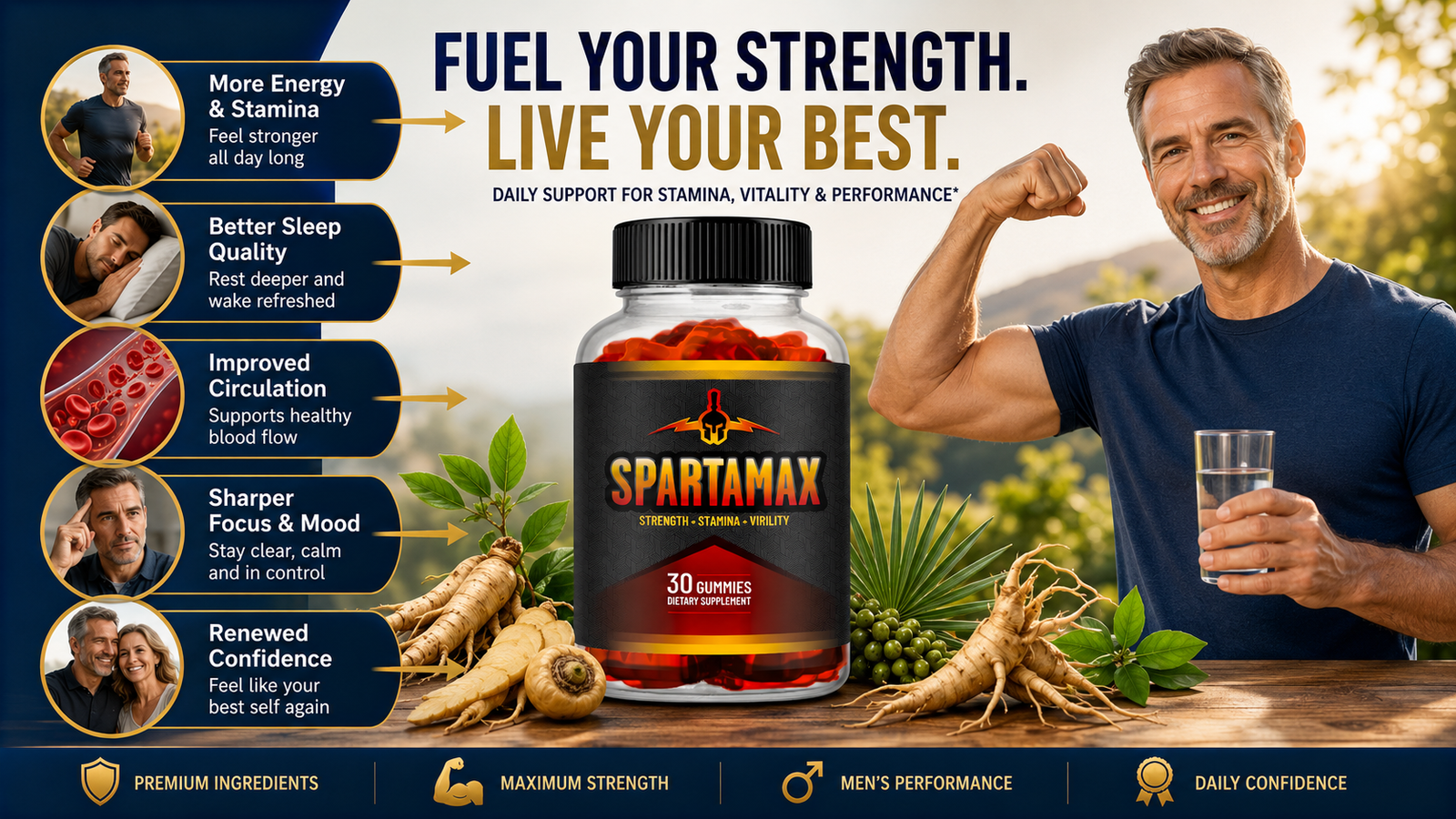
Our Pick for Over 40+: Spartamax
Tongkat Ali, maca, ashwagandha and horny goat weed — the ingredient list the seller published as of 5 September 2026 — in a gummy format built around daily adherence rather than maximum dose. The seller does not disclose per-ingredient amounts.
Building Your Stack, Sensibly
The rational over-40 protocol, in order: fix sleep first (everything else compounds on it), lift 2–4× weekly, get the morning blood test, then add botanical support and evaluate over 12 weeks with a simple weekly energy/drive/sleep log. Combine with the circulation side if that is part of your picture — our Nitric Boost Ultra review covers the complementary vascular approach, and the two approaches are complementary rather than competing. Avoid anything marketed with the words “steroid-like”, proprietary blends hiding doses, and any product promising blood-test changes in a week.
Decoding Your Blood Test: The Numbers That Matter
The morning blood test is the entry ticket, so learn to read it. Total testosterone (the headline number) spans a famously wide reference range — roughly 300–900 ng/dL — but “in range” is not “optimal for you”: a man who slid from 800 to 400 over five years has lost half his hormonal altitude while remaining technically normal. Free testosterone often matters more: SHBG rises with age and binds an increasing share of the total, so a decent total can mask a starved free fraction. Estradiol, LH (which distinguishes testicular from signalling problems) and prolactin complete the picture a good clinician wants.
Testing logistics change results: testosterone peaks in early morning, so 7–10 a.m. draws are the standard; a single bad night before the test can depress readings 10–15%; and one test is a data point, not a diagnosis — confirmation requires a repeat. Bring symptoms to the appointment, not just numbers, because treatment decisions ride on the pairing. And keep your own copy of every result: the five-year trend line you build is diagnostic gold that no single-visit doctor can see without it.
The Cortisol Connection: Why Stress Is a Testosterone Tax
Cortisol and testosterone are manufactured from the same upstream resources and regulated by interlinked axes — and chronic stress rigs the allocation. Sustained cortisol elevation suppresses the hypothalamic signalling that orders testosterone production, degrades the deep sleep where the actual manufacturing happens, and drives the visceral-fat accumulation that further converts testosterone to estradiol. This is why the highest-stress decades of a man’s life — mortgages, careers, teenagers — coincide with the steepest perceived hormonal decline, and why two men with identical lab numbers can feel entirely different depending on their stress physiology.
It is also why adaptogens like ashwagandha keep producing testosterone improvements in trials despite not being “testosterone boosters” at all: they work the cortisol side of the ledger, and freed resources flow downhill. The practical translation is unglamorous — the man grinding 11 p.m. emails while researching supplements has his answer already open in another tab. Boundaries on evening work, actual recovery days, and any regular decompression practice are hormone therapy in the only sense that matters: they change the numbers. Our tested formula’s sleep-first response pattern (sleep scores moved before energy did) is exactly this mechanism showing itself in cohort data.
Training for Testosterone: What the Gym Evidence Actually Says
Exercise raises testosterone — with fine print worth reading. The acute spikes from lifting are transient and mostly irrelevant; the durable win is receptor-level: trained muscle upregulates androgen receptors, letting the same circulating hormone do more work. Programming that maximises this: compound movements (squat, deadlift, press, row) recruiting large muscle mass, progressive overload tracked honestly, 2–4 sessions weekly — and, critically, recovery respected, because the overtraining zone flips the entire equation: chronically exhausted trainees show suppressed testosterone and elevated cortisol, the exact inversion they are chasing. More is better only until it sharply is not.
Cardio’s role is supporting, not starring: moderate aerobic work aids body composition and vascular health (see our circulation coverage), while extreme endurance volume is testosterone-negative in the research — marathon cohorts run lower than lifters. For the over-40 returner, the entry protocol is deliberately boring: two full-body sessions weekly, machines welcome, twelve-week horizon before judging anything. It pairs with the supplement timeline precisely because both are working the same slow biology — and resistance training has far stronger evidence for testosterone in men over 40 than any supplement in this category.
Red Flags and Snake Oil: Navigating the T-Booster Aisle
This category attracts the industry’s worst behaviour, so carry a blacklist. Instant-effect claims: hormonal adaptation is measured in weeks; anything promising “feel it day one” is describing a stimulant, not a testosterone mechanism. “Steroid-like results” framing: legally actionable nonsense — botanicals nudge percentages, steroids multiply them, and marketing that blurs this is lying about magnitude by an order of magnitude. Proprietary blends: the dose-hiding tactic matters double here because the credible ingredients (Tongkat 200–400mg, ashwagandha 300–600mg) have known effective ranges that blends conveniently obscure. Kitchen-sink labels: fifteen “T-boosting” herbs in one capsule means arithmetic guarantees underdosing of all fifteen. Fake urgency and fake science theatre: countdown timers and white-coat stock photos correlate inversely with label honesty across every product we have audited.
What the credible corner looks like instead: short disclosed-dose ingredient lists, realistic percentage-scale claims, guarantee windows long enough for real evaluation, and marketing that mentions sleep and training because the formulator knows where results actually come from. It is a small corner. It is the only one worth your card number.
The 90-Day Compound Plan: Stacking the Levers in Order
Sequenced properly, the levers compound. Weeks 1–2: sleep infrastructure only. Fixed wake time, dark cool room, alcohol off weeknights, screens down an hour early. This is deliberately first — every downstream lever runs on the machinery sleep repairs, and sleep restriction has been shown to lower testosterone in healthy young men within a week, which is a larger effect than anything on this page. Weeks 3–4: add training. Two full-body sessions; boring and repeatable beats ambitious and abandoned. Book the morning blood test now for week 5, so it reflects your lifestyle floor rather than your worst habits. Weeks 5–6: test, then supplement. With numbers in hand and the foundation running, add the botanical formula — single change, attributable results. Weeks 7–12: hold and log. Weekly 1–10s on energy, drive, sleep; progressive overload in the gym; protocol boring by design.
At day 90 you hold something rare: a before/after blood test pair, twelve weeks of self-scores, and one supplement variable cleanly isolated. Whatever the verdict, you know — and the men who run this sequence report the process itself, independent of any capsule, recovered a meaningful share of what they came looking for.
Frequently Asked Questions
How much can natural methods actually raise testosterone?
Stacked lifestyle correction (sleep, training, fat loss, alcohol moderation) can move clinically meaningful double-digit percentages in depleted men; botanicals add single-digit to low-teens on top in responsive users. Nothing natural approaches TRT-scale replacement — the honest ceiling is “noticeably better”, not “twenty-five again”.
What is the best time to test testosterone levels?
Between 7 and 10 a.m., when levels peak — after a normal night’s sleep, since a single short night can depress readings 10–15%. One result is a data point; confirmation needs a repeat test.
Does ashwagandha really increase testosterone?
Trials show modest testosterone improvements alongside significant cortisol reduction — it works the stress side of the hormonal ledger rather than stimulating production directly. That is also why sleep quality typically improves first, since the stress-axis effect shows up before anything hormonal does.
How can I raise testosterone naturally after 40?
In evidence order: 7+ hours of sleep, resistance training 2–4× weekly, visceral fat loss, and alcohol moderation — then botanical support (Tongkat Ali, zinc if deficient, ashwagandha) for the margin on top. Our pick on the evidence is Spartamax.
Do testosterone booster supplements really work?
The honest ones help modestly — single-digit to low-teens improvements in responsive men, felt as better energy, drive and sleep. Nothing natural approaches TRT, and products promising that are lying.
What testosterone level is normal after 40?
Labs vary, but roughly 300–900 ng/dL total testosterone is the common reference range, with symptoms plus low numbers being what matters clinically. Get a morning blood test rather than guessing.
When should I consider TRT instead of supplements?
When a proper morning blood test shows clinically low levels alongside symptoms — that is a medical conversation with an endocrinologist or urologist, not a supplement decision.
This article is informational and not medical advice. Consult your doctor before starting any supplement, especially if you take medication.