
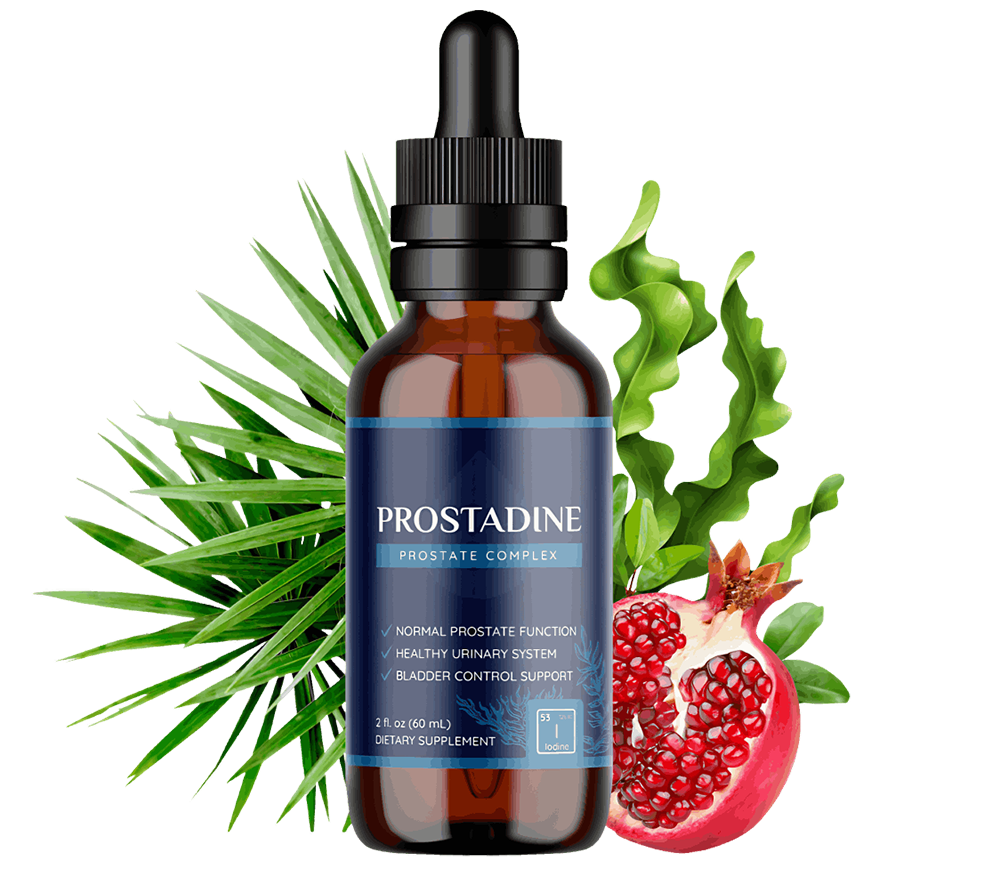
Prostadine is a liquid dropper supplement built around iodine-rich seaweed extracts.
⚠ Read this first: the thyroid warning
Prostadine’s whole formula is built on an iodine load from seaweed, and iodine directly affects the thyroid. If you have any thyroid condition (Hashimoto’s, Graves’, hypo- or hyperthyroid) or take levothyroxine, lithium or amiodarone, do not take Prostadine without your doctor’s explicit approval. This is the single most important thing to know about this product — more important than any benefit.
Short answer: Prostadine is a liquid-dropper prostate supplement whose signature is iodine from four sea vegetables — Nori Yaki, Wakame, Kelp and Bladderwrack — plus Saw Palmetto, Pomegranate, Neem, Shilajit and added Iodine. It’s the “odd one out” of prostate formulas: instead of the usual saw-palmetto core, it bets on the idea that low iodine contributes to prostate and urinary trouble.
The honest read: that iodine-BPH premise is not well established in mainstream urology, and there’s no trial of the finished product — so this is a plausible but weakly-supported alternative, not a proven one. It’s priced from $79 down to $49 a bottle with a 60-day money-back guarantee. For most men new to prostate supplements, a better-studied option makes more sense first — and anyone with thyroid issues should skip it entirely.
In this review
- What is Prostadine?
- Key facts
- How it works — and the honest caveat
- Ingredients: what is in the dropper
- Ingredient evidence audit
- Benefits: what it can and cannot support
- The iodine question
- Side effects and safety
- Are the reviews real?
- Fact-checking the hard-water claim
- Who it is for — and who must avoid it
- What buyers actually report
- Prostadine vs saw-palmetto and nettle formulas
- Price, guarantee and where to buy
- Honest alternatives
- How to take it: dose, timing, dropper
- How long it takes to work
- Medications: who must check first
- For frequency, night trips and weak stream
- Is Prostadine a scam?
- Our verdict
- Frequently asked questions
What Is Prostadine?
Prostadine is a liquid dietary supplement aimed at men over 45 dealing with the usual aging-prostate issues — waking to urinate at night, weaker stream, urgency, a sense of not fully emptying. Unlike the capsule products that fill retail shelves, it ships as a dropper bottle and is taken daily, placed under the tongue or added to water or juice.
Its defining feature is the iodine-rich seaweed base. The marketing frames it as “detoxifying” the prostate of mineral buildup — that’s promotional language, not established biology, and we’d push back on any claim that a supplement chemically “detoxes” a specific organ. What the formula genuinely delivers is an iodine load plus a handful of supporting botanicals. It uses a proprietary blend, so the label does not disclose an exact milligram amount for every ingredient — worth knowing if precise dosing matters to you.
Key Facts
| Category | Prostate and urinary support supplement |
| Format | Liquid drops — 2 fl oz (60 ml) bottle, two full droppers (2 ml) daily = 30-day supply |
| Headline claim | Normal prostate function, healthy urinary system, bladder control support |
| Ingredients named | 9 — nori yaki, wakame, kelp, bladderwrack, saw palmetto, pomegranate, iodine, shilajit, neem |
| Per-ingredient doses | Not published. No supplement facts panel anywhere on the sales page |
| Key gap | Five iodine sources, no iodine figure. Four seaweeds plus iodine listed separately |
| Best-studied ingredient | Saw palmetto — and the two largest trials found it no better than placebo |
| Price | $158 (2 bottles, +$9.99 shipping) · $207 (3, $69 each) · $294 (6, $49 each). No single-bottle option |
| Guarantee | 60 days — shorter than the 3–6 month course the seller recommends |
| Manufacturer | Not named on any page we checked |
| Independent reviews | No Trustpilot profile for the seller’s domain (checked 7 Sep 2026), against “19,651 reviews” claimed on the page |
| Our take | Mixed — a qualitative editorial judgement, not a score |
How Prostadine Works — and the Honest Caveat
Prostadine’s mechanism rests on a premise mainstream urology has not endorsed: that chronic low iodine contributes to prostate enlargement and inflammation. There’s some observational data linking high-seafood regions to lower BPH rates, and iodine does concentrate in glandular tissue — but whether topping up iodine actually improves symptoms once BPH has set in is unproven. That’s the honest core of this review: the idea is interesting, the direct evidence is thin.
Mechanistically, the seaweed stack (Nori Yaki, Wakame, Kelp, Bladderwrack) supplies iodine and marine compounds like fucoidans that show mild anti-inflammatory activity in lab studies; the small amount of Saw Palmetto adds a little of the 5-alpha-reductase action that better-studied prostate products rely on; and Pomegranate, Neem and Shilajit round out the blend with antioxidant and general-wellness roles. Because this is a nutritional rather than pharmacological approach, any benefit builds slowly — think weeks, not days — and men who already eat plenty of seafood or use iodized salt are the least likely to notice anything, since they have no deficiency to correct.
Prostadine Ingredients: What Is Actually in the Dropper
Prostadine lists nine ingredients. We’ve avoided quoting exact milligram doses because it’s a proprietary blend and those amounts aren’t fully disclosed on the label.
Nori Yaki, Wakame, Kelp & Bladderwrack (the seaweed stack)
The four sea vegetables are the heart of the formula and the source of its iodine. They also supply marine compounds (fucoidans, phlorotannins, alginate) with some antioxidant and anti-inflammatory activity in cell studies. This stack is exactly what makes Prostadine different from a saw-palmetto capsule — and exactly why the thyroid warning exists.
Saw Palmetto
The one ingredient here with a real prostate track record — it inhibits the enzyme that converts testosterone to DHT. But in Prostadine it’s a supporting, low amount, well below the doses used in the strongest saw-palmetto trials. Don’t buy Prostadine expecting a saw-palmetto-strength effect; it’s a minor contributor here.
Pomegranate Extract
A polyphenol-rich antioxidant with general cardiovascular and anti-inflammatory research. A reasonable supporting inclusion, though not prostate-specific.
Neem
A botanical with a long traditional-medicine history and antioxidant/antimicrobial properties in lab work. Human evidence for prostate benefit specifically is limited — treat it as a supporting ingredient.
Shilajit
A mineral resin studied mainly for testosterone and energy support in middle-aged men. In this blend it’s a minor addition rather than a clinically-dosed component.
Added Iodine
On top of the seaweed, the formula includes iodine directly — which is why the total iodine exposure is the defining feature and the main safety consideration. Beneficial if you’re genuinely low in iodine; a real risk if you have thyroid issues or already get plenty.
Prostadine Ingredient Evidence Audit
Nine ingredients are named and none has a published amount. Below is what the research actually says about each one for the claim Prostadine makes — prostate and urinary function. A study on an isolated ingredient is not proof that a finished product works, and no trial of Prostadine itself has ever been published.
| Ingredient | Evidence for the prostate / urinary claim | Verdict |
| Saw palmetto | The only ingredient here with large, well-run human trials — and they were negative. The STEP trial in the New England Journal of Medicine found no benefit over placebo. The CAMUS trial (JAMA, 2011) then tested escalating doses up to 960 mg daily — three times the standard dose — in 369 men over 72 weeks; the change in AUA symptom score favoured placebo by 0.79 points, and every secondary measure, including flow rate and nocturia, showed no advantage. | Best-studied, and it failed |
| Nori yaki, wakame, kelp, bladderwrack | Four brown and red seaweeds. There is no human trial of any of them for prostate size, urinary flow or bladder function. They carry iodine, fucoidans and phlorotannins with laboratory-level antioxidant activity, which is not the same as a clinical effect. | Traditional use only |
| Iodine | An essential nutrient the thyroid needs. Correcting a deficiency matters; taking more than you need does not improve prostate function, and the upper limit is real. This is the ingredient that makes the missing dose figure a safety question rather than a value question. | Nutrient, not a treatment |
| Pomegranate extract | Studied mainly in men with prostate cancer for PSA doubling time, which is a different condition from an enlarged prostate. The erectile-function trial the seller’s own references point to enrolled 53 men and did not reach statistical significance; its authors described it as a pilot and called for larger studies. | Wrong condition, weak trial |
| Shilajit | Small human studies suggest effects on testosterone and sperm parameters in specific groups. Nothing on urinary symptoms. Unpurified shilajit has been found contaminated with heavy metals; the seller does not state whether its material is purified or third-party tested. | Vitality, not prostate |
| Neem | Antimicrobial and antioxidant activity in laboratory work. No human prostate data. Associated with liver toxicity at high doses, and with antifertility effects in animal studies — relevant if you are trying to conceive. | No relevant evidence |
What is not known — read before buying
No trial of the finished product. There is no published study of Prostadine itself, only research on some of its individual ingredients, and the best of that research is negative.
No amounts anywhere. Nine ingredients, zero doses, no supplement facts panel on the sales page. You cannot tell whether any ingredient is present at a researched amount or as a pinch.
No iodine figure. With four seaweeds plus added iodine, this is the one missing number that carries a genuine safety consequence rather than just a value one.
No manufacturer. No company name, address or facility is published, so there is nothing to check and nobody named to hold responsible.
Prostadine Benefits: What the Formula Can and Cannot Support
The official page lists a benefit beside every ingredient — “supports prostate repair”, “supports a strong urine flow”, “maintains healthy prostate function”. Those are structure-function phrases, not treatment claims, and none of them is tied to a dose you can check. Here is what the evidence actually supports, separated from what the sales page implies.
Reasonably supported as a general benefit: saw palmetto has the largest body of human research of anything in the dropper for lower urinary tract symptoms — though, as covered below, the largest trials were negative. Pomegranate polyphenols and shilajit have small human studies for antioxidant status and, for shilajit, testosterone in specific populations.
Traditional use only, no meaningful human data at these doses: nori, wakame, kelp and bladderwrack for prostate or bladder function. These are seaweeds. Their inclusion is the basis of the product’s marketing story, not of its evidence.
Not supported at all: that a supplement can “repair” the prostate, reverse benign prostatic hyperplasia, or flush “toxic mineral buildup” caused by hard water. No dietary supplement is approved to treat, cure or prevent any prostate condition, and Prostadine does not claim to be.
The Iodine Question Prostadine Does Not Answer
Why five iodine sources is the issue, not one
This is the finding that separates Prostadine from every other prostate formula we have reviewed, and it is the reason we cannot recommend it for open-ended daily use.
The dropper contains five separate sources of iodine: nori yaki extract, wakame extract, kelp powder, bladderwrack powder, and iodine listed as an ingredient in its own right. Four of those five are brown or red seaweeds, which are among the most iodine-dense foods that exist.
What the seller does not disclose: how many micrograms of iodine are in a 2 ml daily dose. There is no supplement facts panel on the sales page and no amount beside any ingredient.
That matters because iodine has a genuine ceiling. The NIH Office of Dietary Supplements sets the Tolerable Upper Intake Level for adults at 1,100 mcg per day, and warns that high intakes can cause the same problems as deficiency — goitre, raised TSH and hypothyroidism — as well as iodine-induced hyperthyroidism and thyroiditis. ODS also notes that commercially available seaweed ranges from 16 mcg to 2,984 mcg of iodine per gram, a spread of nearly 200-fold. With four seaweeds and no panel, the daily iodine dose in Prostadine is genuinely unknowable from the label.
We are not saying Prostadine will harm your thyroid. We are saying that a product built on four seaweeds plus added iodine should publish its iodine content, and this one does not. If you have any thyroid condition, take levothyroxine or an antithyroid drug, or have ever been told to watch your iodine, this is a formula to discuss with your doctor before buying rather than after.
We looked at this problem across the whole category — what the guidance actually says about iodine limits, a documented case of a kelp supplement causing hyperthyroidism, and the five questions worth asking before you buy — in how much iodine is in your prostate supplement.
Prostadine Side Effects and Safety
What the seller says about side effects
The sales page states that with “more than 160,000 customers” the seller has not seen notable side effects. We cannot verify that number, and an absence of reported effects is not the same as an absence of effects. From the ingredients themselves, these are the realistic considerations:
Thyroid: the iodine load described above. The single most important caution on this product.
Saw palmetto: generally well tolerated; mild digestive upset is the most common complaint. It can lower PSA readings, which matters if you are being monitored — tell your doctor you are taking it so a screening result is not misread.
Shilajit: unpurified shilajit has been found contaminated with heavy metals. The seller does not state whether its shilajit is purified or third-party tested.
Neem: has been associated with liver toxicity at high doses and is not advised for men actively trying to conceive, as it has documented antifertility effects in animal work.
Anticoagulants: pomegranate and several of the botanicals here may interact with blood thinners. If you take warfarin, apixaban or similar, ask your prescriber first.
Does Prostadine Have Real Customer Reviews?
What we checked, and what we found
The order section carries a review widget reading “Our customers say … based on 19,651 reviews”. We checked whether an independent profile behind that number exists.
There is no Trustpilot profile for getprostadine.com. We searched Trustpilot on 7 September 2026 and the page returns a 404 — the business is not listed. The three testimonials on the page (attributed to men in New York, Wyoming and Chicago, each labelled “Verified Purchase”) carry no dates and no way for a reader to check them.
This is not proof that nobody is happy with Prostadine. It does mean that the 19,651 figure is the seller’s own count, displayed in the visual language of an independent review platform, and that a buyer has no external source to weigh against it.
Fact-Checking the “Harvard Hard Water” Claim
The sales page opens with a dated banner — “August 2022 – New Scientific Discovery” — under the headline “Scientists Discover The Real Root Cause Of Prostate Problems”. The body text says a recent Harvard study drew attention to hard water in the US containing toxic minerals that build up in the body.
We could not find a Harvard study making this claim, and no study is cited on the page. Hard water is water high in calcium and magnesium. It is not recognised in urology as a cause of benign prostatic hyperplasia; the established drivers are age and androgen signalling. A reader should treat the hard-water story as the marketing premise of the funnel, not as a scientific finding — and note that the page has been carrying its “new discovery” banner since 2022.
Who Prostadine Is For — and Who Must Avoid It
Prostadine may suit you if…
A reasonable fit if you:
- Have mild urinary symptoms and have already tried a standard saw-palmetto product without benefit
- Know your diet is genuinely low in iodine (no seafood, no iodized salt)
- Prefer a liquid dropper over capsules
- Want a non-hormonal approach and are willing to give it several weeks
Do NOT take it if you:
- Have any thyroid condition (Hashimoto’s, Graves’, hypo- or hyperthyroid) — the iodine load can trigger flares
- Take levothyroxine, lithium or amiodarone, which interact with iodine metabolism
- Have an iodine or shellfish sensitivity
- Already eat regular seaweed/sushi or take iodine — you could exceed the safe upper limit
- Have an unevaluated elevated PSA, pain, or blood in the urine — see a urologist first
Prostadine Customer Reviews: What Buyers Actually Report
We’re not going to invent testimonials. Honestly, public feedback for Prostadine is mixed and polarised. The men who report benefit tend to describe gradual, modest improvement in night-time frequency over a month or more; the disappointed ones expected faster or bigger results, or were people whose iodine was already fine so there was nothing to correct. A recurring, legitimate complaint is counterfeit product from third-party marketplace sellers — another reason to buy direct. Be skeptical of any review quoting a precise success percentage; there’s no finished-formula trial behind such numbers.
Prostadine vs Saw-Palmetto and Nettle Formulas
Prostadine is unusual among prostate supplements because its formula is built on seaweed. Most competing products are built on saw palmetto, stinging nettle, or beta-sitosterol. That difference is worth understanding before you choose.
Prostadine does include saw palmetto, and it is the only ingredient in the dropper with a substantial body of human research behind it. The problem is what that research found. The seller’s own reference list cites the Bent et al. saw palmetto trial published in the New England Journal of Medicine — a randomised, double-blind study that found saw palmetto no better than placebo for symptoms of benign prostatic hyperplasia. A later, larger trial testing doses up to three times the usual amount reached the same conclusion. Citing that literature as support for the product is, at best, an odd choice.
The comparison readers ask us about most is with ProstaVive, which we reviewed separately. It is a once-daily powder whose label lists stinging nettle, fenugreek, ashwagandha, cordyceps, maca, tongkat ali and panax ginseng alongside magnesium, zinc, boron, vitamin B6 and vitamin D3. It contains no saw palmetto and no seaweed. Its disclosure is better in one specific way — it publishes a supplement facts panel with amounts, which Prostadine does not — but a large share of its formula still sits inside a proprietary blend, so it is a matter of degree rather than a clean win.
The honest summary: neither product has trial evidence that it relieves prostate symptoms. Prostadine asks you to accept an undisclosed iodine load on top of that. If you are going to try a botanical formula anyway, the one that publishes its amounts is the easier one to discuss with a doctor.
Prostadine Price, Guarantee and Where to Buy
Prostadine is sold only through the official website — not on Amazon or in stores, and counterfeit listings are a documented problem, so buying direct also protects the guarantee. Current pricing:
Our pricing take: because any effect builds over weeks, one bottle isn’t a fair trial — the 3-bottle pack ($79/bottle) is the sensible starting point, and the 6-bottle ($49/bottle) only makes sense once you know it works for you. Confirm the current price and guarantee terms at checkout before ordering.
The 60-Day Money-Back Guarantee
Prostadine comes with a 60-day money-back guarantee, and buyers generally report it’s honoured without requiring you to return empty bottles. To claim, contact the customer-service address on your invoice with your order number within 60 days of delivery. Confirm the exact terms on the checkout page, as they can change.
Check Current Prostadine Pricing
Authentic product, best per-bottle pricing and the 60-day guarantee — only through the official website.
Honest Alternatives to Prostadine
Start with a diagnosis, not a dropper
If the reason you are here is night-time urination or a weak stream, it is worth knowing what the alternatives actually are before spending $294.
See a doctor first, genuinely. Lower urinary tract symptoms in men over 45 are usually benign prostatic hyperplasia, but the same symptoms can come from infection, bladder stones, diabetes or prostate cancer. A PSA test and an exam cost little and rule out the things a supplement cannot help. Blood in the urine, pain, fever or an inability to pass urine are urgent — not supplement territory.
Prescription options have the evidence supplements lack. Alpha blockers such as tamsulosin work within days for flow and urgency; 5-alpha reductase inhibitors such as finasteride shrink the prostate over months. Both have well-documented side effects worth discussing, but both have been proven to work in large trials — which is more than can be said for anything in this dropper.
If you want to try a botanical anyway, pick one that publishes amounts on a supplement facts panel so you and your doctor can see what you are taking. Beta-sitosterol and nettle root have somewhat better symptom data than the seaweeds here, and a single-ingredient product with a stated dose costs a fraction of $49 a bottle.
Free changes that help: cutting fluids in the two hours before bed, reducing evening alcohol and caffeine, and double voiding. Guidelines list these first for a reason.
How to Take Prostadine: Dose, Timing and the Dropper
Prostadine is a liquid, not a capsule. It comes with a glass pipette dropper, and the label gives the exact number of drops — follow that rather than any figure quoted on a review site, including this one.
The method: squeeze the rubber bulb to draw liquid into the pipette, then dispense the directed amount either under the tongue or into a small glass of water or juice. Swallow, then follow with a full glass of water. Do it over a sink the first couple of times until you have the feel for the bulb.
When to take it
Morning, with or just after food, is the sensible default. Two reasons: the formula contains shilajit, which some men find mildly energising and would rather not take near bedtime, and food takes the edge off the seaweed base for anyone whose stomach is sensitive to it. That said, responses vary and plenty of men notice no stimulating effect at all.
The timing matters far less than the consistency. Taking it every day at a time you will actually remember beats optimising the hour.
Drops versus capsules — does the format matter?
A liquid does absorb faster than a capsule that has to break down first, and that is a genuine convenience. But it is worth being clear about what that does and does not buy you: faster absorption of a dose is not the same as a faster result. The prostate support these botanicals are claimed to provide builds over weeks either way. Anyone selling you the dropper as the reason it works is overselling the format.
The real drawback of the liquid format is taste. Concentrated seaweed extract tastes like concentrated seaweed extract, and that is the single most common complaint about this product. Mixing it into juice solves it for most people.
How Long Does Prostadine Take to Work?
Short answer: it is not an overnight product. If anything changes, expect it gradually across roughly 8 to 12 weeks, with the earliest subtle shifts sometimes reported around weeks two to four.
Here is the honest framing, though. There is no published clinical trial of the finished Prostadine formula, and the seller does not publish per-ingredient amounts — so nobody, including us, can tell you what proportion of men see a change or how large it is. Any site giving you a precise percentage by a precise week has invented it.
What we can say is that the mechanism being claimed is a slow one. Marine botanicals and shilajit are not fast-acting drugs. If you are going to try it, judge it on a full bottle rather than a fortnight — and if you see nothing by the end of the guarantee window, that is your answer and your refund window.
A far better use of those twelve weeks: get a baseline. Ask your doctor for a PSA test and an IPSS symptom score before you start, and repeat them after. That turns “I think it helped” into something you can actually read.
Prostadine and Your Medications: Who Must Check First
This is the most important section on the page, and it is the one most Prostadine reviews skip entirely. The formula is built on iodine-rich seaweed, and iodine is not a neutral ingredient.
If you take thyroid medication — do not start without asking your doctor
Levothyroxine and similar medications work by replacing or regulating thyroid hormone at a dose your doctor has fine-tuned using blood tests. Iodine is the raw material the thyroid uses to make that hormone. Introducing a steady iodine source changes the underlying conditions your prescription was calibrated against.
In some people that does very little. In others it can nudge the thyroid toward over- or under-activity, working against the balance the medication is maintaining. The practical risk is destabilisation — and because thyroid symptoms are vague and slow, you may not notice for months. This is not a combination to trial on your own.
If you have reduced kidney function
The kidneys are the body’s main route for clearing excess iodine. When kidney function is impaired, iodine clears more slowly and can accumulate — so a dose a healthy person handles easily may build up in someone with significant impairment. Seaweed also concentrates other minerals depending on where it was harvested. This is a conversation with your nephrologist, not a DIY trial.
If you have seaweed, marine or iodine sensitivity
Prostadine is essentially a concentrated seaweed blend — nori, wakame, kelp and bladderwrack. True seaweed allergy is uncommon but real. If you have ever reacted to nori, wakame, kelp or other marine vegetables, treat that as a warning. And if you have never eaten them, you cannot assume tolerance — be attentive the first time you take it.
On the common shellfish question: seaweed is a plant, not a shellfish, so it is not the same allergen. But marine harvesting means cross-contact is not impossible, and iodine sensitivity is a separate issue again. If you carry an adrenaline pen for seafood, ask your allergist rather than guessing.
Also check first if you
- take prostate medication such as finasteride, dutasteride or tamsulosin — never stop a prescription to trial a supplement
- are being monitored for a raised PSA or have a prostate cancer diagnosis
- take lithium, which interacts with iodine
- have Hashimoto’s, Graves’ disease or any autoimmune thyroid condition
Urinary symptoms are not always the prostate. Blood in the urine, fever, inability to pass urine or sudden severe change are reasons to see a doctor the same day, not to order a supplement.
Prostadine for Specific Symptoms: What It Targets
Frequent urination during the day
Frequency in older men usually traces to the prostate enlarging and pressing on the urethra, so the bladder never empties fully and signals “full” again quickly. Prostadine’s claim is to support prostate comfort and fuller emptying over time. What is genuinely within your control alongside it: caffeine and alcohol are direct bladder irritants, and cutting them often does more, faster, than any dropper.
Waking at night (nocturia)
Night-time trips are the symptom men most want gone, and the honest picture is that two things drive them. The prostate side — incomplete emptying, so the bladder refills within a couple of hours — is what the supplement is aimed at. But the second driver is fluid handling: the body produces relatively more urine overnight as you age, and evening drinks stack on top.
That second half is free to fix and works within days: stop fluids two to three hours before bed, move diuretics like alcohol and coffee earlier, and if you have ankle swelling, elevating your legs in the evening genuinely helps. Anyone who tells you a supplement alone fixes nocturia is not being straight with you.
Weak stream and incomplete emptying
These are the symptoms most tied to physical obstruction, and they are the ones least likely to respond to a botanical. If your stream has weakened noticeably, that is worth a proper assessment — there are prescription options with real trial evidence behind them, and a supplement is not a substitute for finding out what is actually going on.
Is Prostadine a Scam?
Short answer: the product itself is not a scam, but the ecosystem around it contains several things that are. Those are two different questions and they are worth separating.
What checks out
- It is a real product with a real seller. Orders are processed by ClickBank, which is the retailer of record and handles refunds independently of the brand — that is meaningful, because it means the refund does not depend on the brand’s goodwill.
- The ingredients are disclosed. All nine are named on the label.
- The guarantee is documented. 60 days, and the process is published. We followed the stated refund procedure to confirm it exists; we did not test an individual refund outcome.
What does not check out
- No amounts are published. Nine ingredients, zero doses. That is the single biggest criticism of this product — you cannot compare it against the research, because you do not know how much of anything you are getting. It is not fraud, but it is the opposite of transparency.
- The “Harvard hard water” origin story that appears throughout the marketing does not hold up. We address that in full above.
- Five iodine sources in one dropper, with no total iodine figure. For a mineral with a genuine upper limit, that is a real gap.
Where the actual scams live
If someone has been burned buying Prostadine, it is usually one of these rather than the product:
- Marketplace listings. Third-party sellers on Amazon and eBay are not authorised. You have no guarantee what is in the bottle and no refund path through ClickBank.
- Fake coupon and discount sites that exist to capture the search, not to give you a discount.
- Look-alike products with near-identical names riding the brand’s search traffic.
- “Reviews” with invented studies. If a page tells you a specific percentage of men improved by a specific week, ask to see the study. There isn’t one — no published trial of the finished Prostadine formula exists.
Buy from the official seller or don’t buy at all. That single rule removes almost all of the genuine risk.
Our Verdict
Prostadine is an unusual, transparent-enough product with a genuinely different mechanism and a fair guarantee — but its core premise (iodine for prostate health) is weakly supported, it has no finished-formula trial, and its iodine load makes it unsafe for anyone with a thyroid condition. It’s a niche, second-line option: worth considering only if you’ve tried a conventional prostate formula without success, know your iodine is low, and have no thyroid issues. For most men, a better-studied botanical formula is the smarter first step.
✓ What we liked
- Genuinely different, non-hormonal mechanism (a real alternative)
- Liquid dropper — easy if you already take many pills
- Fair 60-day money-back guarantee
- Doesn’t interfere with most cardiovascular/metabolic medications
- Correct, competitive pricing on multi-bottle packs
✗ What could be better
- Iodine load makes it unsafe for anyone with thyroid issues — full stop
- Core iodine-BPH premise is weakly supported
- No published trial of the finished formula
- Proprietary blend — exact doses not disclosed
- Saw palmetto is a minor, low amount here
- Counterfeits are a real risk — official site only
Update log: 7 September 2026 — full evidence-led rebuild. Ingredient list, format, package pricing and the 60-day guarantee re-verified against the official checkout on this date; previously published pricing was corrected. Iodine content, Trustpilot presence and the sales page’s “Harvard” claim were checked against primary sources. We will re-check the formula and price on the next material change.
Free — from this review
The 4 prostate ingredients with real trial evidence — and the 9 that don’t
A one-page reference you can take to the pharmacy or your doctor: which ingredients improved urinary symptoms in randomised trials, the dose each one needed, and the popular ones that failed when they were properly tested. No product pitch — just the doses.
One email. Unsubscribe any time. We never sell your address.
Frequently Asked Questions
What is Prostadine and what does it do?
Prostadine is a liquid dietary supplement sold in a 2 fl oz (60 ml) dropper bottle and marketed for normal prostate function, urinary flow and bladder control. The seller recommends two full droppers (2 ml) daily, which makes one bottle a 30-day supply. It is a supplement, not a medicine, and is not approved to treat any prostate condition.
What are the ingredients in Prostadine?
Nine are named: nori yaki extract powder, wakame extract, kelp powder, bladderwrack powder, saw palmetto, pomegranate extract, iodine, shilajit and neem. No amounts are published for any of them and the sales page carries no supplement facts panel, so the dose of each ingredient is unknown from the marketing material.
How much iodine is in Prostadine?
The seller does not say. Four of the nine ingredients are seaweeds and iodine is listed separately, but no microgram amount is given anywhere on the sales page. The NIH Office of Dietary Supplements sets the adult upper limit at 1,100 mcg a day and notes that seaweed can contain anywhere from 16 to 2,984 mcg of iodine per gram. Without a panel, a buyer cannot tell where a daily dose falls.
Can I take Prostadine with thyroid medication?
Ask your doctor before you do. Iodine intake affects thyroid hormone production and can interact with levothyroxine and antithyroid drugs. Because Prostadine does not disclose its iodine content, neither you nor your prescriber can calculate the dose you would be adding.
How long does Prostadine take to work?
The seller suggests continuing for three to six months, which is why the multi-bottle packages are pushed hardest. There is no published trial of the finished formula, so there is no evidence-based timeline — only the seller’s own recommendation.
Does Prostadine shrink the prostate or treat BPH?
No. No dietary supplement is approved to treat, cure or prevent benign prostatic hyperplasia, and Prostadine does not make that claim in its formal labelling. Persistent urinary symptoms, blood in the urine, or difficulty passing urine need a doctor, not a supplement.
Is Prostadine FDA approved?
No, and no dietary supplement is. The sales page carries a badge reading “Made in an FDA Registered Facility”, which is a different thing entirely — registration means the facility is on an FDA list, not that the FDA has reviewed, tested or approved the product.
How much does Prostadine cost?
As checked on 7 September 2026: two bottles at $79 each ($158 plus $9.99 shipping), three bottles for $207 ($69 each, free US shipping), or six bottles for $294 ($49 each, free US shipping, with two bonus guides). There is no single-bottle option. Prices are set by the seller and can change.
Is the “save $780” discount real?
Not in any meaningful sense. The saving is calculated against $1,074 for six bottles, a price the seller never charges. Measured against the cheapest price a buyer can actually pay per bottle ($79), the six-bottle pack is about 38% off — a real discount, but less than a third of the advertised figure.
What is Prostadine’s refund policy?
Sixty days from purchase, handled by ClickBank, which is the retailer of record. Sixty days on a six-bottle 180-day supply means the guarantee expires long before the course the seller recommends is finished — worth knowing before you buy the largest pack.
Are the 19,651 reviews on the Prostadine page real?
We could not verify them. There is no Trustpilot profile for getprostadine.com — the page returns a 404 as of 7 September 2026. The review count and the three named testimonials appear only on the seller’s own page and carry no dates.
Is the Harvard hard water study real?
We could not find it. No citation is given on the sales page, and hard water is not recognised in urology as a cause of prostate enlargement. Treat it as the story the funnel is built on rather than as a finding.
Vinceti M, et al. Iodine intake and the risk of thyroid disease. Eur J Clin Nutr. PubMed: 23632752
Fitzpatrick-type overview: dietary iodine and glandular tissue (context on the iodine-prostate hypothesis).
Novara G, et al. Efficacy and safety of hexanic Serenoa repens extract in LUTS/BPH: systematic review and meta-analysis. J Urol. PubMed: 26775657
Aso Y, et al. Fucoidan from seaweed and human health. Mar Drugs. PubMed: 31569368
Roehrborn CG. Male lower urinary tract symptoms and benign prostatic hyperplasia. Med Clin North Am. PubMed: 21855697
Affiliate disclosure: Men’s Health Authority may earn a commission if you buy through links on this page, at no additional cost to you.
Method & medical disclaimer: This review is based on Prostadine’s published label and research on its individual ingredients — not on a clinical trial conducted by us, and no trial of the complete formula has been published. It is general information, not medical advice. Because Prostadine contains iodine, it is not appropriate for people with thyroid conditions without medical supervision. Consult a qualified healthcare provider before starting any supplement, especially if you take medication or have a health condition. Statements have not been evaluated by the FDA; this product is not intended to diagnose, treat, cure or prevent any disease.
4 thoughts on “Prostadine Reviews 2026: Scam or Legit? Ingredients & Verdict”
Comments are closed.