
Bottom line. VisiFlora is a once-daily eye capsule built around lutein and zeaxanthin, the two carotenoids with the best macular evidence. The honest catch: it lists 22 ingredients and publishes an amount for exactly one of them (zinc, 11 mg), and 22 ingredients cannot all sit at researched doses in a single capsule — the AREDS2 formula manages six across two capsules. Despite the “gut-eye” positioning it contains no probiotics. What is genuinely good: the ingredient selection is the right one for macular support, and the checkout runs through ClickBank. Verdict: Mixed — the right ingredients, an unknowable formula, and a cheaper evidence-based alternative in AREDS2.
Vision supplements are a crowded, noisy category, and most of the marketing leans on one genuinely proven idea — that the carotenoids lutein and zeaxanthin support the macula — while quietly hiding how much of them is actually in the bottle. VisiFlora is a 22-in-1 eye-health capsule that stacks those carotenoids with a wide antioxidant and botanical panel. The single most important thing to know before you buy: most of those 22 ingredients, including lutein and zeaxanthin, sit inside one small proprietary blend, so the actual doses are not disclosed. This review explains what that means for you, what the formula can plausibly do, and the safety cautions that matter — especially for smokers.
Quick Takeaway: VisiFlora is a once-daily vegetable-capsule eye formula with 22 ingredients — lutein, zeaxanthin, astaxanthin, lycopene, bilberry, saffron, ginkgo, taurine, alpha-lipoic acid and a vitamin/mineral base (A/beta-carotene, C, E, zinc, copper, selenium, chromium). The catch: 14 of the actives, including the carotenoids, are in a ~351mg proprietary blend with no individual doses shown, so it is not possible to confirm it hits AREDS2 levels. It contains no probiotics despite any “gut-eye” marketing. Pricing runs about $69 for one bottle down to ~$49/bottle on the six-pack, with a 60-day money-back guarantee. Smokers should not take it.
IN THIS REVIEW
Blend
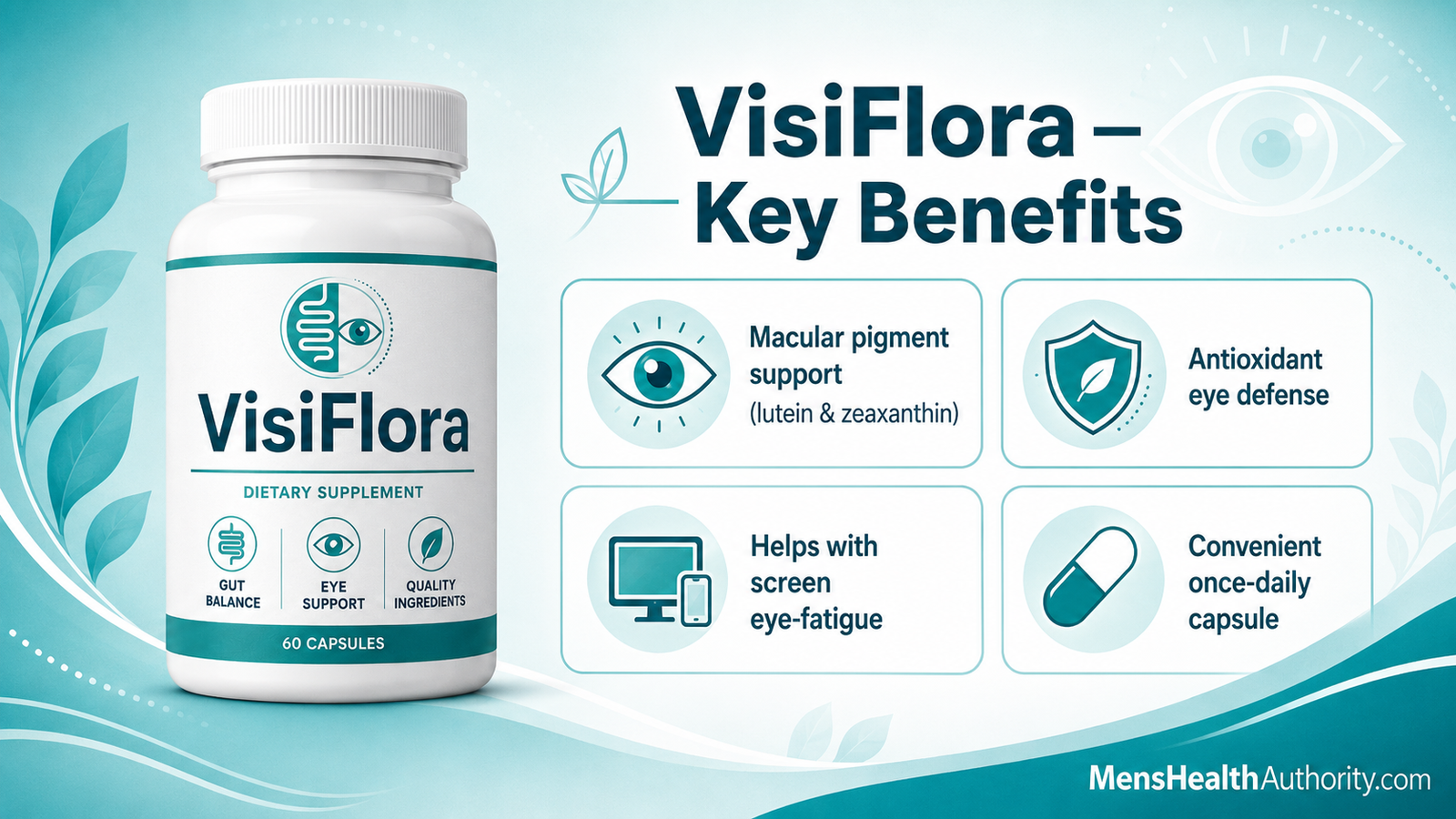
VisiFlora ships in 30-count bottles — one capsule a day, best taken with a meal containing some fat to aid carotenoid absorption.
| Category | Eye Health / Vision Support Capsule |
| Format | Vegetable capsule — 1 daily, 30/bottle |
| Core Actives | Lutein, Zeaxanthin, Astaxanthin, Bilberry (in a blend) |
| Key Caveat | 14 actives in a ~351mg proprietary blend — doses not shown |
| Our Rating | Mixed — good ingredients, doses hidden |
| Guarantee | 60-day money-back guarantee |
| Best Price | From ~$49/bottle on the official website |
Editorial note: this page is our own opinion-based assessment. We did not run a clinical trial on VisiFlora and make no claim to have tracked any users. Any figures below refer to published research on individual ingredients, not to a study we conducted.
What Is VisiFlora?
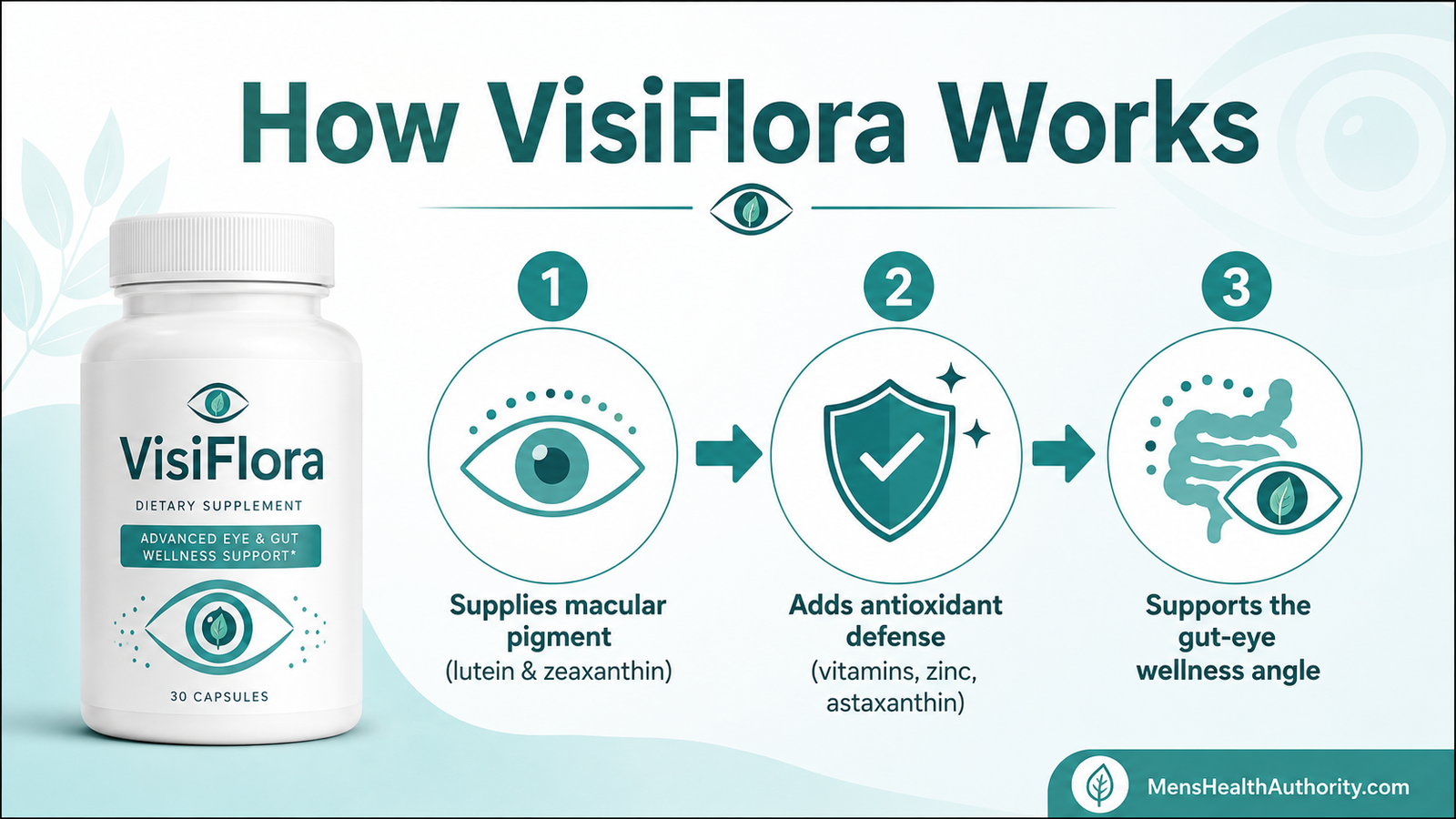
VisiFlora is a once-daily vegetable-capsule eye supplement aimed at adults concerned with age-related macular degeneration (AMD) risk, digital eye strain and general oxidative stress on the retina. Each bottle contains a 30-day supply, and the formula is a “22-in-1” stack: the eye-health carotenoids plus a broad antioxidant, botanical and vitamin/mineral panel.
Here is the honest structure of the label, and it is the crux of this review. A handful of vitamins and minerals — Vitamin A (as beta-carotene), Vitamin C, Vitamin E, zinc, copper, selenium and chromium — are disclosed at stated amounts. But the 14 signature ingredients, including lutein and zeaxanthin, are grouped into a single proprietary blend that totals only about 351mg, with no individual doses printed. That matters enormously, because the whole point of the AREDS2 research is that lutein and zeaxanthin work at specific doses (10mg and 2mg). When those doses are hidden inside a small combined blend, there is no way for a buyer — or us — to confirm the product actually delivers a research-backed amount of the ingredients that do the real work.
Despite marketing language that leans on gut and “flora” themes, the current label contains no probiotic organisms, no CFU count and no named prebiotic. So treat any “gut-eye axis” framing you see as marketing, not formulation. VisiFlora is, at its core, a carotenoid-and-antioxidant eye capsule — a reasonable idea, undermined by a label that won’t tell you how much of the important stuff you’re getting.
How VisiFlora Is Supposed to Work — and the Gut-Eye Claim
The product is sold on a “gut-eye axis” idea: that gut health influences eye health, and that supporting the gut barrier supports vision. The underlying research area is real — there is genuine scientific interest in links between the gut microbiome and ocular inflammation.
But there are no probiotics in it
This is the part worth pausing on. A product marketed on the gut-eye axis contains no probiotic strains and no CFU count at all.
The blend named “Gut-Eye Barrier Complex” is grape seed extract, rutin, quercetin, taurine and alpha lipoic acid. Those are antioxidants and polyphenols. They are reasonable ingredients in their own right, but none of them is a gut bacterium, and the gut-microbiome research the concept borrows from is about bacterial populations.
So the mechanism in the marketing and the ingredients in the capsule are describing two different things. If the gut-eye angle is what persuades you, note that this product does not act on the gut in the way that research does.
What the formula actually is
Stripped of the framing, VisiFlora is a broad antioxidant and carotenoid eye supplement — lutein, zeaxanthin, astaxanthin, bilberry, vitamins C and E, zinc. That is a legitimate and well-trodden category, and those are the right ingredients for it. The questions are how much of each is in there, and whether 22 of them belong in one capsule.
VisiFlora Ingredients: 22 in One Capsule
Read from the seller page on 6 September 2026. VisiFlora lists 22 ingredients across four named blends, taken as one capsule daily with food.
Macular & lens protection
Lutein, zeaxanthin (from marigold), vitamin A as beta carotene, zinc, bilberry extract, lycopene, saffron extract
Vision defense matrix
Astaxanthin, vitamin C, vitamin E, copper, selenium, chromium
Gut-eye barrier complex
Grape seed extract, rutin, quercetin, taurine, alpha lipoic acid
Vision performance boosters
Ginkgo biloba, coleus forskohlii, eyebright
One ingredient has a published amount. The other 21 do not.
Zinc is listed at 11 mg. That is the only number on the page. There is no Supplement Facts panel, and no amount is given for lutein, zeaxanthin, astaxanthin, bilberry or anything else.
Why 22 ingredients in one capsule cannot all be at researched doses
This is arithmetic rather than opinion, and you can check it yourself.
A standard size-0 capsule holds roughly 500 to 800 mg of powder. Now look at what the research uses for just a handful of the ingredients on this list:
- Taurine — studied at 500–2000 mg
- Vitamin C — 500 mg in the AREDS eye trials
- Quercetin — 500–1000 mg
- Alpha lipoic acid — 300–600 mg
- Bilberry extract — 160–480 mg
- Ginkgo biloba — 120–240 mg
- Grape seed extract — 100–300 mg
Those seven ingredients alone, at their studied amounts, come to somewhere between two and four grams. That is three to six capsules’ worth — before you add the other fifteen. It is not physically possible for one daily capsule to deliver researched doses of 22 ingredients.
The clearest comparison is the one eye formula with real clinical evidence behind it. The AREDS2 formulation contains six ingredients and is taken as two capsules a day. VisiFlora claims 22 in one.
That does not make it useless. Lutein and zeaxanthin are the two ingredients with the best macular evidence, and their studied doses are small — around 10 mg and 2 mg — so those two could genuinely be present at useful amounts. But without a panel there is no way to know whether they are, or whether the capsule is mostly the cheap bulk ingredients with a dusting of the expensive ones.
We did not identify a published clinical trial of the finished VisiFlora formula. Everything above is ingredient-level reasoning against published study doses. Formula, price, and terms may change; confirm current details with the seller and read the panel on the bottle that arrives.
What Are the Benefits of VisiFlora?
VisiFlora is marketed for macular protection, sharper vision, reduced eye strain and screen-fatigue relief. Each traces to specific ingredients, so each can be assessed — with the caveat that no amounts are published.
Macular protection
The best-supported claim, and by some distance. Lutein and zeaxanthin are the two carotenoids that concentrate in the macula, and they are in the AREDS2 formulation for good reason. Their studied doses are small enough to fit here.
Antioxidant support
Reasonable. Vitamins C and E, zinc, copper and selenium are the AREDS backbone. Zinc is the one ingredient with a published amount at 11 mg — note AREDS used 80 mg, so this is a nutritional dose rather than a therapeutic one.
Night vision and eye strain
Weak. Bilberry is the traditional ingredient here, but the trials use 160–480 mg and there is no way 22 ingredients in one capsule leaves room for that.
Circulation to the eye
Weak. Ginkgo has some ocular blood-flow research at 120–240 mg. The same space problem applies.
Gut-eye barrier
Not what it sounds like. No probiotics are present. See the section above.
What this product is realistically for
If you want lutein and zeaxanthin in a convenient once-daily capsule with a broad antioxidant base around them, this is a plausible way to get it, and those are genuinely the right ingredients for macular support.
If you want a researched eye formula, the honest comparison is unflattering. The AREDS2 formula is available from many manufacturers, publishes every amount, has the actual clinical trial behind it, and costs a fraction of $49 to $79 a bottle. What you are paying extra for here is the long ingredient list — and the long ingredient list is the reason none of them can be at a full dose.
Who It’s For — And Who Must Avoid It
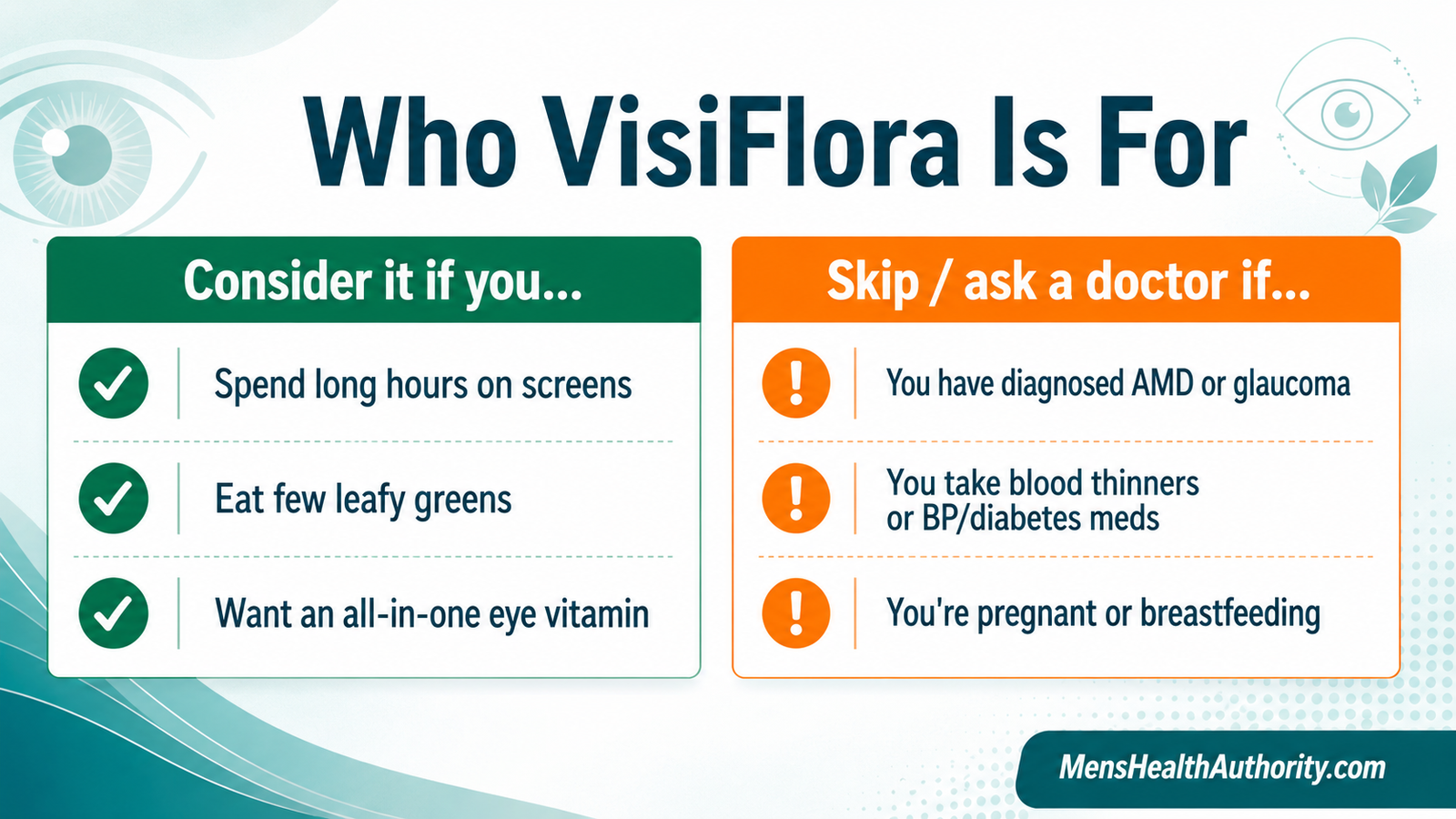
May Be a Reasonable Fit For:
- Non-smoking adults 35+ with heavy screen time who want general antioxidant and carotenoid support and have realistic expectations
- Adults with a family history of AMD who want a broad daily eye-nutrient capsule (ideally after discussing dosing with an eye doctor)
- People whose diet is low in leafy greens and orange/yellow vegetables (the natural carotenoid sources)
⚠ Do NOT take VisiFlora if you smoke — and other cautions
This formula contains beta-carotene. The CARET and ATBC clinical trials found that beta-carotene supplementation increased lung-cancer risk in smokers and former smokers. If you currently smoke or have smoked in recent years, do not take VisiFlora — ask an eye doctor about a smoker-safe, lutein-only formula instead. Separately, bilberry, ginkgo and grape seed all have mild blood-thinning activity, so check with your doctor before combining VisiFlora with warfarin or other anticoagulants/antiplatelet drugs. Bilberry may also nudge blood sugar lower, relevant if you take diabetes medication. If pregnant or breastfeeding, or if you have surgery scheduled, consult your clinician first.
Not the Right Product If:
- You smoke or recently quit (see above)
- You specifically want verified AREDS2 doses — a labelled, single-purpose AREDS2 product is the honest choice there, because VisiFlora hides the carotenoid amounts
- You expect it to restore lost vision or treat diagnosed AMD — it is preventive nutritional support, not treatment
- You take anticoagulants and haven’t cleared it with your doctor
VisiFlora Reviews and Complaints: What We Could Find
We do not publish customer quotes we cannot trace to a dated, checkable source. Here is what the public record contains as of 6 September 2026.
The seller’s domain has no Trustpilot profile. Not a poor score — no profile at all. We could not locate an independent review platform carrying verified buyer feedback for this product.
What a search does return is a large number of review articles on affiliate sites, several of which describe personal trials — “we tried it 30 days”, “we tried it 60 days”. Those pages earn a commission on the same product they are reviewing, as do we, and none of them publishes evidence that the trial took place. We would not treat any of them as a customer review record, including as evidence for the product or against it.
What an absent review record does and does not mean
It is not evidence of a bad product. It usually means a product is recent, or sold almost entirely through affiliate traffic that never routes buyers to a review platform.
But it does mean you cannot check other buyers’ experience before ordering, and neither can we — including whether refunds are honoured. In that situation the guarantee carries the whole weight, so buy through the ClickBank checkout, where refunds are processed independently of the seller and there is a documented dispute route.
And if a page shows you a dozen named VisiFlora customers with photographs and before-and-after stories, ask where they came from. There is no public record for them to have come from.
Where to Buy the Original VisiFlora
On 6 September 2026 we followed the order buttons on the page our link resolves to and confirmed the checkout runs through ClickBank, the authorised retailer that also processes refunds.
Verified 6 Sep 2026: capsules, one daily with food. $79 a bottle for two · $59 a bottle for three · $49 a bottle for six. Free US shipping on the three- and six-bottle packs. Three digital eBooks included. 60-day money-back guarantee. No manufacturer or company address is named anywhere on the page.
The struck-through $99 is not a price anyone pays
All three tiers show “$99” crossed out beside the real figure, with claimed savings of $40, $302 and $434. The page never sells a bottle at $99 — its own highest price is $79.
The genuine saving is still worth having: $49 a bottle on the six-pack against $79 on the two-pack is 38% less per bottle.
The three eBooks are described as worth $214 together. That is a marketing figure attached to digital downloads, not money you would otherwise spend, and we would not let it influence the decision.
One thing to weigh: six bottles is a six-month supply and the guarantee runs 60 days. Two-thirds of that order sits outside the refund window before you finish it.
Pricing, Guarantee & Where to Buy
VisiFlora is sold exclusively through the official website. Pricing follows the standard tiered structure (confirm current pricing on the official site before ordering):
Our pricing take: because any carotenoid benefit builds over months, a single bottle only tests tolerance. But given the proprietary-blend uncertainty, we would not rush into a six-pack here — the three-bottle bundle is the sensible ceiling until you’ve decided the product is doing something for you, and while the 60-day guarantee still has room to protect your spend.
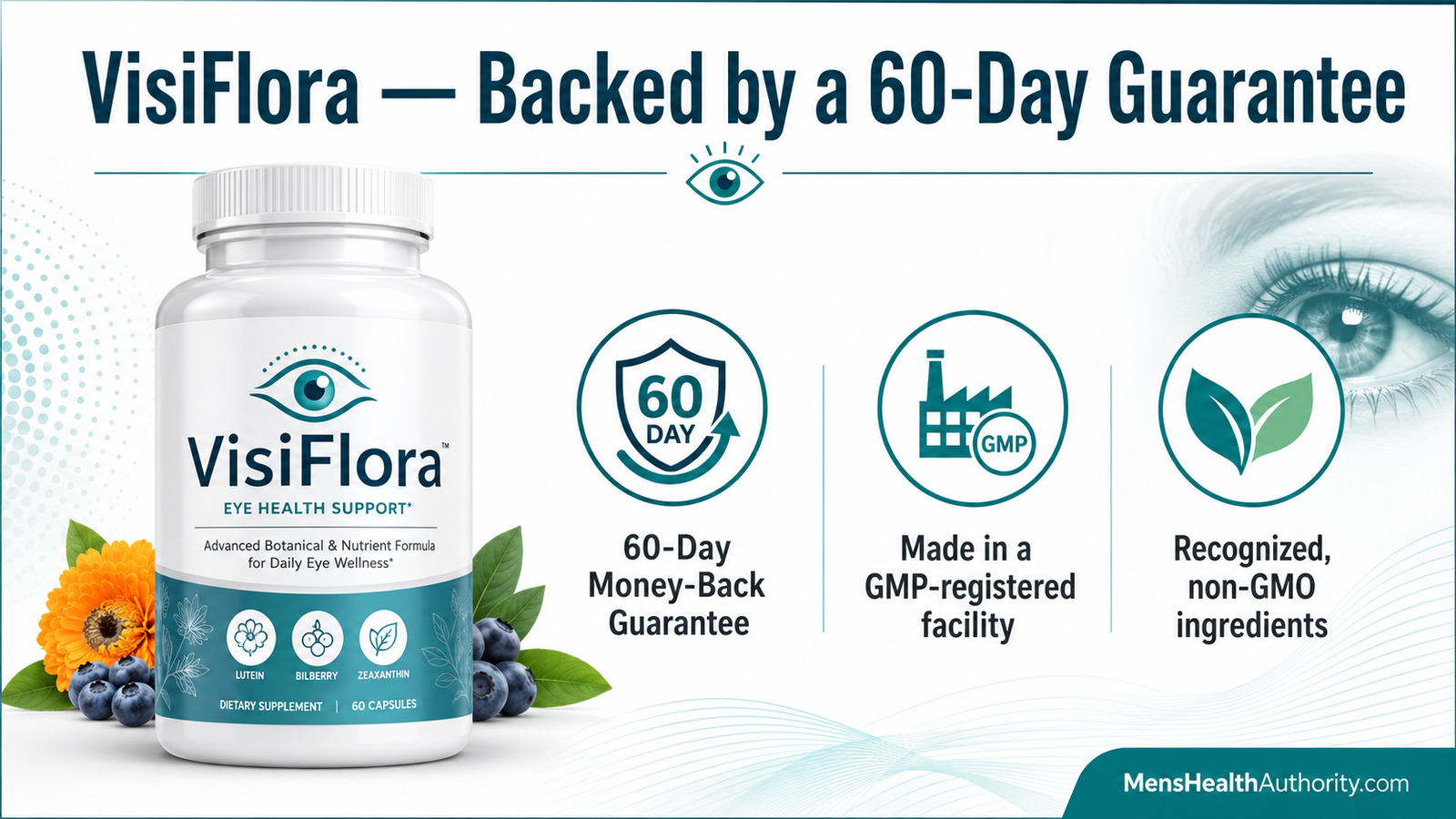
The 60-Day Money-Back Guarantee
VisiFlora offers a 60-day money-back guarantee. To claim it you contact customer service through the official site, request a return authorisation, and ship the bottles back at your own cost; refunds process after the return is received. Shipping fees on the initial order are generally not refunded — you get the product cost back, not delivery. Confirm the current terms at checkout, since the official site is the only authority on the exact policy.
Check the Official VisiFlora Website
Authentic product, current pricing, the full label, and the official 60-day money-back guarantee — only direct from the manufacturer.
Our Independent Verdict
VisiFlora has a genuinely good ingredient list for eye health — the carotenoids and antioxidants are the right names. But the score is held down by the thing that matters most: those ingredients, lutein and zeaxanthin included, sit in an undisclosed ~351mg proprietary blend, so you cannot confirm you’re getting research-backed doses. Add the beta-carotene smoker warning and it’s a “maybe, for the right non-smoker with realistic expectations” rather than a confident recommendation. If verified dosing matters to you, a labelled single-purpose AREDS2 product is the more honest buy. *Safety scored for non-smokers only.
VisiFlora — Pros and Cons
What We Liked
- Genuinely relevant eye-health ingredients (lutein, zeaxanthin, astaxanthin, bilberry, saffron)
- Broad antioxidant panel covering several pathways
- Simple one-capsule daily dose, no stimulants
- 60-day money-back guarantee on direct orders
- Multi-bottle bundles lower the per-bottle cost
What Could Be Better
- Key actives (incl. lutein/zeaxanthin) hidden in a ~351mg proprietary blend — doses unverifiable
- Contains beta-carotene — unsafe for smokers and recent quitters
- “Gut-eye” marketing but no probiotics in the formula
- Slow-acting; some users see no change
- Bilberry/ginkgo/grape seed add blood-thinner interaction flags
- Direct-only sales; steep single-bottle price
Frequently Asked Questions
Age-Related Eye Disease Study 2 Research Group (2013). Lutein + zeaxanthin and omega-3 fatty acids for age-related macular degeneration: the AREDS2 randomized clinical trial. JAMA. PubMed: 23644932
Omenn G.S. et al. (1996). Effects of a combination of beta-carotene and vitamin A on lung cancer and cardiovascular disease (CARET). NEJM. PubMed: 8602180
Piccardi M. et al. (2012). A longitudinal follow-up study of saffron supplementation in early age-related macular degeneration. Evidence-Based Complementary and Alternative Medicine. PubMed: 22690247
Kono K. et al. (2014). Effect of astaxanthin on accommodation and asthenopia. (astaxanthin eye-strain research overview). PubMed: 25429320
NIH National Eye Institute — Age-Related Macular Degeneration & AREDS/AREDS2. nei.nih.gov
Seller page verified 6 September 2026 — the VisiFlora page our affiliate link resolves to, whose checkout runs through ClickBank. The 22-ingredient list, capsule format, pricing tiers, eBook bonuses and 60-day guarantee were read from it directly. Zinc at 11 mg is the only per-ingredient amount published; there is no Supplement Facts panel.
AREDS2 comparison — the Age-Related Eye Disease Study 2 formulation contains six ingredients including 10 mg lutein and 2 mg zeaxanthin, is taken as two capsules daily, and publishes every amount. It also removed beta carotene because of the lung-cancer signal in smokers.
Trustpilot, checked 6 September 2026 — no profile exists for the seller’s domain, and we could not locate an independent platform carrying verified buyer feedback.
Clinical trial search — we did not identify a published clinical trial of the finished VisiFlora formula.
Update log — 6 Sep 2026: Rebuilt to the current review template. Verified the seller page and ClickBank checkout, published the full 22-ingredient list, added the single-capsule dose arithmetic and the AREDS2 comparison, documented that the gut-eye positioning involves no probiotics, corrected the advertised saving to the real 38%, and recorded the absent public review record.
Ready to Check VisiFlora?
Current pricing, the full label, and the official 60-day guarantee — only through the official site.
Affiliate Disclosure: Men’s Health Authority participates in affiliate marketing programmes and may earn a commission when readers purchase through links on this page, at no additional cost to the reader. This does not influence our editorial assessment.
Medical Disclaimer: This review is for informational and educational purposes only and is not medical advice. VisiFlora contains beta-carotene, which may increase lung-cancer risk in smokers. It is a dietary supplement, not a treatment for any eye disease, and does not restore lost vision. Always consult a qualified healthcare provider before starting any new supplement, especially if you smoke, take anticoagulants, are pregnant or breastfeeding, or have a diagnosed eye condition. Statements have not been evaluated by the FDA; this product is not intended to diagnose, treat, cure or prevent any disease.
2 thoughts on “VisiFlora Review (2026): Price, Where to Buy & Does It Work?”
Comments are closed.