
✎ Reviewed by the Malkiat Singh | Last updated: May 2026 | Reading time: 12 minutes
If you’ve noticed that high-stress periods at work, family stress, or financial pressure leave you feeling drained, unfocused, less motivated, or even less interested in sex — that’s not a coincidence. There’s a measurable biological mechanism behind it, and it has a name: the cortisol-testosterone seesaw.
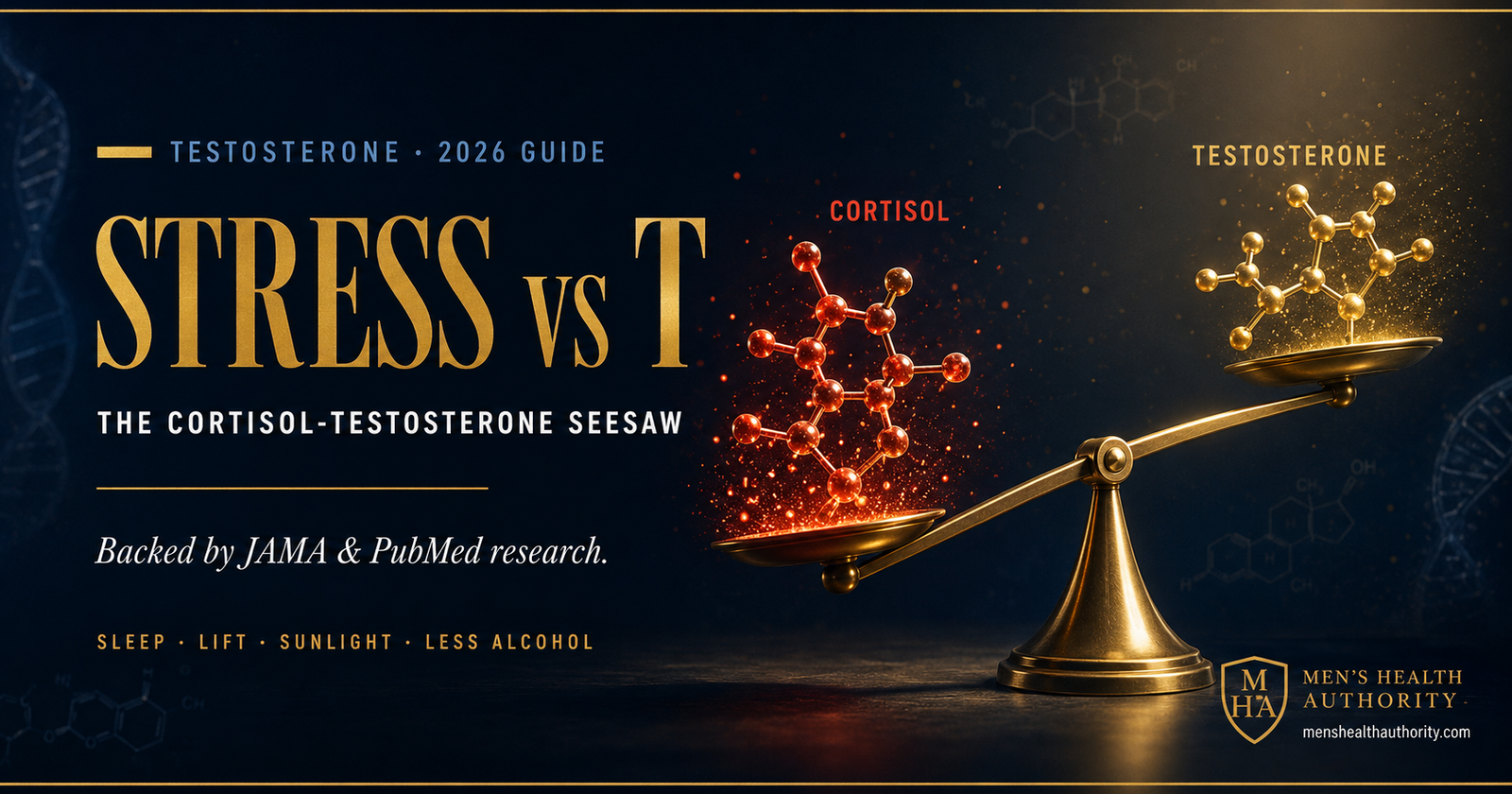
When stress is high, cortisol rises. When cortisol stays high for weeks or months, testosterone drops. The two hormones share the same raw material — pregnenolone — and your body always prioritizes survival hormones (cortisol) over reproductive hormones (testosterone) when it perceives ongoing threat.
For men over 40, this matters even more. Testosterone has already begun its natural age-related decline (approximately 1% per year after age 30). Chronic stress accelerates that decline by 10-15%, according to multiple peer-reviewed studies. The result is what most men describe as “feeling old before my time” — low energy, weight gain around the midsection, poor sleep, reduced libido, and the unmistakable feeling that something has shifted.
The good news is that the cortisol-testosterone connection is one of the most reversible drivers of low T. Unlike age, you can directly influence it through specific, research-backed interventions. This guide breaks down exactly how stress damages testosterone, what symptoms indicate the cycle is happening to you, and the evidence-based strategies that restore the balance.
⚡ Quick Takeaway
Chronic stress damages testosterone through three biological mechanisms — direct cortisol suppression of testicular function, competition for shared hormone precursors, and sleep disruption that prevents nighttime T production. Research-backed reversal strategies include resistance training (not endurance), 7-9 hours of sleep, prioritized morning sunlight, omega-3 sufficiency, and structured cortisol-management techniques. Most men see measurable T improvements within 8-12 weeks of consistent intervention.
🎥 Watch the 60-Second Breakdown
Prefer to watch than read? Here is the quick version before we get into the full guide:
📑 Table of Contents
- How Stress Damages Testosterone (The Biology)
- Symptoms That Stress Is Crushing Your T
- Acute vs Chronic Stress: Why the Difference Matters
- How to Actually Measure What’s Happening
- 7 Research-Backed Strategies to Reverse the Damage
- Realistic Recovery Timeline
- When to See a Doctor
- Frequently Asked Questions
- References
How Does Stress Damage Testosterone Levels?
The cortisol-testosterone relationship operates through three distinct biological mechanisms. Understanding each one matters because the interventions for each are different.
Mechanism 1: Direct HPA Axis Suppression
When your brain perceives stress, the hypothalamic-pituitary-adrenal (HPA) axis activates. Your adrenal glands release cortisol to help you respond to the perceived threat. This system evolved for short-term threats — predators, immediate physical danger — and it works perfectly for those situations.
The problem is that the same system fires for emails, deadlines, financial pressure, relationship stress, and traffic. Your body cannot tell the difference between a tiger and a stressful Zoom meeting. When cortisol stays elevated for weeks or months, it directly suppresses the hypothalamic-pituitary-gonadal (HPG) axis — the system that tells your testes to produce testosterone.
A 2008 study published in Hormones and Behavior demonstrated that elevated cortisol levels were inversely correlated with testosterone in healthy men, with the relationship strengthening as cortisol elevation duration increased. In simpler terms: the longer cortisol stays high, the more testosterone drops.
Mechanism 2: The Pregnenolone Steal
This is the mechanism most men never hear about, but it’s biochemically critical. Cortisol and testosterone are both manufactured from the same upstream hormone precursor — pregnenolone. Pregnenolone is sometimes called the “mother hormone” because every steroid hormone in the body, including cortisol, testosterone, DHEA, and progesterone, traces its production back to it.
Here’s the key: when your body is under chronic stress and demanding constant cortisol production, it diverts pregnenolone toward cortisol synthesis at the expense of testosterone. This is sometimes called “pregnenolone steal” — though the technical term in endocrinology is the redirection of steroidogenic precursors.
The practical implication: you can have perfectly healthy testes, intact signaling, and adequate nutrition, but if your stress is chronically high, the raw material to make testosterone is being routed to cortisol production instead. It is a supply chain problem, not a factory problem.
Mechanism 3: Sleep Disruption
Testosterone is produced primarily during sleep, peaking in the early morning hours of REM and deep sleep. A 2011 study published in the Journal of the American Medical Association found that just one week of sleep restricted to 5 hours per night reduced daytime testosterone levels by 10-15% in healthy young men — equivalent to 10-15 years of aging.
Chronic stress almost always disrupts sleep — either by making it harder to fall asleep, causing nighttime awakenings, or shortening total sleep duration. This creates a vicious cycle: stress reduces sleep quality, poor sleep reduces testosterone production, and lower testosterone further impairs stress resilience and sleep quality.
This is why men who report chronic stress almost always also report sleep issues, and why fixing sleep is one of the most powerful single interventions for restoring testosterone.
What Are the Symptoms of Stress-Driven Low Testosterone?
Stress-driven low testosterone produces a distinct symptom cluster that overlaps with age-related T decline but has some unique features. The most commonly reported symptoms include:
- Persistent fatigue despite adequate sleep hours — feeling exhausted even after 7-8 hours of sleep is a hallmark sign
- Mid-section weight gain — cortisol promotes visceral fat storage, particularly around the abdomen
- Reduced libido and sexual function — often the first noticeable symptom for men over 40
- Mood changes — particularly irritability, anxiety, mild depression, or a flatness of emotion
- Reduced motivation and drive — the “I just don’t care as much anymore” feeling
- Brain fog and reduced focus — difficulty with concentration, memory, mental sharpness
- Sleep disturbance — difficulty falling asleep, waking at 3-4 AM, unrefreshing sleep
- Reduced muscle mass or recovery — workouts feel harder, recovery takes longer
- Decreased grip strength — surprising marker, but well-validated in research
If you recognize four or more of these symptoms and you have been under sustained stress (work, family, financial, or health-related) for more than three months, the cortisol-testosterone connection is likely involved.
What’s the Difference Between Acute and Chronic Stress?
This distinction matters because acute stress and chronic stress have very different effects on testosterone.
Acute stress — short-term, intense, time-limited — actually raises testosterone in healthy men. This is why men often perform well under deadline pressure, in competitive sports, or in challenging situations. A 2010 study in Psychoneuroendocrinology showed that brief acute stress responses produced a transient testosterone increase, likely an evolutionary adaptation for survival and competition.
Chronic stress — sustained over weeks or months — has the opposite effect. The same study found that when stress exposure exceeded approximately 3 weeks of daily elevation, the testosterone response inverted from a temporary boost to a sustained suppression.
This is critical: a hard week at work, a difficult project, or a stressful event will not damage your testosterone in any meaningful way. What damages testosterone is unrelenting stress that doesn’t allow your HPA axis to reset — chronic work pressure, ongoing relationship conflict, financial insecurity, caregiving demands, or unresolved health concerns.
The intervention strategy depends on which type you are dealing with. For acute stress, your body’s natural recovery mechanisms handle it. For chronic stress, deliberate intervention is required.
How Do You Actually Measure Stress and Testosterone Levels?
You cannot fix what you cannot measure. The good news is that both cortisol and testosterone can be tested with reasonable accuracy through standard blood work or specialized labs.
Testosterone Testing
The standard test is morning total testosterone drawn between 7:00 AM and 10:00 AM, when T levels peak naturally. Most physicians use the reference range of 300-1,000 ng/dL for adult men, though optimal levels for men over 40 are typically considered 500+ ng/dL.
For a more complete picture, request:
- Total testosterone — the standard baseline measurement
- Free testosterone — the bioavailable portion that actually affects your body
- SHBG (sex hormone binding globulin) — affects how much T is available to your tissues
- LH (luteinizing hormone) — helps determine if low T is primary (testicular) or secondary (signaling)
Cortisol Testing
Cortisol is more complex because it fluctuates throughout the day. Single morning cortisol blood draws can miss chronic dysregulation. The two most useful tests are:
- 4-point salivary cortisol — measures cortisol at 4 times throughout the day (morning, noon, afternoon, bedtime), revealing whether your circadian cortisol rhythm is healthy or flattened
- 24-hour urinary free cortisol — captures total daily cortisol output, useful for identifying chronic elevation
Many men learn that their morning cortisol is normal but their evening cortisol is significantly elevated — a classic pattern in chronic stress that single blood draws miss entirely.
7 Research-Backed Strategies to Reverse Stress-Driven Low Testosterone
The seven strategies below are ordered by evidence strength and practical impact. Most men benefit from implementing them in sequence rather than all at once.
Strategy 1: Sleep Optimization (Highest Impact)
If you implement only one intervention from this list, make it sleep. The 2011 JAMA study cited earlier showed that just one week of sleep restriction reduced testosterone by 10-15%, while studies of sleep extension in chronically sleep-deprived men have shown comparable testosterone increases within 2-4 weeks.
The non-negotiables:
- 7-9 hours total sleep, every night, no exceptions
- Consistent sleep and wake times — even on weekends, within a 30-minute window
- Cool bedroom — 65-68°F or 18-20°C optimal for testosterone production during sleep
- Dark bedroom — even small amounts of light disrupt melatonin and the downstream effects on T
- No screens 60 minutes before bed — blue light delays sleep onset and reduces deep sleep
Strategy 2: Resistance Training, Not Endurance Cardio
Resistance training is one of the most powerful natural testosterone-raising activities. A 2010 study in the Journal of Strength and Conditioning Research found that 12 weeks of resistance training significantly increased testosterone in middle-aged men.
Equally important: chronic endurance training can lower testosterone in men over 40. Marathon training, long runs at moderate intensity, and high-volume cardio elevate cortisol significantly. If you’re already stressed, adding chronic cardio compounds the problem.
The protocol that works:
- Resistance train 3-4 times per week
- Focus on compound movements: squats, deadlifts, presses, rows, pull-ups
- Keep sessions under 60 minutes to avoid prolonged cortisol elevation
- Lift heavy — 65-85% of one-rep max is the sweet spot for T response
- If you enjoy cardio, prefer short HIIT (15-20 min) or zone 2 walks over long moderate-intensity sessions
Strategy 3: Morning Sunlight Exposure
10-30 minutes of direct sunlight in your eyes within the first hour of waking is one of the most underrated interventions for the stress-testosterone axis. Morning light exposure:
- Anchors your circadian rhythm, which directly regulates cortisol’s natural daily curve
- Supports vitamin D production (vitamin D deficiency is strongly associated with low T)
- Has been shown in research to increase testosterone independently of vitamin D
- Improves sleep onset and depth that night
This is free, takes minimal time, and produces measurable hormone changes within 1-2 weeks.
Strategy 4: Strategic Stress Reduction
You cannot eliminate stress, but you can change how your nervous system responds to it. The most research-backed techniques include:
- Daily structured breathing practice — 5-10 minutes of slow nasal breathing (inhale 4 seconds, exhale 6-8 seconds) measurably reduces cortisol within 2-4 weeks
- Meditation or mindfulness — Studies show 8-week mindfulness programs reduce baseline cortisol levels by 15-20%
- Nature exposure — Even 20 minutes in natural settings reduces cortisol significantly compared to indoor environments
- Time boundaries with work — Hard stop times on work email and tasks lets the HPA axis reset
Strategy 5: Dietary Foundations
Testosterone production requires specific nutritional substrates. The dietary foundations:
- Adequate dietary fat — Total fat intake below 20% of calories has been shown to reduce testosterone. Aim for 25-35% of total calories from quality fats
- Sufficient protein — 0.7-1.0g per pound of bodyweight, with whole-food sources prioritized
- Cholesterol from whole foods — Testosterone is synthesized from cholesterol. Whole eggs, fatty fish, grass-fed beef all support T production
- Adequate carbohydrate timing — Very low carb diets can elevate cortisol in stressed men. Consume most of your daily carbs in the evening to support sleep and cortisol regulation
Strategy 6: Address Hidden Nutritional Deficiencies
Several specific nutrient deficiencies dramatically suppress testosterone:
- Vitamin D — Deficiency strongly correlates with low T. Test 25-hydroxy vitamin D and target 50-80 ng/mL
- Zinc — Essential for testosterone synthesis. Subclinical deficiency is common in stressed men
- Magnesium — Required for T production and stress regulation. Glycinate form is most studied
- Omega-3 EPA/DHA — Reduces inflammation that suppresses T production
Get tested for all four if you suspect chronic stress is affecting your hormones.
Strategy 7: Limit Alcohol
Alcohol acutely and chronically suppresses testosterone. Even moderate drinking (2-3 drinks per evening, 3-4 nights per week) has been shown to reduce morning testosterone in middle-aged men. If you are also stressed, alcohol becomes a double hit because it disrupts sleep architecture (especially REM sleep) precisely when testosterone production is occurring.
Practical guideline: if you drink, limit to 2 drinks maximum per session and at least 3-4 alcohol-free nights per week.
What Is a Realistic Recovery Timeline?
One of the most common questions men ask after starting these interventions is “How long until I feel different?” The honest answer is that it depends on how long the stress-testosterone cycle has been operating, but the typical timeline looks like this:
- Week 1-2: Sleep quality improvements, often the first noticeable change
- Week 2-4: Energy and mood improvements, reduced afternoon crashes
- Week 4-8: Improved focus, reduced brain fog, better workout recovery
- Week 8-12: Measurable testosterone increases on lab work, libido improvements
- Week 12-24: Body composition changes, muscle gains, fat loss around midsection
Most men who consistently implement 4-5 of the seven strategies see meaningful changes within 8-12 weeks. The men who don’t see results almost always fall into one of three categories: inconsistent implementation, unaddressed underlying medical conditions, or stress that is still actively elevated despite the lifestyle changes.
When Should You See a Doctor?
While the lifestyle strategies above are powerful for most men, certain situations warrant a medical evaluation:
- Symptoms persist after 12+ weeks of consistent lifestyle intervention
- Severe symptoms including erectile dysfunction, loss of morning erections, or significant libido loss
- Suspected thyroid issues, diabetes, or other metabolic conditions
- History of testicular injury, surgery, or chemotherapy
- Use of medications that may affect testosterone (opioids, certain antidepressants, statins, corticosteroids)
- Significantly low testosterone on lab work (below 300 ng/dL)
- Symptoms of clinical depression or anxiety requiring professional support
A good physician — preferably one familiar with men’s hormonal health — can order appropriate testing, rule out underlying conditions, and discuss treatment options including testosterone replacement therapy if appropriate.
Frequently Asked Questions
Can Stress Really Lower My Testosterone That Much?
Yes. Research consistently shows that chronic stress can reduce testosterone by 10-30% in men, depending on stress duration and individual factors. For men over 40 who are already experiencing age-related decline, this can mean the difference between optimal energy and full-blown low T symptoms.
How Long Does It Take Chronic Stress to Damage Testosterone?
Research suggests that stress exposure exceeding approximately 3 weeks of daily elevation begins to suppress testosterone rather than boost it. By 8-12 weeks of chronic stress, measurable testosterone drops are typically observable on lab work. The longer the stress duration, the more entrenched the suppression becomes.
Is Cortisol Always Bad?
No — cortisol is essential for life and serves critical functions including waking you up, regulating blood sugar, and responding to immediate threats. The problem is chronic elevation, not cortisol itself. A healthy cortisol curve is high in the morning and gradually drops throughout the day. Stress-related dysregulation often flattens this curve or inverts it.
Can Lifestyle Changes Alone Restore Normal Testosterone Levels?
For most men whose low testosterone is primarily stress-driven, yes. Studies show that comprehensive lifestyle interventions can restore testosterone by 100-200 ng/dL within 12-24 weeks. For men with primary testicular dysfunction, severe deficiency, or significant medical comorbidities, lifestyle changes alone may not be sufficient and medical intervention may be needed.
Does Caffeine Affect Cortisol and Testosterone?
Yes. Caffeine acutely raises cortisol. For most men in moderation (1-3 cups of coffee per day, consumed before noon), this is well-tolerated and does not meaningfully impact testosterone. However, men with chronic stress, anxiety, or sleep issues should consider limiting caffeine or stopping intake by early afternoon (before 2 PM).
What About Adaptogens Like Ashwagandha?
Several adaptogenic herbs, including ashwagandha and Rhodiola rosea, have research supporting their ability to reduce cortisol and modestly support testosterone in stressed men. A 2019 study in the American Journal of Men’s Health showed ashwagandha supplementation produced measurable testosterone increases in stressed men over 8 weeks. They are not magic bullets but can be useful additions to a comprehensive plan.
Can High-Stress Jobs Permanently Damage Testosterone?
Permanent damage is rare unless the stress contributes to physical health conditions like diabetes, severe obesity, or cardiovascular disease that independently affect testosterone. For most men, removing or modifying the stress source produces hormonal recovery, even after years of chronic elevation. The body’s hormonal systems are remarkably resilient when given the right conditions.
Should I Get Testosterone Replacement Therapy?
Testosterone replacement therapy (TRT) is a legitimate medical treatment for men with clinically diagnosed hypogonadism. However, it should generally be considered after lifestyle interventions have been attempted, because TRT carries risks including fertility impacts and cardiovascular considerations. For most men with stress-driven low T, the natural approach is more sustainable. Discuss with a physician familiar with men’s health if you are considering TRT.
References
- Mehta PH, et al. The dual-hormone hypothesis: a brief review and future research agenda. Hormones and Behavior. PubMed PMID: 25849587.
- Leproult R, Van Cauter E. Effect of 1 week of sleep restriction on testosterone levels in young healthy men. JAMA. PubMed PMID: 21632481.
- Hayes LD, et al. Resistance training and the cortisol response in middle-aged men. Journal of Strength and Conditioning Research. PubMed PMID: 20733525.
- Lopresti AL, et al. A randomized, double-blind, placebo-controlled, crossover study examining the hormonal and vitality effects of ashwagandha in aging, overweight males. American Journal of Men’s Health. PubMed PMID: 30854916.
- Pilz S, et al. Effect of vitamin D supplementation on testosterone levels in men. Hormone and Metabolic Research. PubMed PMID: 21154195.
- Cumming DC, et al. Acute suppression of circulating testosterone levels by cortisol in men. Journal of Clinical Endocrinology and Metabolism. PubMed PMID: 6798996.
- Volek JS, et al. Testosterone and cortisol in relationship to dietary nutrients and resistance exercise. Journal of Applied Physiology. PubMed PMID: 8989303.
- Wittert G. The relationship between sleep disorders and testosterone in men. Asian Journal of Andrology. PubMed PMID: 24435056.
About the Authors: This article was independently researched and written by the Malkiat Singh. Our editorial process is documented in our Editorial Standards. For deeper coverage of related topics, see our guides on Best Joint Supplements for Men Over 40 and Best Prostate Supplements for Men Over 50.
Medical Disclaimer: This content is for educational purposes only and is not medical advice. The information provided should not be used to diagnose, treat, cure, or prevent any disease. Always consult a qualified healthcare professional before making changes to your health regimen, especially if you have a diagnosed health condition or take prescription medications.