
What’s in this deep-dive
- Quick Answer: What’s Actually in Prime Biome?
- Probiotic + Botanical Formulas: Evidence, Concerns & Trends
- The Full 10-Ingredient Panel
- Ingredient-by-Ingredient Deep Dive
- The Dose Problem — Read This Section
- The 4-Pillar Framework Explained
- What the Evidence Actually Shows
- How Prime Biome’s Formula Compares
- Who These Ingredients Fit — And Don’t
- Frequently Asked Questions
1. Quick Answer: What’s Actually in Prime Biome?
Prime Biome is a gummy-format gut and skin support supplement built around ten ingredients: Bacillus coagulans (a spore-forming probiotic), Babchi (Psoralea corylifolia, the traditional source of bakuchiol), Dandelion, Fennel, Inulin (prebiotic fiber), Fenugreek, Lemon Balm, Organic Ceylon Ginger, Organic Lion’s Mane, and Slippery Elm Bark. The formula pairs a shelf-stable probiotic with a prebiotic and layers on eight botanicals traditionally used for digestive comfort, skin support, and daily wellness.
The critical caveat up front: all ingredient amounts are undisclosed as part of a proprietary blend. That means no CFU count for the probiotic and no milligram doses for any botanical.
| Ingredient | Role in Formula |
|---|---|
| Bacillus coagulans | Spore probiotic — most heat-stable strain |
| Inulin | Prebiotic fiber (fuel for beneficial bacteria) |
| Babchi (Psoralea corylifolia) | Traditional bakuchiol source — skin-gut axis |
| Fennel, Ginger, Slippery Elm, Lemon Balm | Digestive comfort botanicals |
| Dandelion, Fenugreek, Lion’s Mane | Daily wellness botanicals |
Read the full brand claims and pricing on the official site.
← Back to the full Prime Biome Review Hub (2026)
2. Probiotic + Botanical Formulas: Evidence, Concerns & Trends
Before we get into Prime Biome’s individual ingredients, it helps to understand the category. Combination probiotic-botanical gummies sit at the crossroads of two large research fields — probiotic science, which has solid evidence for specific strains and specific outcomes, and traditional herbal medicine, which has strong historical use but a thinner base of controlled trials.
| Trend / Concern | Source | What It Means | Where Prime Biome Fits |
|---|---|---|---|
| Probiotic evidence is strain-specific and dose-dependent | NIH Office of Dietary Supplements — Probiotics Fact Sheet | Benefits proven for one strain don’t automatically apply to another; CFU count matters | Uses Bacillus coagulans (well-studied genus) but CFU is undisclosed |
| Growing interest in botanical/herbal formulas | NCCIH herbal medicine research trends | Consumer demand for plant-based formulas outpaces controlled trial evidence | Blends 8 botanicals — most with traditional (not clinical) support |
| The gut-skin axis is a real, active research area | Salem I et al., Gut Microbiome as a Major Regulator of the Gut-Skin Axis (Front Microbiol 2018, PMC5885811) | Gut microbiome composition influences skin conditions like acne, rosacea, and eczema | Explicitly built around this axis (Bacillus coagulans + Babchi) |
| Proprietary blend disclosure concerns | FDA Supplement Facts labeling requirements | Manufacturers can legally list total blend weight without per-ingredient doses; consumers can’t verify effective amounts | Prime Biome uses a proprietary blend — no per-ingredient amounts |
Where Prime Biome fits
The formula design is defensible. A spore-forming probiotic (Bacillus coagulans) paired with a prebiotic (Inulin) is one of the best-evidenced synbiotic combinations in the category. Adding botanicals with traditional digestive-comfort use (fennel, ginger, slippery elm, lemon balm) is reasonable. Building around the gut-skin axis is scientifically supported. Where it falls short is dose transparency — without disclosed amounts, we cannot tell whether the probiotic hits the CFU range shown to matter in clinical trials, or whether the botanicals are present at active doses or trace amounts.
3. The Full 10-Ingredient Panel
| Ingredient | Pillar | Category | Traditional / Evidence-Supported Use | Dose Disclosed? |
|---|---|---|---|---|
| Bacillus coagulans | Gut Microbiome | Spore probiotic | Digestive support, IBS symptom reduction (clinical evidence) | No — proprietary blend |
| Inulin (from chicory) | Gut Microbiome | Prebiotic fiber | Fuels Bifidobacteria growth (clinical evidence) | No — proprietary blend |
| Babchi (Psoralea corylifolia) | Skin-Gut Axis | Botanical (bakuchiol source) | Traditional Ayurvedic skin support; topical bakuchiol research | No — proprietary blend |
| Fennel (Foeniculum vulgare) | Digestive Comfort | Carminative botanical | Traditional use for bloating and gas | No — proprietary blend |
| Lemon Balm (Melissa officinalis) | Digestive Comfort | Nervine botanical | Traditional gut-brain axis support; mild anxiolytic | No — proprietary blend |
| Organic Ceylon Ginger | Digestive Comfort | Digestive botanical | Nausea, digestion (clinical evidence) | No — proprietary blend |
| Slippery Elm Bark (Ulmus rubra) | Digestive Comfort | Mucilaginous botanical | Traditional coating for irritated GI lining | No — proprietary blend |
| Dandelion (Taraxacum officinale) | Daily Wellness | Bitter / mild diuretic | Traditional digestive bitter | No — proprietary blend |
| Fenugreek (Trigonella foenum-graecum) | Daily Wellness | Botanical | Blood-sugar support (some clinical evidence) | No — proprietary blend |
| Organic Lion’s Mane (Hericium erinaceus) | Daily Wellness | Functional mushroom | Cognitive / nerve support (emerging evidence) | No — proprietary blend |
4. Ingredient-by-Ingredient Deep Dive
4.1 Bacillus coagulans
What it is: A spore-forming, lactic-acid-producing probiotic bacterium. Category: probiotic (Bacillaceae family). Historically classified as Lactobacillus sporogenes.
Best evidence: Multiple randomized trials support Bacillus coagulans strains for reducing IBS-related bloating, occasional diarrhea, and abdominal discomfort. Its spore-forming structure makes it exceptionally heat-stable and stomach-acid-resistant compared to Lactobacillus and Bifidobacterium strains — an important quality for a gummy format that isn’t refrigerated.
Typical clinical dose: 1–6 billion CFU per day in most studies (strain-specific).
Safety: Generally recognized as safe (GRAS). Immunocompromised individuals should consult a physician before any probiotic.
4.2 Babchi / Psoralea corylifolia
What it is: A leguminous plant native to India whose seeds are the primary botanical source of bakuchiol. Category: traditional Ayurvedic botanical.
Best evidence: The bulk of modern bakuchiol research is topical — bakuchiol serums have been compared favorably to retinol for skin renewal in small trials. Oral evidence for whole Psoralea corylifolia extract is thinner and mostly rooted in traditional Ayurvedic and Traditional Chinese Medicine texts.
Typical clinical dose: Topical bakuchiol 0.5–1% in creams; standardized oral dose not well established.
Safety: Psoralea contains psoralens, which are photosensitizing. Whole-plant Babchi has case reports of liver-related concerns at high doses. Isolated bakuchiol has a cleaner safety profile than whole-plant extract. Avoid if pregnant, nursing, or on photosensitizing medications.
4.3 Dandelion (Taraxacum officinale)
What it is: A common flowering plant; roots and leaves used medicinally. Category: bitter herb / mild diuretic.
Best evidence: Traditional use as a digestive bitter (stimulates bile flow and gastric secretions) and mild diuretic. Human clinical evidence is limited but generally supportive of the diuretic effect.
Typical clinical dose: 500 mg – 2 g dried root per day.
Safety: Well-tolerated. Cross-allergy risk in people sensitive to ragweed, marigolds, chamomile, and other Asteraceae family plants.
4.4 Fennel (Foeniculum vulgare)
What it is: Culinary and medicinal herb whose seeds are used as a carminative. Category: digestive botanical.
Best evidence: Long traditional use for bloating, gas, and infant colic. Some clinical support for reducing menstrual cramping and IBS symptoms.
Typical clinical dose: 200–600 mg fennel seed extract per day.
Safety: Well-tolerated at culinary doses. Contains estrogenic compounds; avoid high doses in hormone-sensitive conditions.
4.5 Inulin
What it is: A soluble fiber (fructan) extracted primarily from chicory root. Category: prebiotic fiber.
Best evidence: One of the most-studied prebiotics. Multiple trials show inulin selectively feeds Bifidobacteria and Lactobacilli species, improving stool regularity and short-chain fatty acid production.
Typical clinical dose: 5–10 g per day for microbiome effects.
Safety: Well-tolerated long-term but famously dose-dependent for gas and bloating in the first 1–2 weeks. People with FODMAP intolerance may not tolerate it well.
4.6 Fenugreek (Trigonella foenum-graecum)
What it is: A legume whose seeds are used both as a spice and a medicinal herb. Category: metabolic botanical.
Best evidence: Moderate clinical evidence for modest reductions in fasting blood glucose and HbA1c in type 2 diabetes; some evidence for testosterone support in men.
Typical clinical dose: 500–1000 mg standardized extract or 5–10 g whole seed per day.
Safety: Generally well-tolerated. Caution if on diabetes medication — additive glucose-lowering effect. Maple-syrup body odor is a benign side effect. Avoid in pregnancy (uterine-stimulating history).
4.7 Lemon Balm (Melissa officinalis)
What it is: A member of the mint family used traditionally as a calming herb. Category: nervine / gut-brain botanical.
Best evidence: Modest clinical support for mild anxiety and sleep quality; traditional use for gut-brain axis conditions and mild digestive upset tied to nervousness.
Typical clinical dose: 300–600 mg standardized extract per day.
Safety: Well-tolerated. Mild sedative effect; use caution with other sedatives.
4.8 Organic Ceylon Ginger
What it is: Rhizome of Zingiber officinale, Ceylon variety. Category: digestive botanical.
Best evidence: Strong clinical evidence for nausea (motion sickness, pregnancy, chemotherapy) and moderate evidence for aiding gastric emptying and reducing indigestion.
Typical clinical dose: 500–1500 mg dried root per day.
Safety: Excellent safety profile. Mild blood-thinning effect at high doses; caution if on anticoagulants.
4.9 Organic Lion’s Mane (Hericium erinaceus)
What it is: An edible functional mushroom. Category: functional mushroom / nootropic.
Best evidence: Emerging evidence for cognitive support, nerve growth factor stimulation, and mild mood benefits. Most clinical trials are small and short-term but promising.
Typical clinical dose: 500–3000 mg per day of fruiting-body extract.
Safety: Well-tolerated. Rare mushroom allergy possible.
4.10 Slippery Elm Bark (Ulmus rubra)
What it is: Inner bark of the slippery elm tree, high in mucilage. Category: mucilaginous botanical / demulcent.
Best evidence: Traditional use as a demulcent that coats and soothes the digestive tract lining. Limited but supportive small-trial evidence for IBS symptom relief.
Typical clinical dose: 400–800 mg per day in capsule form; larger doses as powdered tea.
Safety: Very well-tolerated. Mucilaginous coating can slow absorption of other medications — take separately by 1–2 hours.
Want to see the current brand’s Supplement Facts image directly?
5. The Dose Problem — Read This Section
Every amount is undisclosed. Here is why that matters.
Prime Biome lists all ten ingredients as part of a proprietary blend. The Supplement Facts panel will show the total blend weight (e.g., “Proprietary Blend — X mg”) without listing the milligrams of each individual ingredient. This is legal under FDA labeling rules, but it creates two concrete problems:
Problem 1 — Bacillus coagulans CFU is unknown. Clinical benefit for this probiotic is generally seen at 1–6 billion CFU per day, strain-specific. Without a disclosed CFU count, you can’t tell whether Prime Biome delivers a clinically meaningful dose or a token amount.
Problem 2 — Inulin dose drives both the benefit and the side effect. The prebiotic effect kicks in around 5 g per day. But that same 5 g dose is exactly where gas and bloating begin in most people during the first 1–2 weeks. If Prime Biome contains a small dose of inulin, you may get minimal microbiome effect. If it contains a larger dose, expect an adjustment period.
What to do: Photograph the Supplement Facts panel when your bottle arrives. Contact customer service and ask specifically for the Bacillus coagulans CFU count and inulin milligram amount. Reputable manufacturers will provide these on request even if not on the label.
6. The 4-Pillar Framework Explained
Prime Biome’s ingredient list breaks cleanly into four functional pillars. Each pillar targets a different aspect of gut and wellness support, and the ingredients within each pillar work together — not in isolation.
Pillar 1 — Gut Microbiome
Ingredients: Bacillus coagulans + Inulin.
A classic synbiotic: a hardy probiotic strain paired with a prebiotic fiber that fuels it. This is the biological core of the formula.
Pillar 2 — Digestive Comfort
Ingredients: Fennel, Lemon Balm, Ceylon Ginger, Slippery Elm Bark.
Four botanicals with long carminative and demulcent tradition — they target bloating, gas, and irritated GI lining.
Pillar 3 — Skin-Gut Axis
Ingredients: Babchi (Psoralea corylifolia).
The bakuchiol-adjacent botanical anchor for the skin-gut axis claim. Note: most bakuchiol evidence is topical, not oral.
Pillar 4 — Daily Wellness
Ingredients: Dandelion, Fenugreek, Lion’s Mane.
Three broader-support botanicals: a bitter/diuretic, a metabolic-support herb, and a cognitive-support functional mushroom.
7. What the Evidence Actually Shows
Here is our honest read on the science underlying Prime Biome:
Strong evidence area
Bacillus coagulans + Inulin. The synbiotic pairing of a spore probiotic and a well-studied prebiotic fiber is one of the most-evidenced designs in the probiotic category. Multiple randomized trials of similar combinations show benefits for stool regularity, bloating, and Bifidobacteria colonization. The design is sound; whether Prime Biome hits effective doses is the open question.
Moderate evidence area
Gut-skin axis. The Salem 2018 review (PMC5885811) established the gut-skin axis as a legitimate research area — gut microbiome composition demonstrably influences inflammatory skin conditions including acne, rosacea, and atopic dermatitis. So the concept of a gut-skin supplement is scientifically defensible.
Ceylon Ginger. Solid evidence for nausea and digestion.
Fenugreek. Moderate evidence for modest blood-sugar effects.
Lion’s Mane. Emerging evidence for cognitive support.
Traditional-use / thin evidence area
Babchi (oral). The clinical evidence for bakuchiol is topical, not oral. Oral whole-plant Psoralea corylifolia is used in Ayurvedic and TCM traditions but has thinner controlled-trial support for skin outcomes. This is the weakest scientific link in the formula’s skin-gut claim.
Fennel, Lemon Balm, Slippery Elm, Dandelion. All have long traditional use for the roles they play here. Modern controlled-trial evidence exists but is generally smaller and less consistent than for the top-tier ingredients.
8. How Prime Biome’s Formula Compares
| Feature | Prime Biome | ProDentim | BioTrust Pro-X10 |
|---|---|---|---|
| Category focus | Gut + skin | Oral / gut microbiome | General gut health |
| Probiotic strains disclosed | 1 (Bacillus coagulans) | 5 (fully named) | Multi-strain, disclosed |
| CFU count disclosed | No | Yes — 3.5B CFU | Yes — high CFU |
| Prebiotic included | Yes (Inulin) | Yes (Inulin, MCT) | Yes (PreforPro) |
| Botanical support ingredients | 8 botanicals | 2–3 supporting | Minimal |
| Skin-axis positioning | Yes (Babchi) | No | No |
| Format | Gummy | Chewable tablet | Capsule |
The takeaway: Prime Biome sits in a middle position. Compared to ProDentim, its transparency is worse (CFU not disclosed) but its botanical breadth is greater. Compared to a pure-probiotic product like BioTrust, it offers wider herbal support but less verifiable dose data. If you want maximum dose transparency, Prime Biome is not the pick. If you want the widest botanical footprint in a gummy format, it is.
9. Who These Ingredients Fit — And Don’t
Best match for
Someone looking for a gut-first support product with skin-adjacent benefits in a convenient gummy format. Someone who values a wide botanical footprint and is willing to trade dose transparency for taste and convenience. Someone whose gut symptoms are mild (bloating, occasional irregularity) rather than severe.
Skip if you
- Need a verified single-strain probiotic at a known CFU — pick a pharmacy-grade probiotic with disclosed strain and dose.
- Are allergic to Psoralea, dandelion, ragweed, or Asteraceae family plants — Babchi and dandelion are cross-reactive risks.
- Take diabetes medication — fenugreek can add to glucose-lowering effect. Talk to your prescriber first.
- Are pregnant, nursing, or trying to conceive — Babchi and fenugreek both have pregnancy cautions.
- Take anticoagulants — ginger has mild blood-thinning effect at higher doses.
- Take photosensitizing medications — psoralens in Babchi may amplify the effect.
10. Frequently Asked Questions
What is Bacillus coagulans and why is it in Prime Biome?
Bacillus coagulans is a lactic-acid-producing bacterium that forms protective spores, making it exceptionally heat-stable and stomach-acid-resistant. That property is why it works well in a gummy format — most probiotic strains (like Lactobacillus and Bifidobacterium) require refrigeration and don’t survive stomach acid as reliably. It’s included as the probiotic backbone of the microbiome pillar.
How much Bakuchiol is in each gummy?
Prime Biome doesn’t disclose the Bakuchiol amount — Babchi (Psoralea corylifolia) is listed inside the proprietary blend without a per-ingredient dose. Additionally, most bakuchiol clinical evidence is for topical use, not oral. If you want a verified bakuchiol dose, a topical serum is a better match for the evidence.
Is the inulin dose enough to matter?
We don’t know. Inulin’s prebiotic effect kicks in around 5 g per day. Because Prime Biome uses a proprietary blend, we can’t verify whether the inulin content reaches that threshold. Ask customer service for the milligram amount before you buy if this matters to you.
Does Prime Biome disclose CFU counts?
No. The Bacillus coagulans strain is named, but the CFU (colony-forming unit) count is not disclosed on the label. This is a meaningful transparency gap since probiotic benefit is dose-dependent.
Are the ingredients FDA-approved?
The FDA does not “approve” dietary supplements or their ingredients before market. Prime Biome, like all supplements, is regulated under DSHEA — the manufacturer is responsible for the safety and labeling accuracy of its ingredients, and the FDA can act after the fact if problems arise. Most of Prime Biome’s ingredients are on the FDA’s GRAS (Generally Recognized As Safe) list at typical food doses.
Where can I see the full Supplement Facts panel?
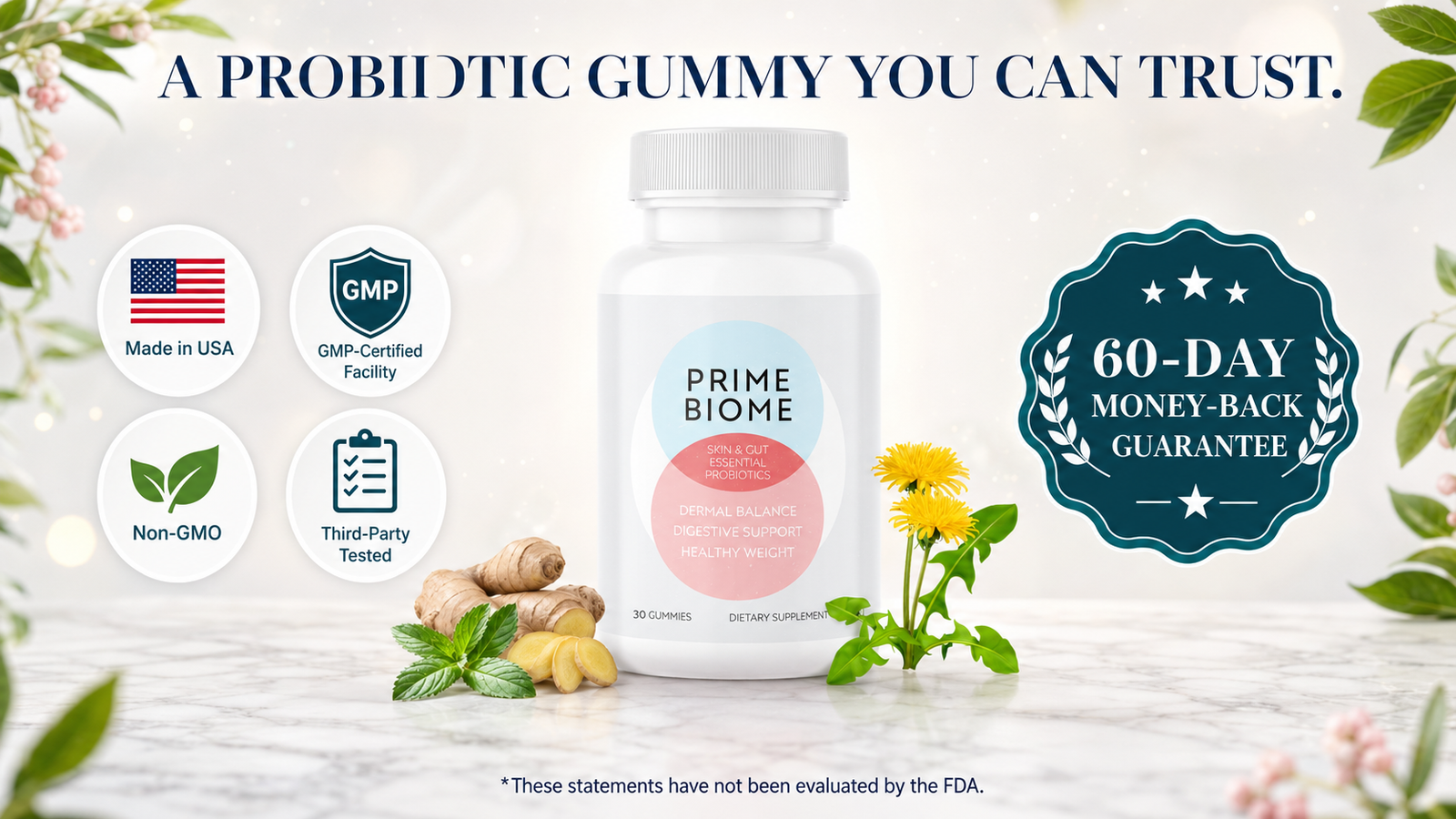
The official Prime Biome website shows the Supplement Facts panel. You can also inspect the physical bottle when it arrives. Under the 60-day money-back guarantee, if the label doesn’t match your expectations, you can return the product.
Bacillus coagulansInulinBabchiBakuchiolFennelLemon BalmCeylon GingerSlippery ElmDandelionFenugreekLion’s Mane
Gut microbiome supportDigestive comfortSkin-gut axisBotanical wellness
Gummy
Research & Transparency
- Salem I, Ramser A, Isham N, Ghannoum MA. The Gut Microbiome as a Major Regulator of the Gut-Skin Axis. Frontiers in Microbiology. 2018;9:1459. PMC5885811.
- National Institutes of Health, Office of Dietary Supplements. Probiotics — Fact Sheet for Health Professionals. ods.od.nih.gov.
- National Center for Complementary and Integrative Health (NCCIH). Probiotics: What You Need To Know. nccih.nih.gov.
- Dhillon SS et al. Efficacy of Bacillus coagulans in gastrointestinal health: a review of clinical trials. PubMed ID 28535163.
- Chaudhuri RK, Bojanowski K. Bakuchiol: a retinol-like functional compound revealed by gene expression profiling and clinically proven to have anti-aging effects. International Journal of Cosmetic Science. Bakuchiol dermatology review (Psoralea corylifolia).