
Finessa Ingredients: An Honest 8-Ingredient Deep Dive (2026)
This ingredients-only breakdown is a companion to our full Finessa review hub. We rate the panel 4.0/5 for transparency of the list but flag serious concerns about undisclosed doses and the inclusion of a stimulant laxative (Cascara Sagrada) that limits Finessa to short-term reset use, not daily long-term supplementation.
- Quick Answer: What’s Actually in Finessa?
- Digestive Powders: Evidence, Concerns & Trends
- The Full 8-Ingredient Panel
- Ingredient-by-Ingredient Deep Dive
- The Dose Problem — Read This Section
- The 3-Pillar Framework Explained
- What the Evidence Actually Shows
- How Finessa’s Formula Compares
- Who These Ingredients Fit — And Don’t
- FAQs
1. Quick Answer: What’s Actually in Finessa?
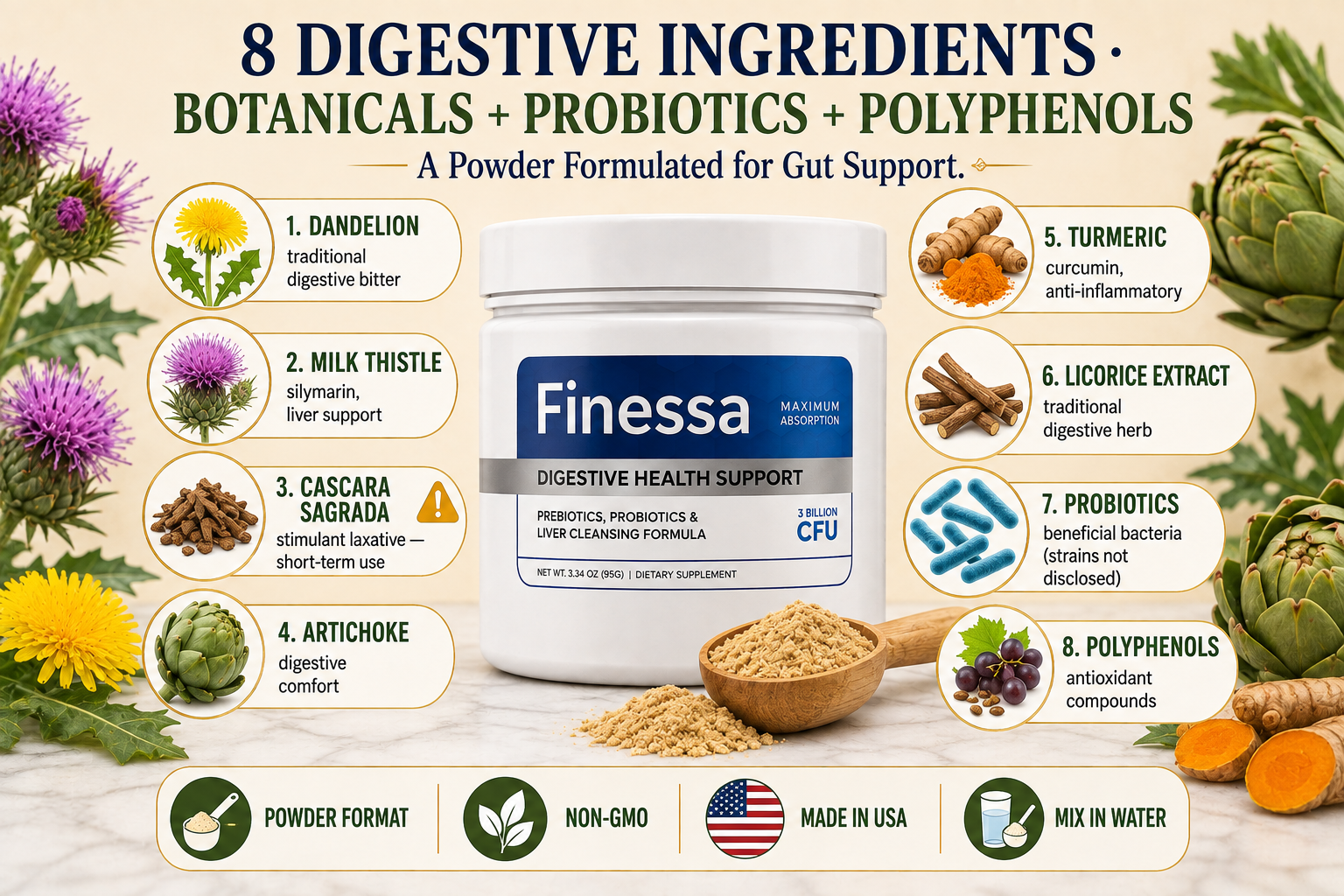
Finessa is a morning powder (one scoop mixed into water) built around eight ingredients: Dandelion, Milk Thistle, Cascara Sagrada, Artichoke, Turmeric, Licorice Extract, Probiotics, and Polyphenols. The formula is grouped by the maker around three pillars — digestive botanicals, liver & metabolic support, and microbiome support.
Amounts of every ingredient are undisclosed on the label material we reviewed at myfinessa.com. That is a significant transparency gap, especially for the stimulant laxative and probiotics (where strain and CFU count determine whether the product does anything at all).
| Ingredient | Pillar | Dose disclosed? |
|---|---|---|
| Dandelion | Digestive | No |
| Milk Thistle | Liver & Metabolic | No |
| Cascara Sagrada | Digestive | No Stimulant Laxative |
| Artichoke | Digestive | No |
| Turmeric | Liver & Metabolic | No |
| Licorice Extract | Liver & Metabolic | No |
| Probiotics | Microbiome | No (strain + CFU not shown) |
| Polyphenols | Microbiome | No (sources not shown) |
Read the Full Finessa Review →
Want the broader verdict, price tiers, and refund process? See our full Finessa review.
2. Digestive Powders: Evidence, Concerns & Trends
Before we grade any single Finessa ingredient, it helps to place the whole category in context. Digestive powders sit in a crowded, largely unregulated space where the science ranges from strong (silymarin for liver injury) to essentially traditional (dandelion “detox”). Four data points shape how we read Finessa:
| Trend / Data point | What it means for Finessa | Source |
|---|---|---|
| FDA 2002 final rule reclassified Cascara Sagrada (and aloe) as no longer generally recognized as safe/effective for OTC laxative use | Finessa’s use of Cascara is legal as a supplement, but the safety profile FDA flagged has not gone away | Federal Register, 20021 |
| ~16% of U.S. adults report chronic constipation; guidance emphasizes fiber, fluids and lifestyle before stimulant laxatives | Finessa is not the first-line NIDDK-style intervention; it’s a botanical short-term option | NIDDK6 |
| Silymarin (from milk thistle) has real, ongoing liver research; NCCIH notes benefits are still not conclusively proven for most conditions | Milk thistle inclusion is reasonable, but dose transparency matters | NCCIH3 |
| FDA CFSAN transparency guidance encourages clear labeling; proprietary blends without individual amounts remain a persistent industry concern | Finessa’s undisclosed amounts are common but still a downside | FDA CFSAN |
Where Finessa fits: It is a botanically-flavored, short-term “reset” product. It is not a replacement for daily fiber, medical management of chronic GI conditions, or evidence-based probiotics with named strains. Read as a short reset (a few weeks, not months), it earns its 4.0/5 ingredient score. Read as a daily long-term supplement, it does not.
3. The Full 8-Ingredient Panel
| Ingredient | Pillar | Category | Traditional / research use | Dose disclosed |
|---|---|---|---|---|
| Dandelion (Taraxacum) | Digestive Botanicals | Bitter herb | Mild diuretic, appetite/bile stimulant (traditional) | No |
| Milk Thistle (Silymarin) | Liver & Metabolic | Hepatoprotective botanical | Silymarin studied for liver support | No |
| Cascara Sagrada | Digestive Botanicals | Stimulant laxative (anthranoid) | Rapid laxative effect; FDA removed OTC status 2002 | No |
| Artichoke (Cynara Scolymus) | Digestive Botanicals | Bitter herb | Bile-flow support, dyspepsia (traditional) | No |
| Turmeric | Liver & Metabolic | Polyphenolic root | Curcumin, anti-inflammatory research | No |
| Licorice Extract | Liver & Metabolic | Traditional herb | GI soothing; potential BP/potassium concern | No |
| Probiotics | Microbiome | Live cultures | Strain-specific benefits | No (strain + CFU unknown) |
| Polyphenols | Microbiome | Umbrella category | Antioxidant/prebiotic-like effects | No (sources unknown) |
4. Ingredient-by-Ingredient Deep Dive
4.1 Dandelion (Taraxacum officinale)
What it is: The common dandelion, used as a bitter tonic in Western and TCM traditions.
Traditional / research use: Mild diuretic and appetite/bile stimulant. Modern clinical evidence is limited but the traditional-use case is long.
Safety profile: Generally well tolerated; use caution if on diuretics or lithium.
Why it’s here: Adds a bitter “digestive prime” note and a mild fluid-loss effect that some users perceive as “debloat.”
4.2 Milk Thistle / Silymarin
What it is: Silybum marianum, with the active flavonolignan complex silymarin.
Traditional / research use: The most-studied herb in this formula. NCCIH notes ongoing research for liver conditions, though benefits are not conclusively proven for most uses.3
Safety profile: Well tolerated; possible mild GI effects. Can interact with certain medications metabolized by CYP enzymes.
Why it’s here: Anchors the liver-support pillar. This is the strongest evidence-supported ingredient in Finessa.
4.3 Cascara Sagrada (Rhamnus purshiana) — the ingredient that defines Finessa
What it is: Bark of a Pacific Northwest buckthorn tree. Its active compounds are anthranoid glycosides (cascarosides), a class of stimulant laxatives.
FDA 2002 history: On May 9, 2002, the FDA issued a final rule reclassifying Cascara Sagrada and aloe laxative ingredients as “not generally recognized as safe and effective” for OTC use because manufacturers did not submit the required safety and effectiveness data.1 The ingredients did not vanish — they moved from the OTC drug category into the dietary supplement category, where labeling standards are lower.
Safety profile: LiverTox lists Cascara among anthranoid laxatives with rare but documented reports of liver injury with prolonged use.2 Chronic stimulant-laxative use is associated with dependence, electrolyte disturbance and colonic changes. It is not recommended for daily indefinite use, in pregnancy, in children, or in inflammatory bowel disease.
Why it’s here: It is the ingredient that gives Finessa its rapid “it worked overnight” effect. Users who feel a strong result within 24-48 hours are almost certainly feeling Cascara. That is exactly why we frame Finessa as short-term reset only.
4.4 Artichoke (Cynara scolymus)
What it is: Leaf extract of the globe artichoke, rich in cynarin.
Traditional / research use: Used for functional dyspepsia and to support bile flow. Small trials suggest symptom benefit for indigestion.
Safety profile: Well tolerated; avoid with bile-duct obstruction.
Why it’s here: Adds a second bitter/bile-flow mechanism that pairs with dandelion and complements liver-support botanicals.
4.5 Turmeric (Curcuma longa)
What it is: The rhizome, standardized (usually) for curcuminoids.
Traditional / research use: Anti-inflammatory and antioxidant research is extensive but curcumin is poorly absorbed on its own. NCCIH notes safety is generally good but bioavailability is a persistent hurdle.4
Safety profile: Well tolerated; can affect anticoagulant effect at higher doses.
Why it’s here: Anti-inflammatory support alongside milk thistle. Finessa does not disclose whether piperine (black pepper) or a bioavailability-enhanced form is used — a real limitation.
4.6 Licorice Extract (Glycyrrhiza glabra)
What it is: Root of licorice, containing glycyrrhizin.
Traditional / research use: GI-soothing (used in DGL form for reflux and gastritis).
Safety profile: Standard glycyrrhizin-containing licorice can raise blood pressure and lower potassium with prolonged use. This is the second reason Finessa is not a daily long-term supplement. Not for people on antihypertensives, digoxin, or with cardiovascular disease unless cleared by a clinician.
Why it’s here: Rounds out the liver & metabolic pillar with a soothing mucosal effect.
4.7 Probiotics
What it is: Live bacterial cultures. Benefits are strain-specific: what a study proves for Lactobacillus rhamnosus GG does not automatically apply to a different strain.
Traditional / research use: NIH ODS notes evidence varies widely by strain, CFU count and condition.5
Safety profile: Generally safe in healthy adults; caution in the severely immunocompromised.
Why it’s here: Anchors the microbiome pillar. But because Finessa does not disclose strain names or CFU count, it is impossible to compare this probiotic component to any published trial.
4.8 Polyphenols
What it is: An umbrella category (flavonoids, phenolic acids, stilbenes, lignans) rather than a single compound.
Traditional / research use: Antioxidant and prebiotic-like activity in the gut.
Safety profile: Broadly safe from dietary sources.
Why it’s here: Supports the microbiome pillar. Finessa does not disclose the source(s) (grape seed? green tea? apple? pomegranate?), which limits any specific claim.
5. The Dose Problem — Read This Section
Finessa lists eight ingredients but discloses zero individual amounts in the material we reviewed. In supplement science, dose is usually the whole story:
- Cascara Sagrada: stimulant-laxative dose determines whether the effect is mild bowel movement support or aggressive purgation with cramping and electrolyte loss. Not knowing the amount is a safety issue, not just a transparency one.
- Probiotics: without a strain name and CFU count (e.g., “Lactobacillus rhamnosus GG, 10 billion CFU”), the word “probiotics” on a label carries almost no clinical meaning.
- Licorice: glycyrrhizin content dictates cardiovascular risk. DGL (deglycyrrhizinated) is a different animal than standard extract — Finessa does not specify.
- Turmeric: without a bioavailability enhancer (piperine, phospholipid, nanoparticle), most oral curcumin is not absorbed. Finessa does not disclose the form.
- Milk thistle: silymarin standardization percentage matters; not disclosed.
Read the Full Finessa Review →
6. The 3-Pillar Framework Explained
The maker organizes Finessa’s eight ingredients around three pillars. This is a marketing scaffold, but it is a reasonable one for describing how the formula tries to work.
1. Digestive Botanicals
Dandelion · Cascara Sagrada · Artichoke
Bitters plus one stimulant laxative. Aims for a rapid “cleanse” feeling. Also the source of Finessa’s short-term-use ceiling.
2. Liver & Metabolic Support
Milk Thistle · Turmeric · Licorice
Hepatoprotective and anti-inflammatory botanicals. Silymarin is the strongest evidence card in the deck; licorice adds risk to weigh.
3. Microbiome Support
Probiotics · Polyphenols
Live cultures plus polyphenol substrates. In principle sensible; in Finessa the lack of strain / source disclosure limits how much you can trust it.
7. What the Evidence Actually Shows
Read honestly, ingredient by ingredient:
- Dandelion & artichoke: largely traditional-use botanicals with modest supportive human data.
- Milk thistle / silymarin: real, ongoing liver research; the standout ingredient. NCCIH still classes benefits as not conclusively proven for most conditions.3
- Turmeric: anti-inflammatory research is deep, but oral bioavailability without piperine or an enhanced form is low. Undisclosed here.
- Licorice: works as a mucosal soother; carries BP/potassium risk with chronic use.
- Probiotics: only meaningful when strain and CFU are known. Not disclosed here.
- Polyphenols: broadly beneficial in diet; specific source not disclosed here.
- Cascara Sagrada: it works because it is a stimulant laxative. Any user testimonial along the lines of “I felt it work in a day” is Cascara doing exactly what a stimulant laxative does. That is not a knock — it is why it is in there. It is also why Finessa is not for daily long-term use.
8. How Finessa’s Formula Compares
| Product | Primary mechanism | Daily long-term OK? | Best use |
|---|---|---|---|
| Finessa | Botanical blend + stimulant laxative + probiotics | No — short-term reset only | Short “reset” window with rapid perceptible effect |
| Psyllium fiber (generic) | Soluble fiber (single mechanism) | Yes | Gentle daily support; slower but sustainable |
| Metamucil | Bulk-forming psyllium fiber; no stimulant | Yes | Standard daily fiber supplementation |
| Colon Broom | Fiber-only (psyllium-based) | Yes | Flavored daily fiber alternative |
Finessa is faster to feel than any fiber-only competitor because of Cascara. But it is less appropriate for daily use than any of the fiber-based options for exactly the same reason.
9. Who These Ingredients Fit — And Don’t
- Adult using it as a short-term reset (a few weeks, not months)
- No cardiac, kidney or liver conditions
- Not on diuretics, digoxin, blood thinners, or antihypertensives
- Not pregnant or breastfeeding
- Comfortable with a morning powder-in-water routine
- Need daily long-term digestive support (choose fiber-based instead)
- Have IBD, IBS-D, heart disease, kidney disease, or active liver disease
- Take diuretics, digoxin, antihypertensives, or medications with narrow therapeutic index
- Are pregnant, breastfeeding, or under 18
- Want a probiotic you can trace to published strain-specific research
10. FAQs
Cascara Sagrada is a stimulant laxative. It gives the formula its rapid, perceptible “it worked” effect within 24-48 hours. That is also why Finessa is best framed as a short-term reset rather than a daily long-term supplement.
The dose is not disclosed on the material we reviewed. This matters because stimulant-laxative dose determines the difference between gentle and aggressive effect. Check the current physical bottle label before purchase.
No. The label material we reviewed lists “Probiotics” as an umbrella term without specifying strains (e.g., Lactobacillus rhamnosus GG) or CFU count. Without that information the probiotic component cannot be mapped to any published clinical trial.
Plain curcumin from turmeric is poorly absorbed orally. Formulas that pair it with piperine (black pepper), phospholipids, or use nano-enhanced forms achieve much higher blood levels. Finessa does not disclose which form of turmeric it uses.
Silymarin is the flavonolignan complex from milk thistle seed, containing silybin, silydianin and silychristin. It is the most-studied component of the formula and the reason milk thistle is used for liver support.3
No — we don’t recommend it. Two ingredients drive this: Cascara Sagrada (stimulant laxative, associated with dependence and electrolyte issues with chronic use)1,2 and standard licorice extract (BP and potassium concerns with prolonged use). Use Finessa as a short reset; use fiber-based options for daily long-term support.
Ready to Check Finessa’s Current Label & Pricing?
180-day money-back guarantee · Best price is the official site · Read our full Finessa review hub before ordering.
Research & Transparency
- U.S. Food and Drug Administration. Final Rule: Status of Certain Additional Over-the-Counter Drug Category II and III Active Ingredients. Federal Register, May 9, 2002. Cascara Sagrada and aloe laxative ingredients reclassified as no longer GRASE for OTC use.
- LiverTox: Clinical and Research Information on Drug-Induced Liver Injury. Cascara Sagrada. National Institute of Diabetes and Digestive and Kidney Diseases. NBK548159.
- National Center for Complementary and Integrative Health. Milk Thistle. nccih.nih.gov
- National Center for Complementary and Integrative Health. Turmeric. nccih.nih.gov
- NIH Office of Dietary Supplements. Probiotics — Fact Sheet for Health Professionals. ods.od.nih.gov
- National Institute of Diabetes and Digestive and Kidney Diseases. Constipation — Symptoms, Causes, Treatment. niddk.nih.gov