
Written by: Malkiat Singh
Published: June 14, 2026 | Last Updated: June 14, 2026
⏱️ 8 min read | ✓ Editorially Reviewed | ⓘ Affiliate Disclosure
Home » Ingredients » Ashwagandha
Ashwagandha is the best-evidenced single herb in the men’s-health toolkit — especially for stress, sleep, and a modest lift in testosterone. Here’s the honest rundown on what it does, how to dose it, and who should be careful.
What Is Ashwagandha?
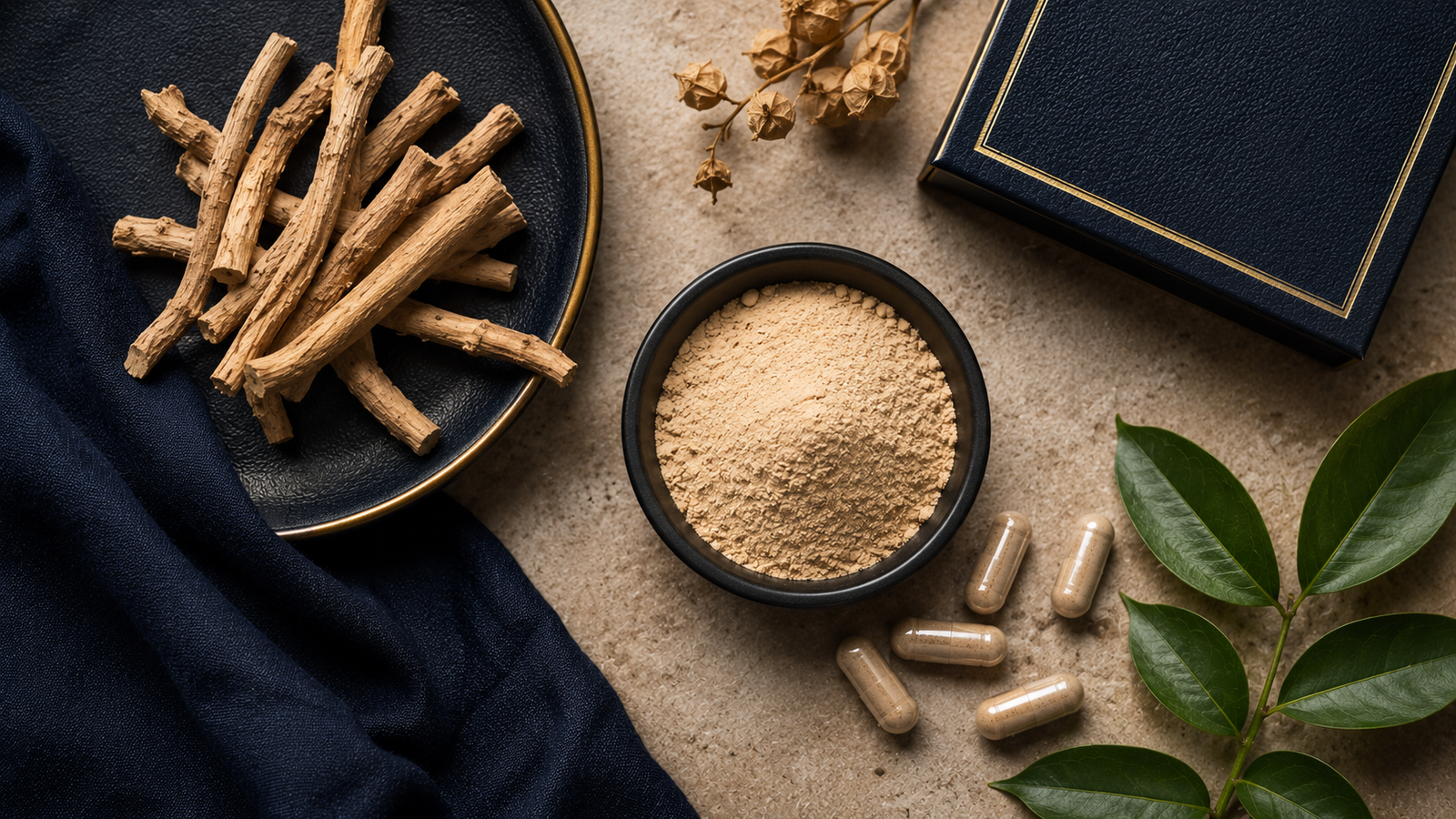
Ashwagandha (Withania somnifera), sometimes called Indian ginseng or winter cherry, is a small shrub whose root has been central to Ayurvedic medicine for thousands of years. It is classified as an adaptogen — a plant traditionally used to help the body cope with stress. Of all the botanicals marketed for men’s health, ashwagandha arguably has the strongest and most consistent base of modern human research, which is why it appears in everything from testosterone formulas to sleep aids.
The active compounds are a group of naturally occurring steroidal lactones called withanolides. As with most herbs, the concentration of withanolides varies between products, which is why standardized extracts — most commonly the branded forms KSM-66 and Sensoril — are preferred in research and in quality supplements.
How Ashwagandha Works
Ashwagandha’s headline mechanism is its effect on cortisol, the body’s main stress hormone. By helping to lower chronically elevated cortisol, it can ease the physical and mental toll of stress — and because cortisol and testosterone are biological opposites, calming cortisol can indirectly create a more favorable hormonal environment. This is the link between its stress benefits and its modest effects on testosterone.
It is also thought to support the nervous system and sleep quality, which matters more than people realize: poor sleep itself lowers testosterone and worsens mood, so an ingredient that improves both stress and sleep can have knock-on benefits across men’s health.
What the Research Actually Shows
The evidence here is genuinely good by supplement standards. Controlled trials have shown that standardized ashwagandha extracts can meaningfully reduce stress and cortisol in adults under chronic stress. [1] In resistance-training men, an eight-week trial found that ashwagandha supplementation was associated with greater gains in muscle strength and size and a rise in testosterone compared with placebo. [2]
The honest caveats: the testosterone effect is modest and most evident in men under stress or training hard, not a dramatic boost in everyone; and study results vary with the extract and dose used. Still, for stress, sleep, and a gentle hormonal assist, ashwagandha is one of the few ingredients where the research and the marketing roughly line up.
Potential Benefits
- Reduces stress and cortisol — its best-supported benefit.
- Supports sleep quality, which itself benefits testosterone and mood.
- May modestly support testosterone and muscle, particularly in stressed or training men.
- May support mood and a sense of well-being as a downstream effect of lower stress.
How Much to Take (Dosage)
Most research uses a standardized extract at roughly 300 to 600 mg per day, often split into two doses or taken in the evening to support sleep. Branded standardized extracts such as KSM-66 (typically standardized to a higher withanolide content from the root) and Sensoril are the forms most commonly studied, so matching the dose to a recognized standardized extract is more meaningful than the raw milligram figure on a generic product.
Like other adaptogens, ashwagandha works best with consistent daily use over several weeks rather than as a one-off, so give it a fair trial of at least a month or two.
Safety and Side Effects
Ashwagandha is generally well tolerated. The most common side effects are mild — stomach upset, loose stools, or drowsiness, the last of which is sometimes a welcome effect at night. Because it can be mildly sedating, some people prefer to take it in the evening.
Two cautions deserve emphasis. First, there have been rare reports of liver injury associated with ashwagandha supplements, so it is wise to avoid it if you have liver disease and to stop and seek advice if you notice symptoms like unusual fatigue, dark urine, or yellowing skin. Second, it may increase thyroid hormone levels, which can be a problem for people with thyroid conditions.
Who Should Avoid It
Check with your doctor before taking ashwagandha if you have a thyroid condition, an autoimmune disease (such as rheumatoid arthritis, lupus, or type 1 diabetes), or liver problems, or if you take sedatives, thyroid medication, or immunosuppressants. It is not recommended during pregnancy or breastfeeding. As always, if you are using it hoping to address a specific health issue, a conversation with a healthcare provider beats guesswork.
How to Choose a Quality Ashwagandha
- Choose a standardized extract — KSM-66 or Sensoril are the most researched, with a stated withanolide percentage.
- Look for third-party testing for purity and to confirm the label.
- Match the studied dose — around 300–600 mg per day of a standardized extract.
- Decide timing by goal — evening for sleep and stress, split doses for all-day support.
KSM-66 vs Sensoril: Which Extract?
The two extracts you will see most often are branded and standardized, but they are tuned differently. KSM-66 is a root-only extract standardized to a higher withanolide content and is the form used in much of the testosterone, strength, and stress research — it is often favored for daytime use and physical-performance goals. Sensoril is drawn from root and leaf with an even higher withanolide concentration and is frequently associated with stress relief and a more calming, sometimes sedating profile, which can suit evening use. Neither is universally “better”; the right pick depends on your goal. What matters most is that you are getting a standardized, named extract at a studied dose rather than an unbranded powder of unknown potency.
Beyond Hormones: Sleep, Mood, and Recovery
It is a mistake to think of ashwagandha purely as a “testosterone” ingredient. Its most reliable, best-documented benefits are on stress and sleep — and those matter enormously for men’s health on their own. Better sleep supports testosterone, recovery, and concentration; lower stress improves mood and reduces the cortisol that works against muscle and libido. Some men take ashwagandha with no interest in hormones at all, simply for calmer evenings and deeper sleep. Viewed this way, even if the testosterone bump is modest, the stress-and-sleep benefits can produce real downstream improvements in how you feel and perform — which is part of why it remains the most popular adaptogen in men’s wellness.
Frequently Asked Questions
Can I take ashwagandha with other supplements?
It generally combines well with ingredients like Tongkat Ali, zinc, and magnesium, which is why they often appear together in formulas. Be more cautious combining it with sedatives or other calming supplements, since the effects can add up, and check interactions if you take medication.
Does ashwagandha boost testosterone?
It can modestly support testosterone, with the clearest effects in men who are stressed or training hard. Its strongest and most consistent benefit is reducing stress and cortisol.
When should I take it — morning or night?
Either works. Many men take it in the evening because it can be mildly calming and supports sleep; split dosing works for all-day stress support.
Is ashwagandha safe long-term?
It is generally well tolerated, but long-term data is limited and rare liver-injury reports exist. Use a standardized, third-party-tested product, and avoid it if you have thyroid, autoimmune, or liver conditions without medical advice.
Related Reading
Sources
- Lopresti AL, Smith SJ, Malvi H, Kodgule R. (2019). An investigation into the stress-relieving and pharmacological actions of an ashwagandha (Withania somnifera) extract. Medicine, 98(37):e17186. PubMed
- Wankhede S, Langade D, Joshi K, et al. (2015). Examining the effect of Withania somnifera supplementation on muscle strength and recovery: a randomized controlled trial. Journal of the International Society of Sports Nutrition, 12:43. PubMed