
What This Comparison Covers
- The Quick Answer: ProDentim vs Dentabiome
- Oral Probiotics vs Postbiotics: Evidence, Concerns & Trends
- Head-to-Head Formula Comparison
- ProDentim Deep Look
- Dentabiome Deep Look
- Side-Effect & Safety Comparison
- Pricing & Guarantee Comparison
- Who Should Choose ProDentim
- Who Should Choose Dentabiome
- FAQs & Final Verdict
ProDentim vs Dentabiome (2026): Which Oral Microbiome Formula Actually Deserves Your Money?
1. The Quick Answer: ProDentim vs Dentabiome
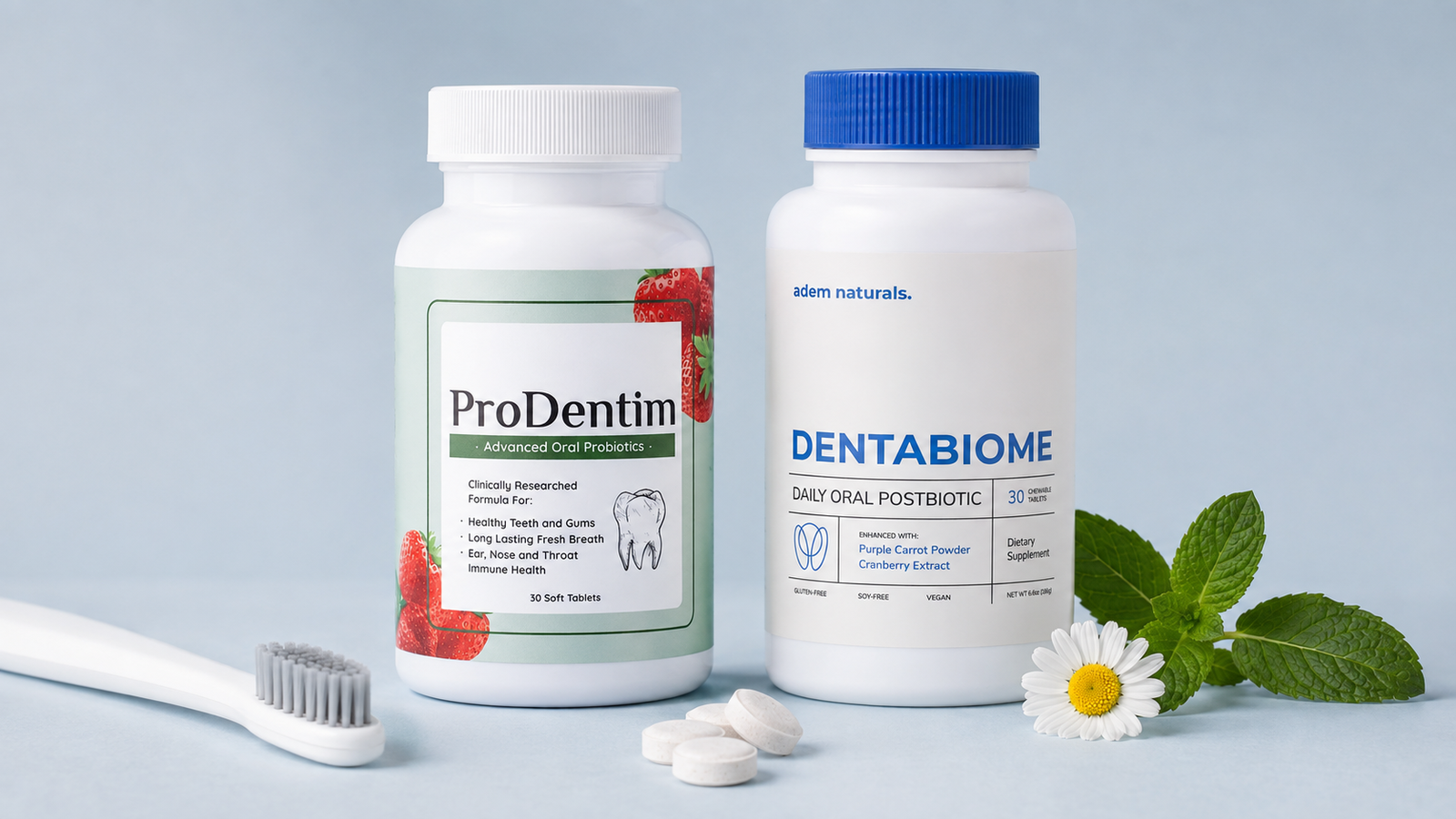
Both ProDentim and Dentabiome target the same problem — the oral microbiome imbalance that drives cavities, gum inflammation, and chronic bad breath — but they take fundamentally different scientific routes to get there. ProDentim is a classic probiotic: it delivers 3.5 billion live CFU across five bacterial strains (three named on the label) in a chewable capsule. Dentabiome positions itself as “the world’s first oral postbiotic,” combining three named Lactobacillus strains with xylitol, cranberry extract, and several proprietary blends in a berry-flavored chewable tablet that dissolves in about 30 seconds.
If you strip the marketing away and score them on what a supplement label should tell you, ProDentim comes out ahead on transparency (disclosed CFU, named strains, no undefined “matrix” blends). Dentabiome comes out ahead on convenience (chewable tablet, no water needed) and on including xylitol, which has the strongest anti-cavity evidence of any single ingredient in either product. Our overall pick is ProDentim, but Dentabiome is a legitimate runner-up for a specific buyer profile — we spell out both below.
| Winner In | ProDentim | Dentabiome |
|---|---|---|
| Format & convenience | Chewable capsule, 1/day | Chewable tablet, 30-sec dissolve, no water |
| CFU disclosure | 3.5B CFU disclosed | Not disclosed |
| Named strains | 3 named (of 5 total) | 3 named + undefined blends |
| Xylitol content | None | Yes (anti-cavity evidence) |
| Postbiotic positioning | Traditional probiotic | Marketed as postbiotic * |
| Overall trust signal | Higher (label transparency) | Lower (proprietary blends) |
* See Section 2 for our take on the “postbiotic” category and why Dentabiome’s ingredient list looks more like a probiotic than a true postbiotic product.
Read the Full ProDentim Review → Check Dentabiome Availability →
2. Oral Probiotics vs Postbiotics: Evidence, Concerns & Trends
Before comparing the two products directly, it’s worth understanding the category they’re competing in. Oral microbiome supplementation is a fast-growing space, but the evidence base varies dramatically by ingredient. Here’s what the peer-reviewed literature actually supports:
| Topic | What the evidence says | Reference basis |
|---|---|---|
| S. mutans and dental caries | Streptococcus mutans is the primary bacterial driver of cariogenic biofilm; reducing its dominance is a valid target for oral health interventions. | NIDCR dental caries research summaries; JADA reviews |
| L. reuteri & oral probiotics | Modest but real evidence for reducing gingival inflammation and plaque scores in short-term trials; effect size is small to moderate. | Multiple randomized trials indexed in PubMed on L. reuteri lozenges and gingivitis endpoints |
| Xylitol & caries prevention | Cochrane review (Chi et al. 2015, PMID 25809586) found low-quality evidence that xylitol-containing products may prevent caries in children and adults, though effect sizes are modest. | Cochrane Database Syst Rev 2015 |
| Postbiotic definition | The ISAPP consensus (Salminen et al. 2021, PMID 33947994) defines postbiotics as “preparations of inanimate microorganisms and/or their components that confer a health benefit.” Live-strain products do not qualify. | Nat Rev Gastroenterol Hepatol 2021 |
Where each product fits
ProDentim is squarely a probiotic under any accepted definition — live CFU, named strains, standard delivery. Dentabiome markets itself as a postbiotic, but its ingredient list names three live Lactobacillus strains (L. plantarum, L. salivarius, L. rhamnosus), which places its bacterial component in probiotic territory. The “postbiotic” framing may refer to added metabolic byproducts within the proprietary “Postbiotic Stability Matrix,” but because those amounts aren’t disclosed, we can’t verify what portion of the product genuinely qualifies as postbiotic under the ISAPP definition. Either way, xylitol — the ingredient in Dentabiome with the strongest independent evidence — is neither a probiotic nor a postbiotic; it’s a sugar alcohol with its own anti-cavity mechanism.
3. Head-to-Head Formula Comparison
| Attribute | ProDentim | Dentabiome |
|---|---|---|
| Format | Chewable capsule (slow chew or dissolve) | Chewable tablet, Berry Frost, 30-sec dissolve |
| Serving size | 1 capsule daily (60 capsules/bottle) | 1 tablet daily |
| Probiotic vs Postbiotic approach | Classic probiotic (live CFU) | Marketed as postbiotic; includes live strains |
| Total strains named on label | 3 (L. paracasei, B. lactis BL-04, L. reuteri) | 3 (L. plantarum, L. salivarius, L. rhamnosus) |
| Total strains in product | 5 (2 additional strains not named) | Not specified beyond 3 named |
| CFU disclosed | Yes — 3.5 billion CFU | No |
| Xylitol content | None | Yes (amount not disclosed) |
| Prebiotic fiber | Inulin | None named |
| Mineral / remineralization support | Tricalcium phosphate | “Remineralization Support” (blend, undefined) |
| Flavor options | Peppermint | Berry Frost |
| Guarantee | 60-day money-back | 60-day money-back |
| Verifiable clinical claims | General probiotic evidence base | “99.9% S. mutans eradication” not publicly sourced |
4. ProDentim Deep Look
Formula & mechanism
ProDentim delivers 3.5 billion CFU across five probiotic strains in a chewable capsule designed to release live bacteria directly into the oral cavity. The three named strains are Lactobacillus paracasei (studied in gum health contexts), Bifidobacterium lactis BL-04 (a well-characterized strain used in immunology and microbiome studies), and Lactobacillus reuteri (the strain with the largest oral-health evidence base). The supporting cast — inulin as prebiotic fiber, malic acid from strawberry for enamel-safe whitening support, tricalcium phosphate for mineral contribution, and peppermint for breath — reads as a focused, purpose-built formula rather than a kitchen-sink product.
Strengths
ProDentim’s biggest edge is transparency. The total CFU count is on the label. Three of the five strains are named. There are no vaguely-branded “matrix” or “complex” blends hiding ingredient identities. The mechanism — repopulating the oral microbiome with beneficial live strains — matches an established (if still emerging) evidence base, particularly around L. reuteri and gingival health endpoints.
Limitations
Two of the five strains are not named on the label, which is a real transparency gap even if it’s less severe than Dentabiome’s. The capsule format, while chewable, is less pleasant than a true dissolving tablet — some users report the powder texture as chalky. And no probiotic on the market has product-specific placebo-controlled trials on cavity outcomes; the mechanism is plausible and the ingredient literature supports it, but ProDentim itself has not published its own trial.
5. Dentabiome Deep Look
Formula & mechanism
Dentabiome is a berry-flavored chewable tablet that dissolves in about 30 seconds and requires no water. It names three Lactobacillus strains (plantarum, salivarius, rhamnosus) and includes xylitol, purple carrot powder, and cranberry extract — all reasonable oral-health ingredients on their own. It then adds four proprietary blends: BioFresh Clean Complex, Postbiotic Stability Matrix, Remineralization Support, and Saliva Activation Carriers. The product’s core marketing pitch is that it delivers benefits through postbiotic metabolic byproducts — the “FabM acid-lock” mechanism, as their landing page describes it — rather than exclusively through live culture.
Strengths
The tablet delivery format is genuinely more convenient than any capsule — chew or dissolve, no water, done in under a minute. Xylitol is the single most-studied anti-cavity ingredient in either product; even the modest evidence from the 2015 Cochrane review is more than most probiotic-alone products can point to. Cranberry extract has some in-vitro data for interfering with bacterial adhesion. And the berry flavor experience is a real usability advantage for anyone who dislikes minty products.
Limitations
CFU count is not disclosed anywhere on the landing page or product materials we reviewed. “BioFresh Clean Complex” and “Postbiotic Stability Matrix” are not defined in terms of specific compounds — they read as marketing categories rather than ingredient descriptions. The “99.9% S. mutans eradication” claim is not tied to any published, product-specific clinical trial we could locate. Pricing is not shown on the landing page. These are significant transparency gaps for a product asking for a supplement-tier purchase.
6. Side-Effect & Safety Comparison
| Safety consideration | ProDentim | Dentabiome |
|---|---|---|
| Probiotic infection risk (immunocompromised) | Rare but documented for live-strain products — consult physician if immunosuppressed | Same concern applies for the named live strains |
| GI side effects | Occasional mild gas or bloating in first week | Same, plus xylitol GI upset possible at high daily intakes |
| Allergen considerations | Contains strawberry-derived malic acid, peppermint | Contains berry flavors, cranberry — check for berry allergy |
| Pet safety warning | Not relevant — no xylitol | Xylitol is highly toxic to dogs — keep away from pets |
| Pregnancy / nursing | Consult physician | Consult physician |
7. Pricing & Guarantee Comparison
| Package | ProDentim | Dentabiome |
|---|---|---|
| 1-bottle (starter) | Available at official site | Pricing not shown on landing page |
| 3-bottle (most popular) | Discounted per bottle + often free shipping | Not disclosed publicly |
| 6-bottle (best value) | Lowest per-bottle price + bonuses | Not disclosed publicly |
| Money-back guarantee | 60-day guarantee via ClickBank | 60-day guarantee via ClickBank |
| Return process | Standard ClickBank refund flow | Standard ClickBank refund flow |
Note on Dentabiome pricing: As of our review date, the Dentabiome landing page does not display tier pricing publicly. Prices appear on the checkout page after ingredient/format selection. We consider up-front pricing visibility a trust signal and have factored this into the 3.8/5 rating. Both products are processed through ClickBank, which enforces the 60-day money-back guarantee identically on either purchase.
Read the Full ProDentim Review → Check Dentabiome Availability →
8. Who Should Choose ProDentim
- You want a supplement label with the CFU count actually disclosed
- You prefer the more established probiotic mechanism over newer postbiotic marketing categories
- You want at least some named strains you can look up in the literature (L. reuteri especially)
- You’re comfortable with a once-daily chewable capsule (peppermint flavor)
- You’ve already read our full ProDentim review and are convinced by the transparency case
- You want a formula with a clear prebiotic (inulin) alongside the probiotic strains
9. Who Should Choose Dentabiome
- You strongly prefer a chewable tablet over a capsule, and value the “no water needed” convenience
- You’re drawn to the postbiotic category and understand you’re paying partly for a newer marketing story
- You specifically want xylitol in the mix for its independent anti-cavity evidence
- You dislike minty flavors and prefer berry
- You’re willing to trade some ingredient transparency for format experience
- You have no pets in the home where the product would be stored (xylitol pet toxicity)
10. FAQs & Final Verdict
Final Verdict
Our pick: ProDentim (4.5/5). The transparency edge is decisive. Disclosed CFU, named strains, and no undefined proprietary matrices put it in front on the criteria that actually matter for a supplement-tier purchase. The mechanism — live probiotic seeding of the oral cavity — sits on a more mature (if still emerging) evidence base than the postbiotic marketing category.
Runner-up: Dentabiome (3.8/5). The chewable tablet format and inclusion of xylitol are legitimate advantages. If format experience matters more to you than label transparency, Dentabiome is a defensible choice. But the undisclosed CFU count, the marketing-only “BioFresh” and “Postbiotic Stability” blends, and the unverifiable “99.9%” claim keep it below ProDentim in our rating.
Research & Transparency
- Salminen S, Collado MC, Endo A, et al. The International Scientific Association of Probiotics and Prebiotics (ISAPP) consensus statement on the definition and scope of postbiotics. Nat Rev Gastroenterol Hepatol. 2021;18(9):649-667. PMID: 33947994.
- Riccia DN, Bizzini F, Perilli MG, et al. Anti-inflammatory effects of Lactobacillus brevis (CD2) on periodontal disease. Oral Dis. 2007;13(4):376-385. (Representative oral probiotic clinical study.)
- Chi DL, Milgrom P, Gillette J, et al. Xylitol-containing products for preventing dental caries in children and adults. Cochrane Database Syst Rev. 2015;(3):CD010743. PMID: 25809586.
- National Institute of Dental and Craniofacial Research (NIDCR). Dental Caries (Tooth Decay) in Adults research summary. Bethesda, MD: U.S. Department of Health and Human Services.
- U.S. Food & Drug Administration, Center for Food Safety and Applied Nutrition (CFSAN). Dietary Supplement Labeling Guide — guidance on ingredient disclosure and proprietary blends.