
A label-first analysis of the current Prostadine liquid — four seaweeds, added iodine, saw palmetto, pomegranate, neem and shilajit — and where the marketing outruns the evidence.
Iodine safety flagged
No finished-product proof claimed
Independent-publisher and affiliate disclosure: Men’s Health Authority is not the manufacturer, seller or official Prostadine website. This supporting article contains an affiliate link. If you purchase through a qualifying link, we may earn a commission at no additional cost to you. That does not alter our ingredient conclusions.
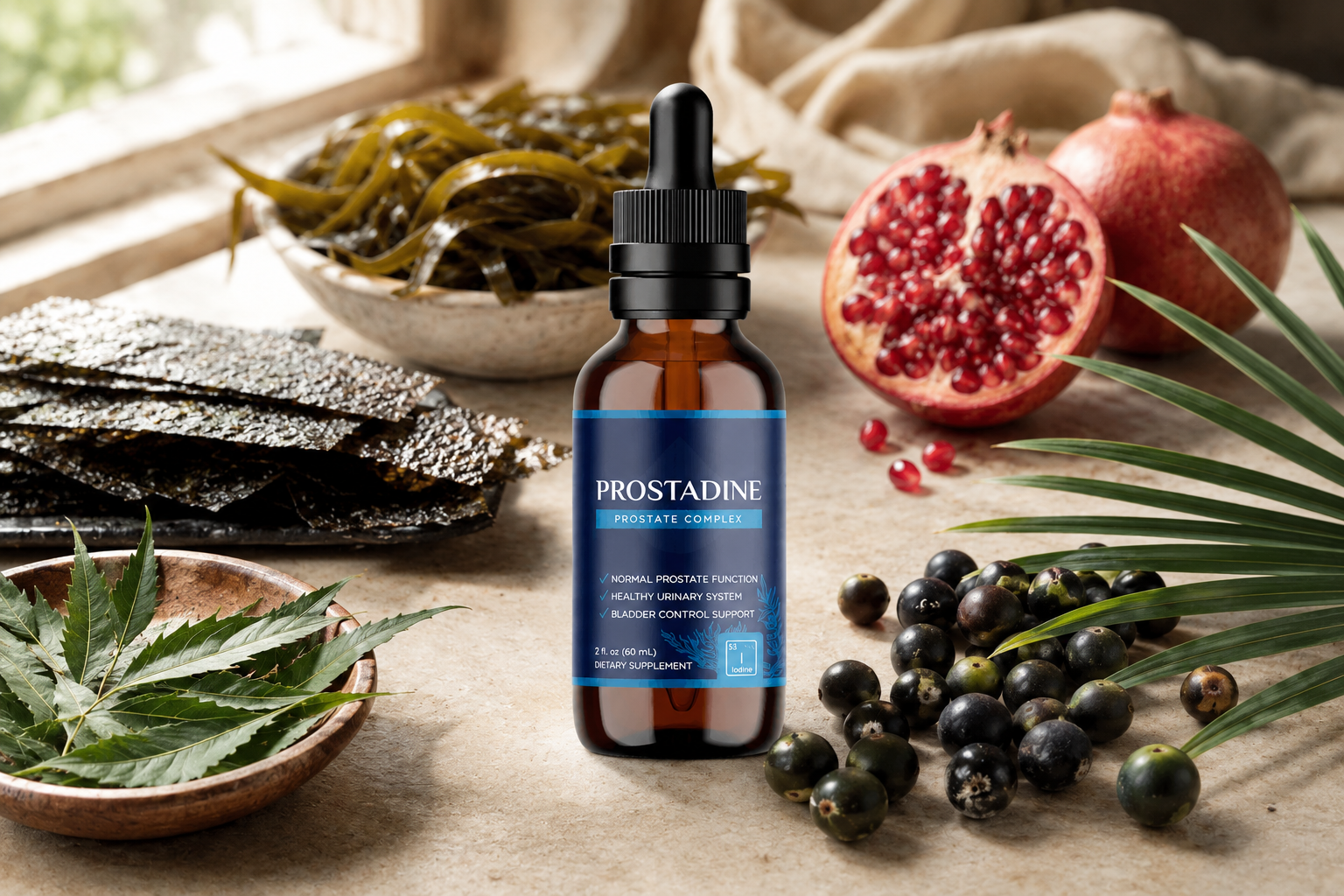
Short answer: The current Prostadine label lists nine ingredients — nori yaki, wakame, kelp, bladderwrack, saw palmetto, pomegranate, iodine, neem and shilajit — in a liquid dropper delivering approximately 2 mL once daily. No individual per-ingredient amounts are disclosed, including total iodine per dropper, which is the most safety-relevant number in the formula. Saw palmetto has the most direct BPH research of any listed ingredient, but Cochrane-quality trials have not supported strong effectiveness claims, and no clinical trial of the complete Prostadine liquid has been published.
Prostadine formula summary
| Product form | Liquid drops in a 60 mL dropper bottle |
|---|---|
| Serving listed by seller | Approximately 2 mL (two full droppers) once daily; 30 servings per bottle |
| Main ingredient groups | Four seaweeds, saw palmetto, pomegranate, added iodine, neem, shilajit |
| Most prostate-relevant listed botanical | Saw palmetto, based on ingredient-specific BPH research |
| Largest transparency limitation | No per-ingredient amounts; total iodine per dropper not disclosed |
| Finished-product clinical trial | We did not identify a published randomized clinical trial of the exact current formula |
Current Prostadine ingredients
The list below comes from the seller-hosted materials checked on . Formulas can change, so compare against the label on the bottle you receive.
| Ingredient | Listed amount | Evidence relevance |
|---|---|---|
| Nori Yaki Extract Powder | Not disclosed | Nori seaweed; contributes iodine |
| Wakame Extract (Undaria pinnatifida) | Not disclosed | Brown seaweed; contributes iodine |
| Kelp Powder | Not disclosed | Brown seaweed; highly variable iodine content in commercial products |
| Bladderwrack Powder (Fucus vesiculosus) | Not disclosed | Brown seaweed; contributes iodine; potential heavy-metal accumulation from harvest source |
| Saw Palmetto (Serenoa repens) | Not disclosed | Most-studied herbal for BPH — mixed higher-quality evidence |
| Pomegranate Extract (Punica granatum) | Not disclosed | PSA-related research in cancer survivors; not established for BPH |
| Iodine (added mineral) | Not disclosed | Essential mineral; upper limit 1,100 mcg/day adults from all sources |
| Neem (Azadirachta indica) | Not disclosed | Traditional use in dental and antimicrobial contexts; not prostate-specific |
| Shilajit | Not disclosed | Some testosterone/vitality research; not established for BPH |
Label-verification limit: We reviewed seller-hosted materials but have not authenticated a physical bottle or laboratory tested the liquid. No per-ingredient amount is disclosed, which prevents dose-specific efficacy or safety assessment for any single component.
How we evaluated the Prostadine ingredient list
We separated three questions:
- What does the seller list? Establishes the marketed formula.
- What has been studied independently? Ingredient research may show plausibility or safety questions.
- Has the exact finished product been tested? Necessary before calling the complete formula clinically proven.
We did not identify a published randomized clinical trial of the exact current Prostadine liquid. Ingredient studies therefore cannot establish product-specific effectiveness, side-effect frequency or expected timeline.
Seaweed and iodine evidence
The four seaweeds combined
Nori, wakame, kelp and bladderwrack contribute iodine, trace minerals and fibre. Edible seaweeds have long culinary history at food-level intake. There is no strong clinical evidence that any of these seaweeds reduce prostate size, improve urinary flow or treat BPH.
Added iodine (separate ingredient)
The NIH Office of Dietary Supplements sets the adult Tolerable Upper Intake Level for iodine at 1,100 mcg per day from all sources.[1] Combining added iodine with four seaweeds creates a compound-exposure question that the undisclosed dose cannot answer.
Variable seaweed iodine content
Independent testing has shown that commercial kelp products can contain highly variable iodine — sometimes many times the recommended daily intake per serving. This makes an undisclosed-dose seaweed formula the least predictable iodine source in the supplement category.
Heavy-metal considerations
Brown seaweeds can concentrate small amounts of arsenic or other heavy metals depending on harvest source. Independent batch testing for iodine content and heavy-metal levels for the current Prostadine batch was not reviewed.
Saw palmetto, pomegranate, neem and shilajit evidence
Saw palmetto — the most prostate-relevant ingredient
A Cochrane systematic review of Serenoa repens for BPH concluded that saw palmetto did not significantly improve urinary symptom scores compared with placebo in double-blind studies, even at higher doses.[2] Some earlier open-label research suggested modest benefits, but higher-quality controlled evidence is disappointing. The Prostadine saw palmetto amount is not disclosed and cannot be compared with the ~320 mg/day used in trials.
Pomegranate
A small phase II study reported pomegranate juice was associated with a longer PSA doubling time in men with rising PSA after cancer treatment.[3] A later randomized trial did not confirm meaningful benefit over placebo.[4] Neither study evaluated Prostadine or concerned BPH symptoms.
Neem
Traditional uses in dental, skin and antimicrobial contexts. Human clinical evidence specific to prostate symptoms is limited. Long-term safety data for concentrated neem preparations is not well established, and some case reports have linked concentrated neem with rare hepatotoxicity.[5]
Shilajit
Small studies have examined shilajit for testosterone or male-vitality outcomes, but sample sizes are limited and results depend on the specific extract. Traditional-use profile does not establish a proven BPH or urinary benefit. Purified vs unpurified shilajit varies substantially in heavy-metal content.
Does the complete formula have strong prostate evidence?
No product-specific clinical proof was identified. Saw palmetto has extensive BPH research that mostly does not support strong effectiveness claims. Pomegranate has interesting but conflicting PSA-related research in cancer survivors. The other ingredients either lack prostate-specific evidence (nori, wakame, kelp, bladderwrack, neem, shilajit) or contribute mineral load without a proven mechanism (added iodine).
Evidence hierarchy: A seller label can establish what is marketed. Ingredient studies can suggest plausibility or safety concerns. Only a well-designed trial of the exact finished formula can establish product-specific effectiveness — and none was identified for the current Prostadine liquid.
This is not a formula built around the strongest BPH evidence. Persistent urinary symptoms deserve medical assessment because BPH is only one possible cause; infection, medication effects, bladder disorders, diabetes, neurological disease and prostate cancer can also produce urinary changes.
How transparent is the Prostadine formula?
The seller names nine ingredients but discloses no individual amounts. This is more limited transparency than most competing supplements. Specific limitations:
- Per-ingredient amounts are not disclosed for any of the nine components
- Total iodine per dropper is not disclosed — the most safety-relevant number in this formula
- Extract types, standardisation markers and species-level identification vary in detail
- Shilajit purification standard is not disclosed
- No independent certificate of analysis or finished-product laboratory report was reviewed
- No randomized trial of the exact complete formula was identified
These limitations do not prove the product is ineffective or unsafe. They define what can and cannot be responsibly concluded from the available information.
What safety questions do the ingredients raise?
The safety-defining question for Prostadine specifically is total iodine exposure. Because five of nine ingredients contribute iodine (four seaweeds plus added iodine), and no individual amount is disclosed, dose-specific thyroid safety assessment is impossible.
- Thyroid conditions: chronic iodine intake above 1,100 mcg/day can cause hyperthyroidism or hypothyroidism, particularly in people with pre-existing thyroid disease.[1] Anyone on thyroid medication should not use without medical clearance.
- Anticoagulants: saw palmetto and pomegranate may affect bleeding time in some people.
- Blood-pressure medication: pomegranate can mildly influence blood pressure.
- Prostate-symptom medication: do not stop finasteride, dutasteride or tamsulosin to try Prostadine without prescriber approval.
- Pregnancy: some ingredients (particularly concentrated neem) may not be appropriate.
Important: If you have any thyroid history — hypothyroidism, hyperthyroidism, Hashimoto’s, Graves’, thyroid nodules or nodule surgery — do not use Prostadine without endocrinology or primary-care approval.
Read the dedicated Prostadine side effects and interactions guide for a more complete safety analysis.
Our Prostadine ingredient verdict
Prostadine combines one moderately researched prostate botanical (saw palmetto, with weaker high-quality evidence than sales copy implies) with pomegranate, four seaweeds, added iodine, neem and shilajit.
The principal transparency weakness is the complete absence of per-ingredient amounts, including the most safety-relevant number in the formula (total iodine per dropper). This limits both efficacy comparison against research doses and safety assessment for thyroid-sensitive users.
Our conclusion is cautious: the ingredient concept is broad and mineral-heavy, but available research does not establish that the complete Prostadine liquid treats BPH, and its undisclosed-iodine profile makes it a poor choice for anyone with thyroid history.
Read the complete Prostadine review
Frequently asked questions
What are the main Prostadine ingredients?
The current liquid label lists nori yaki extract powder, wakame extract, kelp powder, bladderwrack powder, saw palmetto, pomegranate extract, iodine, neem and shilajit — nine ingredients in total.
How much iodine is in one Prostadine dropper?
The seller does not disclose total iodine per dropper. Because four seaweeds also contribute iodine, calculating total daily exposure is not possible from the seller-hosted materials.
Does Prostadine contain saw palmetto?
Yes, saw palmetto is on the current ingredient list. The amount is not disclosed, so it cannot be compared with the ~320 mg/day of standardised extract typical in BPH research.
Is Prostadine a liquid or a capsule?
Prostadine is currently sold as a liquid in a 60 mL dropper bottle. The seller directs users to take approximately 2 mL (two droppers) once daily.
Are Prostadine ingredients FDA-approved?
Dietary supplements are not FDA-approved for safety and effectiveness before sale. Manufacturers are responsible for lawful labelling and product safety, while the FDA can act against adulterated or misbranded supplements.
Is Prostadine clinically proven?
We did not identify a published randomized clinical trial of the complete current formula. Research on individual ingredients does not prove that the finished liquid has the same effects.
Can I take Prostadine if I have a thyroid condition?
Not without medical clearance. Prostadine combines four seaweeds with added iodine, total iodine per dropper is not disclosed, and iodine can destabilise thyroid conditions or thyroid medication.
Sources and further reading
- NIH Office of Dietary Supplements. Iodine — Fact Sheet for Health Professionals.
- Tacklind J, MacDonald R, Rutks I, Stanke JU, Wilt TJ. Serenoa repens for benign prostatic hyperplasia. Cochrane Database of Systematic Reviews. 2012.
- Pantuck AJ, et al. Phase II study of pomegranate juice for men with rising PSA following surgery or radiation for prostate cancer. Clinical Cancer Research. 2006.
- Pantuck AJ, et al. A randomized, double-blind, placebo-controlled study of pomegranate extract on rising PSA levels. Prostate Cancer and Prostatic Diseases. 2015.
- National Center for Complementary and Integrative Health. Herb–Drug Interactions: The Science.
- National Institute of Diabetes and Digestive and Kidney Diseases. Enlarged Prostate (Benign Prostatic Hyperplasia).
- U.S. Food and Drug Administration. FDA 101: Dietary Supplements.
Medical disclaimer: This article provides general educational information and is not medical advice. It does not diagnose, treat or prevent any condition. Consult a qualified healthcare professional about urinary or thyroid symptoms and before using a supplement, especially if you take medication or have a medical condition.