
GlucoBerry Review (2026): Does the Blood Sugar Drain Formula Actually Work?
The short version: GlucoBerry is the cleanest product in the blood-sugar category we graded. Four named ingredients, a real named formulating physician, ordinary retail distribution instead of a maze of look-alike sales pages. It takes the top score in our set at 3.9 out of 5, mostly by not doing what competitors do.
The biggest problem is that MD/Process publishes no milligram figure for any ingredient — not on themdprocess.com, not on Amazon or Walmart, not in the NIH Dietary Supplement Label Database, which has no GlucoBerry entry at all. It is not even a declared proprietary blend. The numbers are simply absent, so the claim that ingredients are dosed “for maximum efficacy within the body” cannot be checked. A second, structural problem: GlucoBerry leads with its weakest-evidenced ingredient and treats its best-evidenced one as supporting cast.
Disclosure: Men’s Health Authority earns a commission if you buy through links on this page, at no extra cost to you. Commission does not set our scores. This is consumer journalism, not medical advice, and it does not diagnose, treat or prevent any disease. If you have diabetes or prediabetes, or take glucose-lowering medication, speak to your doctor first.
Verdict: The most focused formula in this category, from the only company in it that names a real person and sells through mainstream retail. Still not dose-disclosed. Best in a weak field.
Check the Current GlucoBerry Price →Official site · 180-day money-back guarantee
Who’s Behind It?
How It’s Supposed to Work
What’s Actually Inside
The Dose Problem
Does It Actually Work?
Complaints and Refunds
Pros and Cons
Side Effects and Interactions
Official Website & Where to Buy
Pricing and Guarantee
How It Compares
Who It’s For
What Works Better
FAQ
Final Verdict
Sources
About This Review
What Is GlucoBerry?
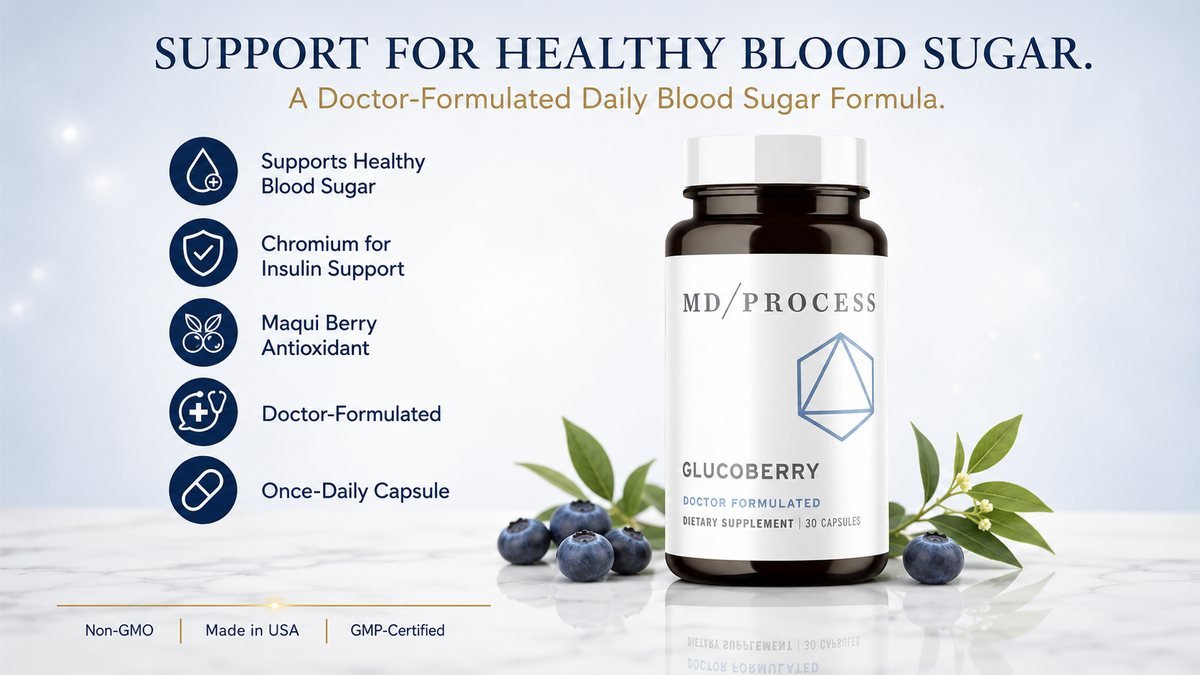
GlucoBerry is a once-daily capsule from MD/Process, a supplement company in Atlanta, Georgia. A bottle holds 30 gelatin capsules, a 30-day supply at one capsule each morning with food.
Four ingredients are named: maqui berry extract, sold as branded Delphinol; chromium, as chromium picolinate; biotin; and Gymnema sylvestre leaf powder. The rest of the label is gelatin, magnesium stearate and silicon dioxide — capsule shell and flow agents, not actives. Four is unusually restrained in a category where 11- and 24-ingredient blends are normal.
The marketing hangs on one idea: MD/Process calls GlucoBerry “the first nutritional supplement in history to support your blood sugar by supporting a healthy Blood Sugar Drain”, located “inside your kidneys”. It is a dietary supplement, not a medicine: the FDA does not review it before sale. It does not claim to treat diabetes. Neither do we.
Who’s Actually Behind GlucoBerry?
The seller is MD/Process, which also markets Body Wake. It publishes a working US phone number, 1-800-942-1935, and an address at 10 Glenlake Parkway, Suite 130, Atlanta, GA 30328 — more contactability than most of this category offers.
It is not a clean picture. Reviewopedia reports several addresses tied to MD/Process, including what it identifies as a virtual office and a fulfilment address shared with other heavily advertised supplements. Shared fulfilment is common. A virtual office as the corporate address is a softer signal than a head office.
The formulator is named as Dr. Mark Weis, M.D. That matters more than it sounds. Competing products lean on personas like “Dr. Ethan ‘Hawk’ Wilson” with no licence number and no state board listing. Dr. Weis is presented as a real, identifiable person, so the “Doctor-Formulated” badge refers to somebody rather than nobody. We could not verify his credentials against a state licensing board, so treat the qualification as unconfirmed. Named-and-unverified still beats invented.
Where the operation does resemble the category is domain sprawl. Alongside the official site we found clone and affiliate pages at en-glucoberry-us.com, us-theglucoberry.com, glucoberry.co and usa-glucoberry-usa.com. They advertise “$39/bottle” as standard and “85% off $129”, matching no official price, and add claims the brand does not make, including “Improves insulin sensitivity and glucose tolerance” and “Rated 4.9/5 by 27,000+ customers”. All invented downstream of the manufacturer.
How It’s Supposed to Work
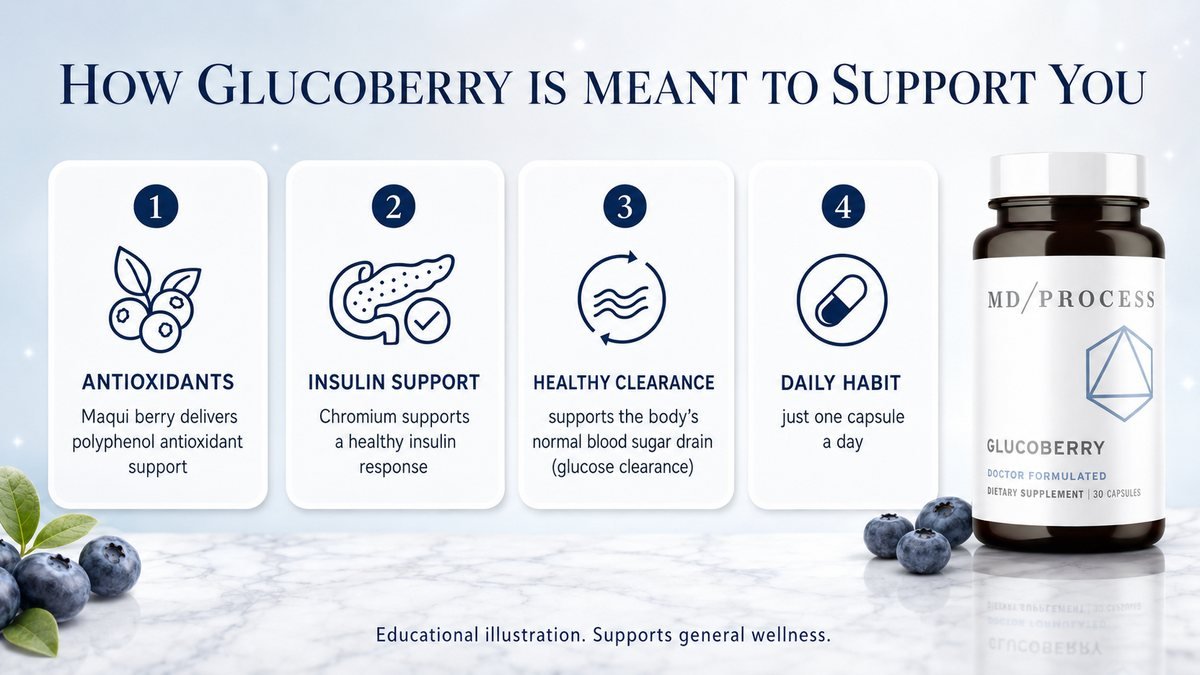
Strip the branding and the claimed mechanism is renal glucose excretion, which is real physiology. Your kidneys filter glucose continuously, and almost all of it is reabsorbed in the proximal tubule by a transporter called SGLT2. Above a certain blood concentration that reabsorption saturates and glucose spills into urine. This is the same pathway prescription SGLT2 inhibitors are built to exploit.
MD/Process rebrands it as the “Blood Sugar Drain”. The biology is sound. Two things about the pitch are not. First, “the first nutritional supplement in history” is puffery: there is no register of supplement mechanisms against which such a claim could be checked.
Second, and more important, the leap from mechanism to product is not evidenced. The maqui research the funnel leans on does propose sodium-glucose cotransporter inhibition as one possible explanation for the glucose readings it recorded.[1] A proposed mechanism in a small extract trial is not a demonstration, and we found no study showing the finished capsule increases urinary glucose excretion in anyone. It has never been measured against the thing it is named after. The line “eat more of your favorite foods” has nothing behind it either.
What’s Actually Inside
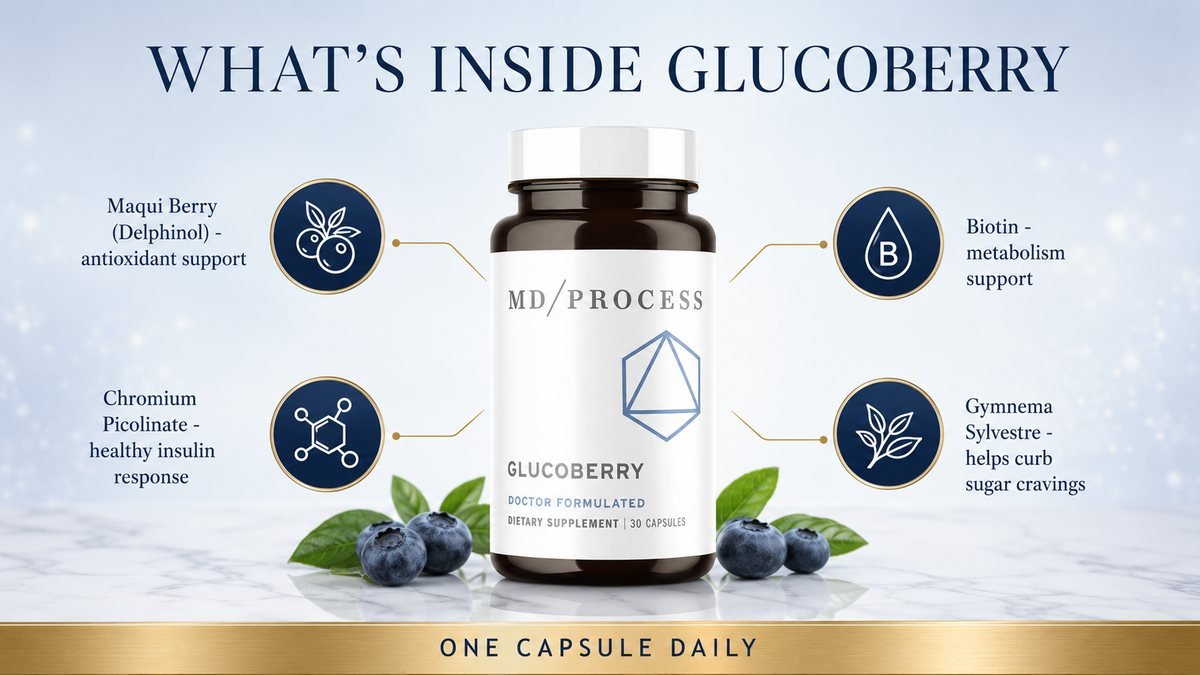
Four named actives, zero published quantities. Here is the formula with our evidence grade for each, based on human research rather than marketing.
| Ingredient | Marketed role | Human evidence | Dose disclosed? |
|---|---|---|---|
| Maqui berry extract (Delphinol) | Lead ingredient; “activates the Blood Sugar Drain” | Weak | No |
| Chromium (as chromium picolinate) | Insulin signalling support | Moderate | No |
| Biotin | Carbohydrate metabolism | Weak alone | No |
| Gymnema sylvestre leaf powder | Sugar cravings, fasting glucose | Weak–moderate | No |
| Gelatin, magnesium stearate, silicon dioxide | Capsule and flow agents, not actives | Not applicable | No |
Maqui berry extract (Delphinol)
Maqui is a Chilean berry rich in anthocyanins, particularly delphinidin. Delphinol is standardised to roughly 35% anthocyanins and about 25% delphinidin — percentages of an unpublished total, so they say nothing about how much extract is in the capsule.
Three small human trials support it: a reduced postprandial glucose rise in impaired glucose regulation;[1] lower blood glucose and improved lipids in prediabetics over three months;[2] and lower fasting and post-load glucose and insulin during an oral glucose tolerance test.[3] All three are small, use surrogate endpoints rather than months of HbA1c, and test the same proprietary extract with no independent replication. This is the weakest evidence base of the four, and the one the product is named after.
Chromium (as chromium picolinate)
Chromium is the strongest card here and it is played second. A 2020 meta-analysis in Pharmacological Research pooling 28 randomised controlled trials found chromium reduced fasting plasma glucose by 19.00 mg/dL and HbA1c by 0.71%.[4] An HbA1c reduction that size would be clinically meaningful.
The counterweight: a separate review found only limited evidence of effectiveness for chromium in type 2 diabetes.[5] The confidence intervals in the pooled analysis are wide, with the fasting glucose effect running close to nothing at one end. Chromium is plausible, not settled — and with no amount published, you cannot tell whether the capsule delivers anything near the trial doses.
Biotin and Gymnema
Biotin alone has almost nothing behind it for blood sugar; the supporting study is from 1988, tiny and dated.[6] It gets interesting combined with chromium, which is how GlucoBerry uses it. A placebo-controlled double-blind trial in poorly controlled type 2 diabetes tested chromium picolinate plus biotin together,[7] and a further trial reported improved glucose metabolism on the same combination in overweight patients.[8] That pairing is a real formulation decision, not label decoration.
Gymnema is an Ayurvedic leaf with long traditional use for sugar cravings. A 2021 review in Phytotherapy Research covering 10 studies and 419 participants found reductions in fasting glucose, postprandial glucose and HbA1c.[9] Read the fine print: those reductions were measured against baseline rather than placebo, and heterogeneity ran at I² of 90 to 99%, too high to quote pooled figures as an expectation. A 2023 systematic review was more favourable;[10] a 2007 review was cautious.[11] GlucoBerry also uses leaf powder, not a standardised extract, which usually means fewer gymnemic acids per milligram — a milligram we do not have.
One label inconsistency: a reseller listing calls GlucoBerry “vegetarian, vegan-friendly”, but the label’s other ingredients include gelatin. Both cannot be true.
The Dose Problem
This is the review in one section. GlucoBerry publishes no milligram or microgram figure for any of its four ingredients.
We looked everywhere a dose should appear. No quantified Supplement Facts panel on themdprocess.com. None on the Amazon listing, ASIN B0BZS683PS. None on Walmart. The NIH Dietary Supplement Label Database, which archives panels for tens of thousands of US products, returns zero GlucoBerry entries. The only quantity statement in the marketing is that ingredients are present “in doses proven for maximum efficacy”.
This differs from the usual complaint. GlucoBerry is not hiding behind a declared proprietary blend the way competitors do, and a blend at least gives you a total weight and a descending ingredient order. GlucoBerry gives neither.
Why it matters: the sales page cites real research, and every one of those studies used a specific amount.[4][3] Citing a study without disclosing your dose transfers that study’s credibility onto your capsule without earning it. A capsule with a token sprinkle of maqui can cite the same paper as one containing the trial amount, and from outside the two are indistinguishable. That is why a clean formula scores 3.9 and not 4.5.
Does It Actually Work?
Nobody knows, because the finished product has never been tested. There is no clinical trial of the four-ingredient capsule, no published pilot, no independent assay of what is in it. What exists is evidence for its individual ingredients, at doses that may or may not match what you would swallow.
The best reference point is a 2022 network meta-analysis of nutritional supplements for glycaemic control in type 2 diabetes.[12] A consistent picture appears across that literature: the better-supported nutrients produce modest but real changes in fasting glucose and HbA1c, smaller than diet and weight change deliver, and largest in people poorly controlled to begin with. Chromium sits in that band.[4] Gymnema sits a tier below, held down by trials measured against baseline rather than placebo.[9] Maqui sits below that.
Concretely: if the capsule contains meaningful amounts of chromium and Gymnema, a modest improvement in fasting glucose over several months is a reasonable hope. If it is mostly maqui with traces of the rest, expect nothing measurable. You cannot tell which you bought, and neither can we. It will not replace medication.
What the evidence actually supports
- No trial has tested the capsule itself; every claim rests on ingredient studies at undisclosed doses.
- Chromium is the best-supported ingredient here, though dissenting reviews call its evidence limited.
- The chromium plus biotin pairing has direct combination-trial support.
- Maqui berry, the ingredient the product is named after, has the thinnest evidence of the four.
- The “Blood Sugar Drain” is real kidney physiology, but no study shows this product affects it.
- Realistic expectation if doses are adequate: a modest change in fasting glucose over months.
Complaints, Refunds and the Trust Record
We searched the public regulatory record. No FDA warning letter. No FTC enforcement action. No lawsuit. We could not retrieve a Better Business Bureau profile for MD/Process, so its BBB standing is unknown rather than good.
None found is not the same as clean. Supplement companies operate largely outside pre-market review, and the absence of a warning letter often reflects limited regulatory attention rather than verified compliance. What we can say is that we found no documented pattern of enforcement — better than competitors whose funnels rely on unidentifiable doctors.
On the consumer side, the substantive issue is the refund policy, not the product. Reviewopedia reports that the returns process requires sending back remaining unopened bottles at your own expense, contradicting the “no questions asked” empty-bottle language on the sales page. The other item is the clone-domain layer: affiliate pages quoting “85% off $129” and “4.9/5 from 27,000+ customers” are not MD/Process, and that rating appears nowhere in the brand’s own material.
Verify this yourself: call 1-800-942-1935 and ask three things. One, exactly what must be returned for a refund under the 180-day guarantee — empty bottles, unopened bottles, or both. Two, who pays return shipping. Three, whether they will send the quantified Supplement Facts panel. Get the answers by email. A vague answer is your answer.
See Today’s GlucoBerry Bottle Options →Official site · 180-day money-back guarantee
Pros and Cons
Pros
- Four named ingredients, no 20-item blend to hide behind.
- A real, identifiable formulating physician rather than an invented persona.
- The chromium plus biotin pairing has direct human combination-trial support.
- Sold on Amazon and Walmart as well as direct, so it exists in a normal supply chain.
- A reachable US phone line and a published Atlanta address.
- 180-day window, with no fake-value ebook bonuses padding the offer.
Cons
- Not one milligram figure published anywhere, including the NIH label database.
- Built around maqui berry, its weakest-evidenced ingredient.
- The guarantee terms contradict themselves: empty-bottle “no questions asked” versus unopened bottles returned at your cost.
- “First supplement in history” and “eat more of your favorite foods” are unsupported copy.
- Gelatin capsule, so not vegetarian, despite a reseller listing calling it vegan-friendly.
- No trial of the finished product, and a virtual-office address flagged by consumer reporting.
Side Effects, Interactions and Who Should Avoid It
These four ingredients are individually well tolerated at typical amounts, and the short list genuinely lowers risk: fewer actives, fewer interaction pathways. But the amounts here are undisclosed, and you cannot assess a dose-dependent risk without a dose.
The interaction that matters most is additive glucose lowering. Chromium and Gymnema both have human data showing reduced fasting glucose.[4][9] If you take insulin, a sulfonylurea or another glucose-lowering drug, adding something that pushes the same direction can take you lower than intended. Hypoglycaemia is a real clinical event. Anyone on diabetes medication needs their doctor involved and more frequent monitoring at first.
Biotin has a frequently overlooked problem: at supplemental doses it interferes with laboratory immunoassays, including some thyroid tests and cardiac troponin, producing falsely high or low results and a real risk of misdiagnosis. Because the amount is undisclosed, you cannot judge whether yours matters. Tell any doctor ordering bloodwork that you take a biotin-containing supplement.
Chromium picolinate is generally tolerated, with gastrointestinal upset and headache the common complaints and kidney concerns raised around high chronic intakes. Gymnema most often causes stomach upset. Maqui showed no notable safety signal in the small trials available, which detect uncommon harms poorly.
Skip it if you are pregnant or breastfeeding, since none of these have adequate pregnancy safety data; if you have significant kidney disease, both for the chromium question and because the product’s premise concerns renal function; or if you avoid animal products, because the capsule is gelatin. And the line that matters most: diabetes is managed by a physician, with monitoring and for many people medication. No supplement substitutes for that, and delaying real treatment to try a capsule is the most expensive mistake available here.
GlucoBerry Official Website — Where to Buy Safely
GlucoBerry is sold through its official website, themdprocess.com, and on legitimate Amazon and Walmart listings. Buying direct is the safest route — it’s the only way to be sure of genuine product, current pricing and a valid 180-day guarantee. Avoid the clone domains covered above (en-glucoberry-us.com, glucoberry.co and similar) and marked-up resellers such as TheOrderStore: orders placed there risk counterfeits, invented “85% off” pricing, and a refund claim that sits with an intermediary rather than the seller.
Go to the Official GlucoBerry Website →Official site · 180-day money-back guarantee
Pricing, Guarantee and Where to Buy
Official one-time pricing from themdprocess.com, plus the 10% Subscribe and Save tier:
| Package | One-time total | Per bottle | Subscribe and Save |
|---|---|---|---|
| 1 bottle (30 days) | $59 | $59 | $53.10 |
| 3 bottles (90 days) | $147 | $49 | $44.10 |
| 6 bottles (180 days) | $234 | $39 | $35.10 |
Free US shipping applies to the three- and six-bottle orders only. There are no bonus ebooks, which we count in its favour, since invented “$109 value” digital products are a standard tell. One review page quoted $198 for six bottles; treat $234 as current.
The guarantee contradiction. This is the biggest problem with the offer. The sales page advertises a “180-Day ‘Empty-Bottle’ Money-Back Guarantee” refunding “100% of the purchase price, no questions asked”. Reviewopedia reports that the actual policy requires returning any remaining unopened bottles, at your own expense. Those are incompatible. An empty-bottle guarantee means you can finish the product and still be refunded; demanding unopened bottles back at your cost means the opposite. On a six-bottle order those readings are hundreds of dollars apart. We are not calling either version false. The company publishes both, and a buyer cannot know which applies.
Before you order: get the refund terms in writing. Ask whether empty bottles qualify and who pays return postage, by email. If the 180-day guarantee is your main reason for buying — and for an undisclosed-dose formula that is a rational reason — then the guarantee’s real terms are what you are paying for. Buy one bottle first if you want to test the refund process cheaply.
Buy direct from themdprocess.com, or the legitimate Amazon and Walmart listings. Avoid the clone domains listed earlier, which quote pricing the brand does not offer, and marked-up resellers such as TheOrderStore at $97.95. Guarantees are honoured by whoever sold you the product, so a third-party purchase may leave you with no 180-day window.
View Current GlucoBerry Pricing and Guarantee Terms →Official site · 180-day money-back guarantee
How It Compares to the Other Blood-Sugar Formulas We Graded
| Product | Best For | Doses Disclosed | Guarantee | Our Score |
|---|---|---|---|---|
| GlucoBerry | Cleanest focused formula | No (cited only) | 180 days | 3.9 / 5 |
| Gluco Extend | Contains berberine | No (proprietary blend) | 180 days | 3.7 / 5 |
| Gluco6 | Simplest daily capsule | No (~570 mg blend) | 60 days | 3.3 / 5 |
| Sugar Defender | Convenient liquid drops | No | 60 days | 3.2 / 5 |
| Cholibrium | Heart / cholesterol (off-category) | Partial | 365 days | 3.1 / 5 |
GlucoBerry tops this table on transparency and structure, not ingredient quality. It names four ingredients instead of hiding eleven in a blend, names a real physician, and sells through Amazon and Walmart rather than a rotating set of look-alike domains.
On raw materials, Gluco Extend arguably holds the better card. Berberine is the best-evidenced compound in this category, supported by a meta-analysis in type 2 diabetes[13] and a 2024 umbrella meta-analysis covering glycaemic control and inflammation.[14] That beats anything in GlucoBerry. The catch is that berberine’s presence is asserted on some of Gluco Extend’s official pages and absent from others. A well-evidenced ingredient you cannot confirm is worth less than a modest one you can.
The two 60-day products lose on refund window as well as formula. Cholibrium has the longest guarantee at 365 days and the only partial dose disclosure in the set, but it targets cholesterol. Every product here shares the same failure: none tell you how much of anything you are getting.
Who It’s For — and Who Should Skip It
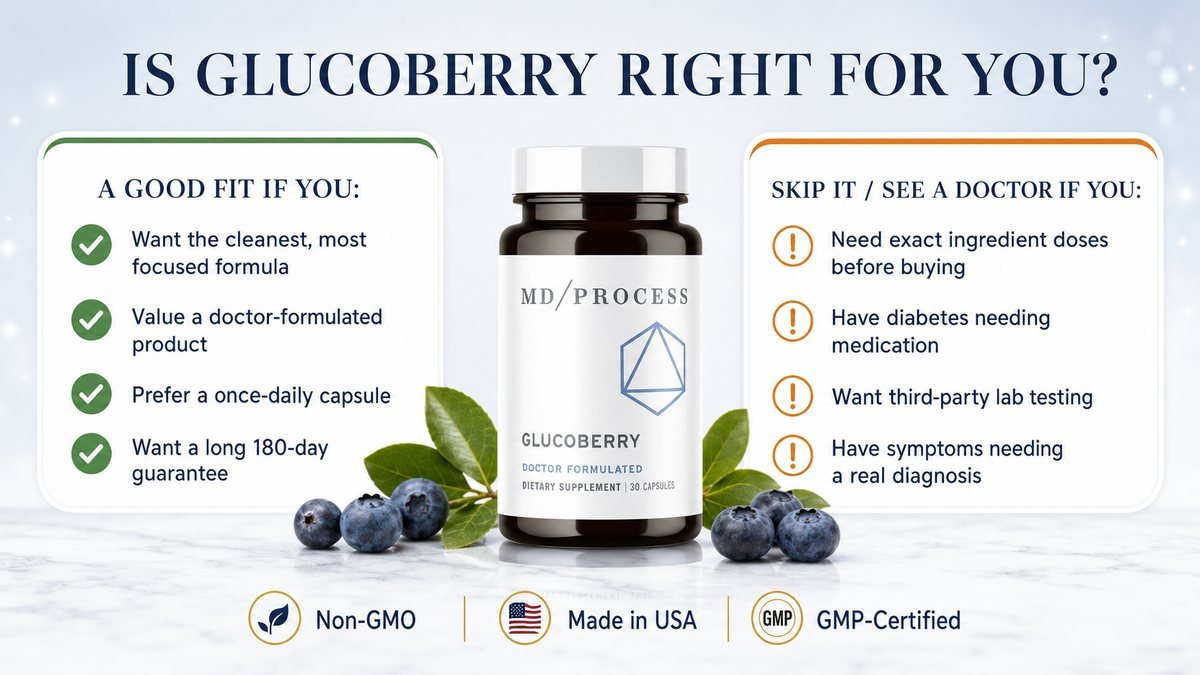
GlucoBerry suits a narrow reader. You have mildly elevated fasting glucose or a prediabetes result, you are already doing the things that actually move it, and you want one supplement on top with a long refund window and a short ingredient list. You accept that you are buying an unquantified formula, largely because you can get your money back. On those terms it is defensible, and it is the one we would pick here.
Skip it if you want to know what you are swallowing. That is not fussiness; it is the basis of judging whether a supplement can work, and this product does not answer it. Skip it if you have diagnosed type 2 diabetes and hope this reduces your medication, or if you are on insulin or a sulfonylurea and have not spoken to your doctor. Skip it if you are pregnant, breastfeeding, have kidney disease, or avoid animal products. And skip it if $234 is money you would notice — the honest expected benefit does not justify stretching for it.
What Works Better Than Any Supplement
Weight loss is the strongest lever most people have. Losing a meaningful percentage of body weight improves insulin sensitivity and fasting glucose more reliably than any capsule in this category. Nothing in our comparison table approaches that effect size.
Diet composition is next, and the practical version is simpler than the internet suggests: fewer refined carbohydrates and sugar-sweetened drinks, more fibre, protein at each meal, and attention to portions at the meals that spike you hardest. You do not need a branded protocol.
Exercise works two ways. Resistance training builds muscle, which is where most post-meal glucose ends up stored. Aerobic activity improves insulin sensitivity within days, and a ten-minute walk after your largest meal blunts the post-meal rise. Both are free. Sleep matters more than people expect: short sleep worsens insulin sensitivity within a week.
If you are going to buy nutrients, buy the ones you are short of, because the evidence is strongest in people who are deficient. Zinc has a 2019 meta-analysis of 32 randomised trials behind it, reporting fasting glucose down 14.15 mg/dL and HbA1c down 0.55%.[15] Magnesium has double-blind trial support, strongest in deficiency.[16] Alpha-lipoic acid has a 24-trial meta-analysis behind it.[18] Vitamin D mainly helps those already deficient.[17] A blood test costs less than a six-bottle order and tells you which of these, if any, applies to you. And if you have diabetes, medication prescribed and monitored by a doctor outperforms everything above.[12]
Frequently Asked Questions
Does GlucoBerry actually lower blood sugar?
Nobody has tested the finished product, so there is no direct answer. Its chromium has meta-analysis support for reducing fasting glucose and HbA1c; Gymnema has weaker support. Because no doses are published, you cannot tell whether the capsule delivers amounts comparable to those trials. Expect modest changes at best, alongside diet and exercise.
How much of each ingredient is in a capsule?
Not disclosed. MD/Process publishes no milligram or microgram figures on its own site, on Amazon, on Walmart, or in the NIH Dietary Supplement Label Database, which holds no GlucoBerry entry. It is not declared a proprietary blend either, so the quantities are simply absent. The marketing says only that ingredients are present “in doses proven for maximum efficacy”.
What is the “Blood Sugar Drain”?
It is MD/Process’s branding for renal glucose excretion, the process by which your kidneys filter glucose and either reabsorb it via SGLT2 or pass it into urine. The physiology is real, and it is the target of prescription SGLT2 inhibitor drugs. No study shows GlucoBerry itself increases urinary glucose excretion in humans.
Is GlucoBerry a scam?
No. It is a real product from a contactable Atlanta company, sold on Amazon and Walmart, with no FDA warning letter, FTC action or lawsuit found. Our criticisms are undisclosed doses, overreaching claims such as “first in history”, and a self-contradictory refund policy. Those are quality problems, not fraud.
Does GlucoBerry have an official website, and where should I buy it?
Yes — GlucoBerry is sold on its official website, themdprocess.com, and on legitimate Amazon and Walmart listings. Use the links on this page to reach the official source. Avoid clone domains quoting “85% off” pricing the brand does not offer, since a purchase there can leave you without a valid 180-day guarantee.
Who is Dr. Mark Weis?
He is named as GlucoBerry’s formulator on themdprocess.com. Unlike the personas fronting several competing products, he is presented as a real, identifiable individual. We could not verify his medical credentials against a state licensing board, so treat the qualification as unconfirmed.
How long before I notice anything?
The relevant ingredient studies ran over weeks to months, not days. The three-month prediabetes trial of the maqui extract is the closest reference point. Given the 180-day refund window, judging it after eight to twelve weeks of consistent use, with fasting glucose readings rather than how you feel, is reasonable.
Can I take it with metformin or insulin?
Only with your doctor’s knowledge. Chromium and Gymnema both have data showing glucose reduction, so stacking them onto medication that does the same thing can drive blood sugar too low. If you proceed, monitor more frequently for the first few weeks and tell your prescriber exactly what you are taking.
Is the 180-day guarantee real?
The window is real; the terms are contradictory. The sales page promises an empty-bottle refund with no questions asked, while consumer reporting says the policy requires unopened bottles returned at your expense. Those cannot both apply. Call 1-800-942-1935 and get the conditions in writing before ordering multiple bottles.
Is GlucoBerry vegetarian, and where should I buy it?
No, the capsule is gelatin, which is animal-derived, despite one reseller listing calling it vegan-friendly. Buy direct from themdprocess.com or the legitimate Amazon and Walmart listings. Avoid clone domains advertising “85% off $129” and a “4.9/5 rating from 27,000+ customers”, and marked-up resellers such as TheOrderStore at $97.95.
The Final Verdict
GlucoBerry scores 3.9 out of 5, the highest in our blood-sugar set, and it matters what that number means. It is not a strong score. It is the best available in a category where every product refuses to say how much of anything it contains, and where rival funnels are fronted by physicians who do not appear to exist.
What it gets right is real: four named ingredients rather than a blend built to look impressive, a chromium and biotin pairing with combination-trial support, a named formulator, a phone number a person answers, mainstream retail, and a 180-day window instead of 60. What it gets wrong is also real. No published dose, which makes the central efficacy claim uncheckable, and a formula built around maqui berry rather than the chromium that could justify the purchase. Add a self-contradictory guarantee and you have a product that deserves consideration, not confidence.
Buy it if you have mildly elevated glucose, you are already fixing the things that matter, and you will use the refund window if nothing changes. Start with a single bottle. Do not buy it if you have diabetes and are hoping to avoid a doctor, and do not buy it expecting to eat more of your favourite foods.
Check GlucoBerry Availability on the Official Site →Official site · 180-day money-back guarantee
Sources
- Maqui berry extract and postprandial glucose (2014). PMID: 24861886
- Maqui berry extract, glucose and lipids in prediabetes (2016). PMID: 27820958
- Delphinol maqui extract and oral glucose tolerance testing (2016). PMID: 28025651
- Chromium and glycaemic control: meta-analysis of 28 randomised trials (2020). Pharmacological Research. PMID: 32730903
- Chromium in type 2 diabetes: limited evidence of effectiveness (2016). PMID: 27261273
- Biotin and glucose metabolism (1988). PMID: 3280936
- Chromium picolinate plus biotin in type 2 diabetes: randomised trial (2006). PMID: 17109595
- Chromium picolinate plus biotin in overweight type 2 diabetes (2007). PMID: 17506119
- Gymnema sylvestre and glycaemic outcomes: 10 studies, 419 participants (2021). Phytotherapy Research. PMID: 34467577
- Gymnema sylvestre: systematic review and meta-analysis (2023). PMID: 36580574
- Gymnema sylvestre: systematic review of clinical evidence (2007). PMID: 18047444
- Nutritional supplements for glycaemic control: network meta-analysis (2022). PMID: 35963372
- Berberine in type 2 diabetes: meta-analysis (2012). PMID: 23118793
- Berberine, glycaemic control and inflammation: umbrella meta-analysis (2024). Clinical Therapeutics. PMID: 38016844
- Zinc and glycaemic control: meta-analysis of 32 trials (2019). American Journal of Clinical Nutrition. PMID: 31161192
- Magnesium and glucose metabolism: meta-analysis of double-blind trials (2021). PMID: 34836329
- Vitamin D and glycaemic control in type 2 diabetes (2024). PMID: 39355942
- Alpha-lipoic acid and glycaemic markers: meta-analysis of 24 trials (2018). Metabolism. PMID: 29990473
About This Review
How we scored: 30% ingredient evidence quality in humans, 25% dose transparency and label verifiability, 20% company transparency and regulatory record, 15% guarantee and refund practice, 10% value per day. GlucoBerry lost nearly all available points on dose transparency and recovered them on ingredient focus and company identifiability. Our research covered the themdprocess.com funnel, the Amazon and Walmart listings, reseller and clone-domain pages, consumer reporting, the NIH label database, and FDA, FTC and BBB records. Where a figure is not published, we say so rather than estimating it.
Written by the MHA Research Team, reviewed by James Carter, Lead Health Researcher. Men’s Health Authority has no relationship with MD/Process beyond an affiliate arrangement, which does not affect scoring.
Medical disclaimer: this article is information only, not medical advice. It does not diagnose, treat, cure or prevent any disease, including diabetes. Diabetes and prediabetes require monitoring by a qualified clinician. Do not start, stop or change any medication based on this page.
Last updated: 22 July 2026. Update log: pricing re-checked against themdprocess.com; guarantee-term conflict added as a named finding.