
Audifort Review 2026: Does This Hearing & Tinnitus Drop Really Work?
The short version: Audifort is a liquid dropper supplement marketed for hearing support, tinnitus (ringing in the ears) and “ear wellness.” It blends 20+ ingredients — the named ones include maca root, grape seed, green tea, capsicum, gymnema and GABA. Here’s the honest catch: most of those are circulation, blood-sugar and adaptogen ingredients with little direct human evidence for hearing, and the broader research on herbal tinnitus supplements is weak.
This review is deliberately skeptical, because your hearing deserves it. We’ll show what’s realistic and what’s marketing.
Quick answer: Audifort is a legitimately sold hearing-support supplement with a 90-day guarantee, but the evidence that it improves hearing or reduces tinnitus is thin — its ingredients are mostly general-wellness botanicals, and rigorous reviews of similar tinnitus supplements have found little benefit. It may be worth a low-risk try for some, but it is not a treatment, and new or worsening tinnitus/hearing loss needs a real medical evaluation first.
Key Takeaways
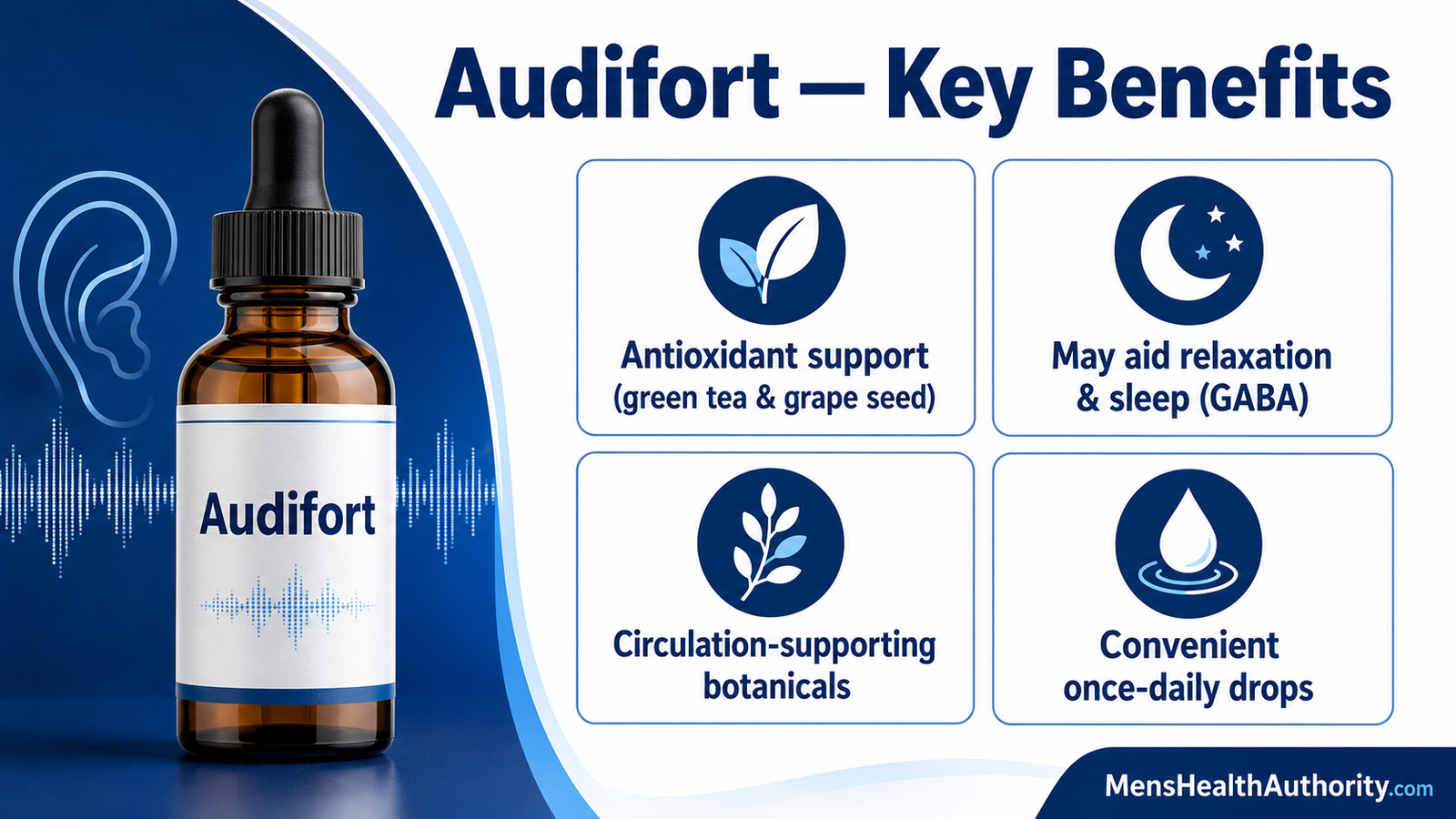
- What it is: A twice-daily liquid dropper blend of 20+ botanicals and nutrients marketed for hearing and tinnitus support.
- Best-supported use: General antioxidant/wellness support and possibly relaxation/sleep (from GABA) — not a proven hearing or tinnitus treatment.
- What it will NOT do: It will not cure tinnitus, reverse hearing loss, or fix an ear-drum, wax, infection or nerve problem — those need a doctor.
- Safety: Generally low-risk, but gymnema and capsicum can affect blood sugar and stomach, green tea adds caffeine, and GABA may cause drowsiness — check with a doctor if you take medication or are pregnant.
- Guarantee: Sold with a 90-day money-back guarantee through the official ClickBank checkout.
Check Audifort’s Current Price →Official site • secure ClickBank checkout
What this review covers
What actually causes tinnitus & hearing loss
How Audifort is meant to work
Ingredients & evidence grading
Benefits you might reasonably expect
How it compares to other approaches
Who it’s for / who should skip it
Side effects & safety
What users tend to report
How to take it & a realistic timeline
When to see a doctor (important)
Tips to get more from it
Common mistakes people make
Pricing, guarantee & where to buy
What the research actually shows
Is Audifort legit or a scam?
FAQ
Editorial verdict
What is Audifort?
Audifort is a dietary supplement sold as liquid drops (a tincture) and marketed for hearing health, tinnitus relief and “ear wellness,” with secondary claims around mental sharpness and energy. The maker describes it as a blend of “over 20 carefully selected ingredients,” though only about six are named publicly: maca root, grape seed, green tea, capsicum annuum, gymnema sylvestre and GABA. You take it twice daily — one dropper before breakfast and one before lunch — under the tongue or mixed into water or juice.
Look closely at those named ingredients and a pattern jumps out: they’re mostly circulation, blood-sugar and adaptogen/energy ingredients (gymnema for blood sugar, capsicum for circulation, maca and green tea for energy, GABA for calming). That’s a very different profile from what hearing researchers actually study for tinnitus and hearing loss. It’s a wellness blend framed as a hearing product — which is the core of our skepticism.
What actually causes tinnitus & hearing loss
To judge a hearing supplement, you have to know what it’s up against — and why “drops” rarely fix the real problem. Tinnitus and hearing loss have many distinct causes, most of them structural or neurological:
- Noise damage: Loud sound permanently kills the delicate hair cells of the inner ear. Once gone, they don’t regenerate — no supplement rebuilds them.
- Age-related loss (presbycusis): Gradual wear on the cochlea and auditory nerve.
- Earwax, infection or fluid: Common, very treatable causes a doctor can fix in minutes — no drops required.
- Medication toxicity: Some drugs (certain antibiotics, high-dose aspirin, some chemo agents) are “ototoxic.”
- Neurological tinnitus: The brain’s auditory pathways become overactive, generating phantom sound even without an ear problem.
- Vascular or medical conditions: High blood pressure, diabetes, thyroid issues, or — rarely — a tumor (acoustic neuroma), which is why one-sided tinnitus always needs a doctor.
The honest implication: a botanical supplement can, at best, support general ear and vascular wellness and possibly calm the stress/sleep side of living with tinnitus. It cannot address most of the real drivers above. That ceiling should frame every claim you read about Audifort.
How Audifort is meant to work
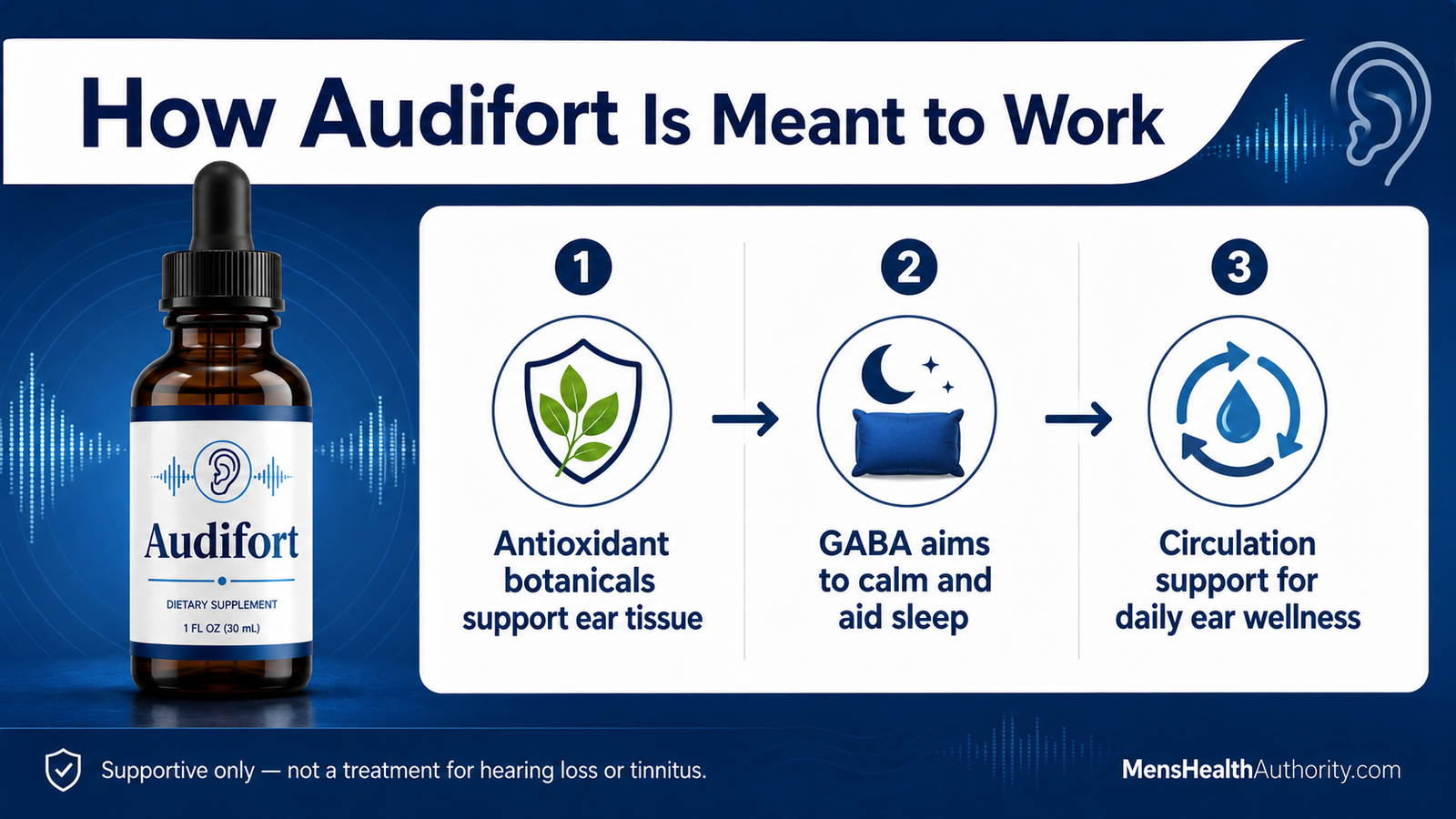
The plausible (not proven) mechanisms behind the named ingredients are:
- Antioxidant protection: Green tea (EGCG) and grape seed provide antioxidants; oxidative stress is one contributor to inner-ear damage, and antioxidants have been explored — mostly in animals — for noise-related hearing damage.[4]
- Circulation support: Capsicum is a vasodilator; the theory is better blood flow to ear tissues, though this isn’t demonstrated to change hearing.
- Calming the tinnitus experience: GABA is an inhibitory neurotransmitter; the pitch is that it quiets overactive signals. In reality, oral GABA’s ability to reach the brain is limited and debated.
- General wellness: Maca and gymnema target energy and blood sugar — indirect at best for hearing.
Ingredients & the evidence behind them
Honest grading of the named ingredients, judged specifically for hearing/tinnitus in humans. Strong = large high-quality human trials; Moderate = promising but smaller/indirect; Weak = mostly traditional, animal or non-ear data.
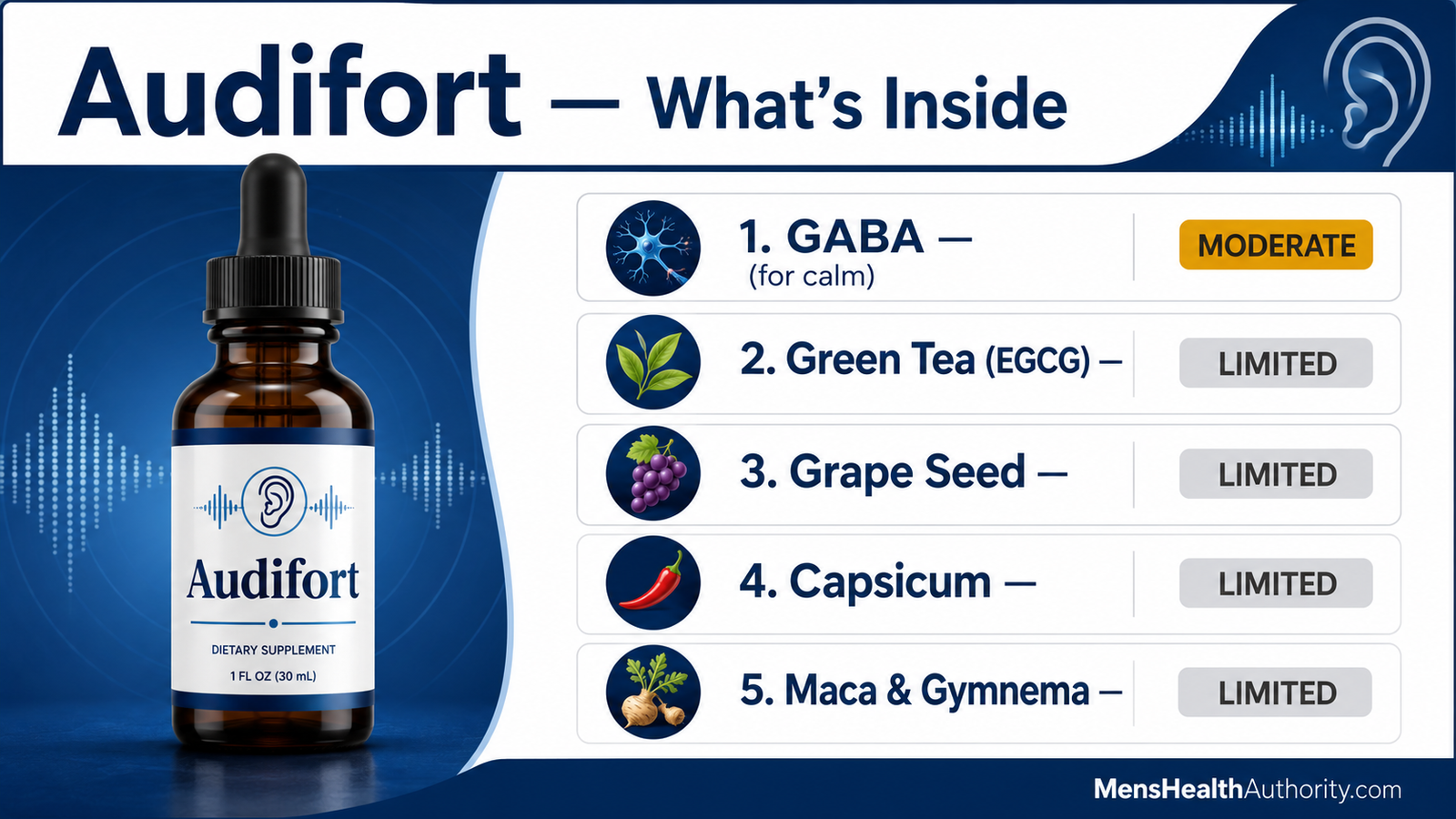
GABA Moderate (for calming, not hearing)
What it does: GABA is the brain’s main inhibitory neurotransmitter, and the GABA system is genuinely implicated in tinnitus. Some people report relaxation and better sleep with oral GABA.
Honest read: The catch is that orally taken GABA poorly crosses the blood–brain barrier, so whether a dropper meaningfully changes brain GABA is doubtful. Any benefit is more likely relaxation/sleep than true tinnitus reduction. Moderate for calm, weak for hearing.
Green Tea Extract (EGCG) Weak (eye/ear-specific)
What it does: A well-studied antioxidant. Antioxidant strategies against noise-induced hearing damage are an active research area.[4]
Honest read: Evidence for antioxidants protecting hearing is mostly experimental/animal and preventive (around noise exposure), not proof that green tea reverses existing tinnitus or hearing loss.
Grape Seed Extract Weak (hearing-specific)
What it does: Rich in proanthocyanidins with antioxidant activity demonstrated largely in animal models.[5]
Honest read: Plausible antioxidant support; no solid human hearing/tinnitus trials. Along for the antioxidant ride.
Capsicum Annuum Weak
What it does: Contains capsaicin, a vasodilator that may support circulation.
Honest read: No credible human evidence that it improves hearing or tinnitus. Traditional/mechanistic only.
Maca Root & Gymnema Sylvestre Weak (hearing-specific)
What they do: Maca is an energy/adaptogen herb; gymnema is best known for blood-sugar support.
Honest read: Neither has meaningful human evidence for hearing or tinnitus. They fit a general-wellness formula more than an ear one.
See Audifort Package & Bundle Options →Official site • money-back guarantee
Benefits you might reasonably expect
Framed honestly and as support, the realistic (modest) upside is:
- General antioxidant intake from green tea and grape seed.
- Possible relaxation or better sleep for some people (GABA, adaptogens), which can make tinnitus feel less intrusive.
- A low-risk, guarantee-backed option to try if you’ve already ruled out medical causes with a doctor.
What it will not reliably do: silence tinnitus, restore lost hearing, or replace hearing aids, wax removal, infection treatment or an audiologist’s care.
How Audifort compares to other approaches
| Approach | What it targets | Evidence | Notes |
|---|---|---|---|
| Audifort (drops) | General wellness, “ear support” | Weak / unproven for hearing | 90-day guarantee; low risk |
| See an audiologist / ENT | The actual cause | Standard of care | Finds treatable causes |
| Hearing aids / sound therapy | Hearing loss & tinnitus masking | Strong for many | Most effective for real loss |
| CBT for tinnitus | Distress & coping | Good evidence for quality of life | Doesn’t remove the sound but reduces its impact |
The takeaway: if tinnitus is affecting you, the highest-value first steps are medical evaluation, and for many, sound therapy or CBT — all better supported than any supplement. Audifort is at most a low-risk add-on after those.
Who it’s for — and who should skip it
Might suit you if…
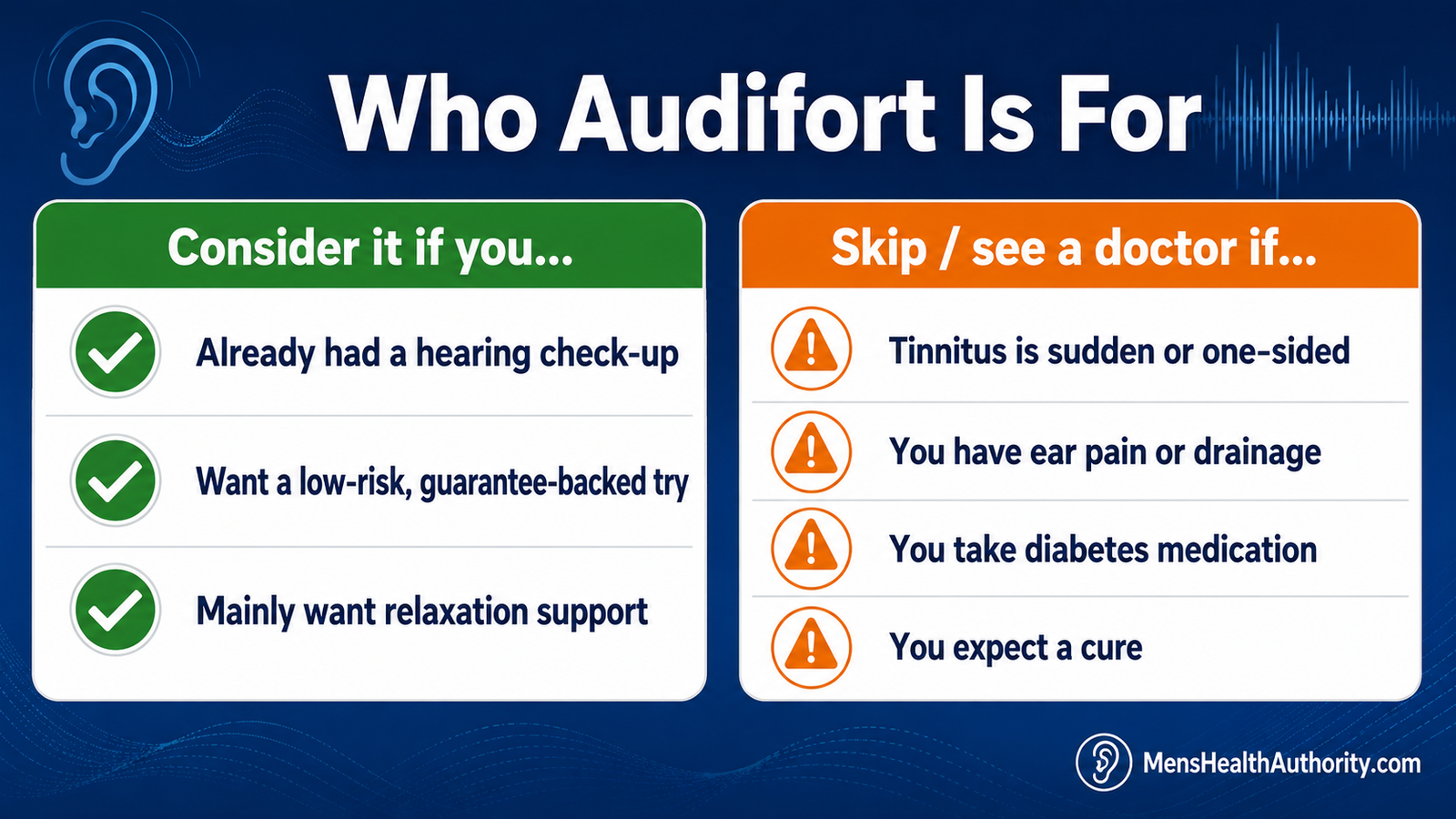
- You’ve already had a hearing/tinnitus check-up and no treatable cause was found.
- You want a low-risk, guarantee-backed wellness try and have realistic expectations.
- You’re mainly after general antioxidant/relaxation support.
Skip / see a doctor first if…
- Your tinnitus is new, sudden, one-sided, or came with hearing loss or dizziness — see a doctor promptly.
- You have ear pain, drainage, or suspect wax/infection (easily treated).
- You take diabetes medication (gymnema/capsicum can lower blood sugar) or are sensitive to caffeine (green tea).
- You’re pregnant or breastfeeding.
- You expect it to cure tinnitus or restore hearing — it won’t.
Side effects & safety
Audifort’s named ingredients are generally low-risk at typical amounts, but a dropper you take twice daily still deserves care:
- Gymnema sylvestre can lower blood sugar — important if you take diabetes medication (risk of hypoglycemia).
- Capsicum may cause stomach upset or a burning sensation in sensitive people.
- Green tea contains caffeine, which can worsen jitteriness or, for some, subjective tinnitus.
- GABA may cause drowsiness or, occasionally, a tingling sensation.
- Undisclosed ingredients: Because the full formula isn’t public, anyone with allergies, on medication, or pregnant should review the physical label with a pharmacist.
Alcohol-based tinctures can also interact or irritate; check the base if that matters to you.
What users tend to report
We don’t invent ratings or testimonials, and we treat sales-page reviews skeptically since the seller curates them. Across independent discussion, hearing/tinnitus supplements show a familiar split: a minority report the ringing feels “quieter” or that they sleep better; many notice nothing and stop. Tinnitus is also strongly influenced by stress, sleep and attention, so relaxation effects (or simple placebo) can make a product feel helpful without changing the underlying hearing. That’s not a knock — it’s a reason to judge Audifort on evidence and the guarantee, not on hopeful anecdotes.
How to take it & a realistic timeline
The label direction is one dropper before breakfast and one before lunch, held under the tongue for absorption or mixed into water/juice. Realistic expectations:
- Weeks 1–2: Most people feel nothing specific; some notice mild calming.
- Weeks 3–8: If anything shifts, it’s usually the experience of tinnitus (less bother, better sleep), not the sound disappearing.
- 90 days: The maker suggests longer use — conveniently matching the 90-day guarantee. Use that window to judge honestly and request a refund if you see no value.
When to see a doctor (please read this)
This matters more for hearing than for almost any other supplement category. See a doctor or audiologist promptly if your tinnitus is sudden, one-sided, pulsing in time with your heartbeat, or paired with hearing loss, dizziness or ear pain — these can signal treatable or serious conditions (infection, sudden sensorineural hearing loss, or rarely a tumor) where early treatment changes the outcome. No supplement should delay that visit. Once serious causes are ruled out, a wellness product like Audifort is a reasonable low-stakes experiment — but never a substitute for the evaluation.
Tips to get more from Audifort (or any hearing formula)
- Get the check-up first. Rule out wax, infection and treatable loss before spending months on drops.
- Protect your hearing. Use ear protection around loud sound and keep headphone volume moderate — prevention beats any pill.
- Work the stress/sleep angle. Since tinnitus tracks with stress and poor sleep, good sleep hygiene and relaxation often help more than the supplement itself.
- Try sound therapy. Background sound or maskers are well supported for making tinnitus less intrusive.
- Track the 90-day window. Note your purchase date so the guarantee doesn’t lapse before you decide.
Common mistakes people make
- Using drops instead of a diagnosis. The biggest mistake — delaying care for a cause a doctor could actually treat.
- Expecting silence. Even effective tinnitus care usually reduces distress, not the sound entirely; a supplement promising to “end the ringing” is overpromising.
- Ignoring blood-sugar interaction. Gymnema plus diabetes medication can push blood sugar too low.
- Buying multi-bottle bundles first. Try the smallest option before committing to a 6-bottle supply.
- Buying from third-party sellers. Counterfeit risk and no valid guarantee — official site only.
Pricing, guarantee & where to buy
Audifort is sold on its official website via ClickBank. Pricing at the time of writing (confirm current numbers on the official page):
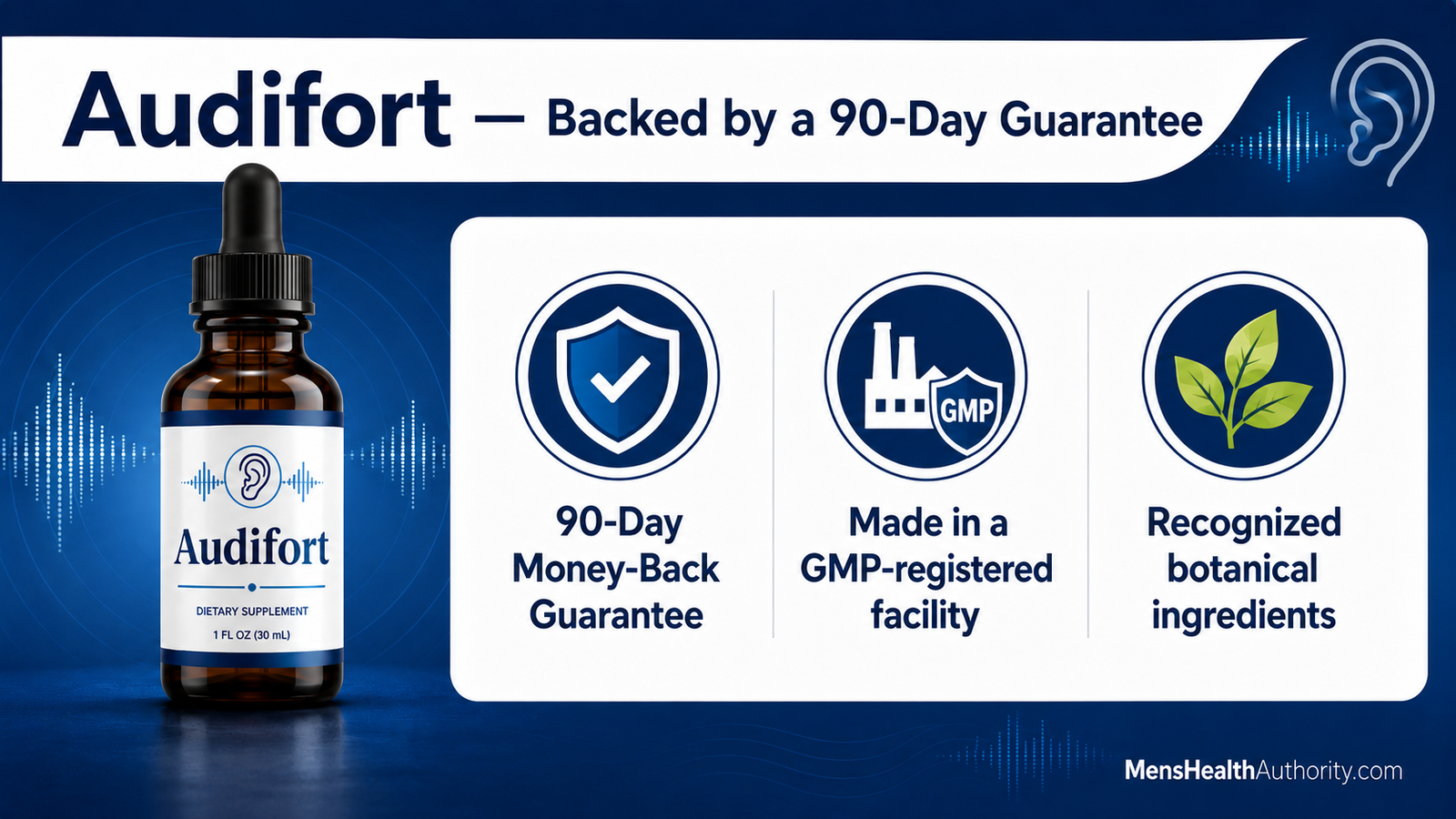
Buy only through the official site so the 90-day guarantee is valid. The generous refund window is the single best reason to feel comfortable trying it: if it does nothing for you, you can ask for your money back. Given the weak category evidence, treat the smallest bundle as the sensible starting point rather than a 6-bottle commitment.
Visit the Official Audifort Site →Lowest per-bottle price on bundles • 90-day guarantee
What the research actually shows (and its limits)
Two honest boundaries define Audifort’s evidence:
1. No trial on the product. There is no published clinical study of Audifort itself, and its full formula and doses aren’t public — so its specific hearing/tinnitus claims are unproven.
2. The category evidence is weak. The most-studied tinnitus supplements, ginkgo and zinc, did not show convincing benefit in Cochrane reviews.[1][2] Antioxidant approaches to hearing protection are promising mainly in experimental/animal work and for preventing noise damage, not reversing established loss.[4] A zinc trial in people with noise-related tinnitus showed only limited effects.[3]
None of this makes Audifort a scam — it makes it a wellness product whose hearing claims outrun the evidence. Buy it, if at all, as a low-risk experiment backed by the guarantee.
Is Audifort legit or a scam?
Audifort appears to be a legitimate product rather than a scam: it’s sold through ClickBank with a real 90-day money-back guarantee, uses recognized, generally safe ingredients, and doesn’t force a subscription. The fair criticism is about overstated efficacy and transparency, not fraud — the marketing implies hearing and tinnitus benefits the evidence doesn’t support, and the full formula/doses aren’t disclosed. “Legit but oversold, and unproven for its main claim” is the accurate summary. The guarantee genuinely limits your financial risk, which is the strongest point in its favor.
Frequently asked questions
Does Audifort really cure tinnitus?
No. No supplement cures tinnitus, and there’s no trial showing Audifort reduces it. At best it may support relaxation/sleep and general wellness, which can make tinnitus feel less intrusive for some people.
Will it restore my hearing?
No. Damaged inner-ear hair cells don’t regenerate, and no drop reverses hearing loss. See an audiologist for real hearing loss.
How long until I notice anything?
If anything, some notice mild calming within a few weeks. Use the 90-day guarantee window to judge value, and stop if you see nothing.
Is it safe with my medications?
Check with a doctor or pharmacist — gymnema and capsicum can lower blood sugar, green tea adds caffeine, and the full formula isn’t public. Especially important if you take diabetes medication.
Is Audifort FDA-approved?
No supplement is “FDA-approved.” Supplements are regulated as foods, not drugs, and cannot legally claim to treat or cure disease.
Is one-sided ringing okay to treat with drops?
No — one-sided or pulsating tinnitus should be evaluated by a doctor promptly, as it can signal a treatable or serious cause.
Where should I buy it?
Only through the official website so the 90-day guarantee applies. Avoid third-party marketplace listings.
Is Audifort worth it?
Only as a low-risk, guarantee-backed experiment after ruling out medical causes. Don’t expect it to fix hearing or tinnitus, and start with the smallest bundle.
Does it replace a hearing test?
No. A proper hearing evaluation is the essential first step; a supplement is not a substitute.
Editorial verdict
Safe and guarantee-backed, but its hearing claims outrun the evidence.
Pros
- Recognized, generally safe ingredients
- Long 90-day money-back guarantee
- Convenient sublingual drops
- May aid relaxation/sleep for some
- No forced subscription
Cons
- No evidence it improves hearing or tinnitus
- Ingredients are mostly general-wellness, not ear-specific
- Full formula & doses undisclosed
- Category’s best ingredients (ginkgo, zinc) failed in reviews
- Marketing overstates what’s proven
Bottom line: Audifort is a legitimate, low-risk wellness supplement wrapped in hearing-and-tinnitus marketing the science doesn’t back. If you’ve already seen a doctor and want a guarantee-protected experiment, the 90-day refund makes a small bundle reasonable — but keep your expectations low and put your real effort into medical evaluation, hearing protection, sleep and sound therapy, which are far better supported.
View the 90-Day Money-Back Guarantee →Official site • secure checkout
References
- Sereda M, et al. “Ginkgo biloba for tinnitus.” Cochrane Database of Systematic Reviews / review of RCTs. pubmed.ncbi.nlm.nih.gov/30339143
- Person OC, et al. “Zinc supplementation for tinnitus.” Cochrane Database of Systematic Reviews. 2016. pubmed.ncbi.nlm.nih.gov/27879981
- “Effects of oral zinc supplementation on patients with noise-induced hearing loss associated tinnitus: a clinical trial.” 2019. pubmed.ncbi.nlm.nih.gov/30987704
- “Antioxidant Therapy as an Effective Strategy against Noise-Induced Hearing Loss: From Experimental Models to Clinic.” 2023. pubmed.ncbi.nlm.nih.gov/37109564
- “Grape Seeds Proanthocyanidins: An Overview of In Vivo Bioactivity in Animal Models.” 2019. pubmed.ncbi.nlm.nih.gov/31614852