
FemiCore is a women’s bladder-health supplement — a daily capsule that pairs five Lactobacillus probiotic strains with cranberry, bearberry, berberine, and mimosa pudica, marketed to support bladder control, a balanced urinary microbiome, and fewer of those sudden “gotta-go” moments and leaks. This is an honest, independent review: what’s actually in it, what the evidence for those ingredients does and doesn’t support, the safety notes worth knowing, and who should skip it. It is not medical advice, and FemiCore is a supplement — not a treatment for incontinence or a urinary-tract infection, and not a substitute for seeing a doctor or a pelvic-floor physiotherapist.
Quick answer: FemiCore is a once-daily capsule aimed at women who want gentler support for bladder comfort and urinary-microbiome balance. A couple of its ingredients — specific Lactobacillus strains and cranberry — have real, if modest, research behind them for urinary and vaginal health, mostly around reducing recurrent UTIs. But the finished product hasn’t been tested in a published trial, doses aren’t disclosed, and nothing here “cures” leaks or incontinence, which respond best to pelvic-floor training and medical care. Think gentle support layered on top of the real fundamentals — not a fix.
- What it is: a once-daily women’s capsule combining five Lactobacillus probiotic strains with cranberry, bearberry, berberine, and mimosa pudica.
- Best-supported use: reducing recurrent UTIs and supporting a Lactobacillus-rich urinary/vaginal microbiome — cranberry and L. crispatus have real, if modest, clinical evidence.
- What it will not do: it does not cure bladder leaks, urgency, or an active urinary-tract infection.
- Safety: contains bearberry and berberine — check with a doctor first if pregnant, breastfeeding, or on medication.
- Guarantee: 60-day money-back guarantee through the official listing.

FemiCore — a women’s bladder-and-urinary-microbiome capsule, taken once daily. [Confirm directions on the official label.]
📄 In This Review
- What is FemiCore?
- The bladder & urinary microbiome: why they matter for women
- How FemiCore works
- Ingredients: what the evidence says
- Benefits you might reasonably expect
- FemiCore vs other approaches
- Who it’s for — and who should skip it
- Side effects & safety
- What users tend to report
- How to take it & realistic timeline
- The part that matters most: pelvic floor & your doctor
- Getting the most out of FemiCore
- Common mistakes with bladder supplements
- Pricing, guarantee & where to buy
- What the research actually shows
- Is FemiCore legitimate?
- FAQ
- Our editorial verdict
- References
What Is FemiCore?
FemiCore is a dietary supplement in capsule form, designed to be taken once daily, that targets women’s bladder and urinary-tract health. Its pitch is built around a specific idea: that bladder urgency, frequency, and those small, embarrassing leaks are influenced not just by muscle tone but by the balance of bacteria in the urinary and vaginal tract — and that topping up “good” bacteria, alongside a few traditional urinary botanicals, can help.
The formula pairs five Lactobacillus probiotic strains (crispatus, acidophilus, plantarum, gasseri, and casei) with cranberry extract, bearberry (uva ursi), granular berberine, and mimosa pudica. That’s a blend that reaches in two directions at once: the probiotics and cranberry toward the urinary-microbiome and UTI-prevention angle, and the botanicals toward a more traditional “urinary cleanse” story.
A precise word on what it is and isn’t. FemiCore is a supplement that aims to support everyday bladder comfort and urinary-microbiome balance. It is not a treatment for urinary incontinence, an overactive bladder diagnosis, or a urinary-tract infection, and it does not replace medical care or pelvic-floor physiotherapy. Leaks, urgency, pain, or blood in the urine are all reasons to see a doctor — some causes are simple and very treatable, and only an evaluation can tell which one you’re dealing with.
The Bladder & Urinary Microbiome: Why They Matter for Women
To judge whether FemiCore’s premise holds up, it helps to understand what it’s actually targeting — and where a supplement realistically fits.
Why bladder issues are so common in women
Urinary urgency, frequency, and stress leaks (a little urine escaping with a cough, laugh, or sneeze) are extremely common in women, and they become more common with age, after childbirth, and around menopause. The reasons are partly anatomical — a shorter urethra — and partly hormonal: the drop in estrogen around menopause thins and changes the tissues of the bladder and vaginal area, which can affect both comfort and the local bacterial balance. None of this is a personal failing, and most of it is treatable.
The urinary microbiome is real — and younger science
For a long time, urine was assumed to be sterile. We now know the urinary tract has its own community of bacteria, and that in healthy women it tends to be rich in Lactobacillus species — the same broad family that dominates a healthy vaginal microbiome. When that balance is disrupted, the risk of recurrent urinary-tract infections appears to rise. This is a genuine and active area of research, which is exactly why probiotics aimed at the female urinary and vaginal microbiome are a reasonable, if still-emerging, idea.
Where a supplement realistically fits
Here’s the honest framing: some strains and cranberry have modest evidence for reducing recurrent UTIs, and supporting a Lactobacillus-friendly microbiome is a sensible goal. But no oral supplement has been shown to cure stress incontinence or an overactive bladder — those respond best to pelvic-floor training, weight management, bladder-training techniques, and, when needed, medical treatment. So think of a product like FemiCore as a possible support layer for microbiome and UTI-prevention goals, sitting on top of — never instead of — the fundamentals and a doctor’s input.
How Does FemiCore Work?
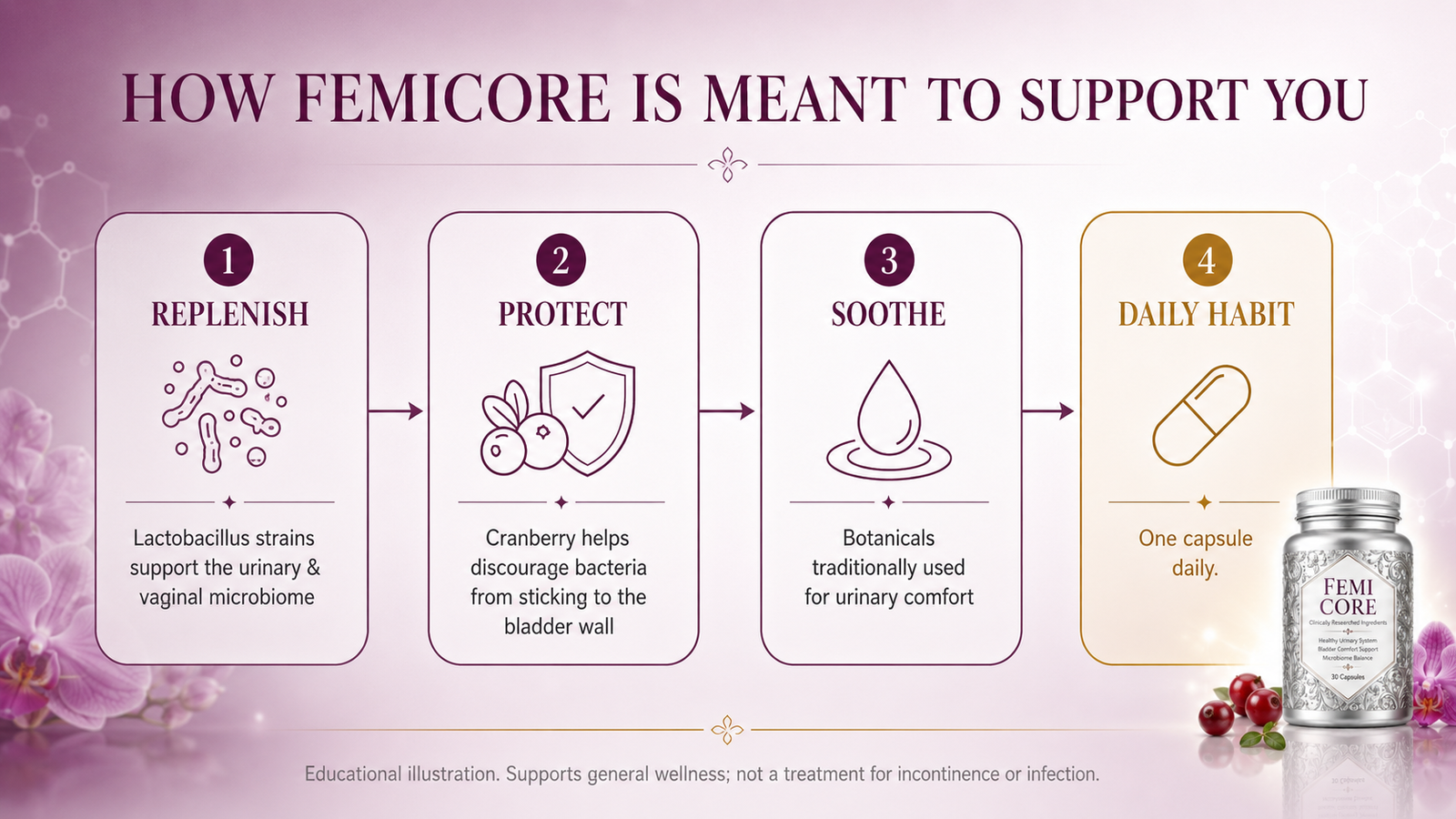
FemiCore works — to the extent it works — by combining ingredients that individually target the urinary microbiome and urinary-tract comfort. There isn’t a single mechanism; it’s a “cover a few bases” formula, and its ingredients pull in a couple of directions.
- Rebalance the microbiome: the five Lactobacillus strains are intended to support a Lactobacillus-rich urinary and vaginal environment, which is associated with fewer recurrent UTIs.
- Support the urinary tract: cranberry contains compounds (proanthocyanidins) studied for making it harder for certain bacteria to stick to the bladder wall; bearberry has a traditional urinary-antiseptic history.
- The “cleanse” angle: mimosa pudica and berberine lean on a more traditional gut-and-cleanse marketing story, with much weaker evidence for bladder-specific benefit.
Because this works — if at all — by gradually shifting a bacterial balance and offering mild urinary-tract support, the honest expectation is subtle, cumulative help over weeks of consistent use, not an overnight change and not a cure for leaks. As with any probiotic-based product, results vary a great deal from person to person, and non-response is common.
FemiCore Ingredients: What the Evidence Says
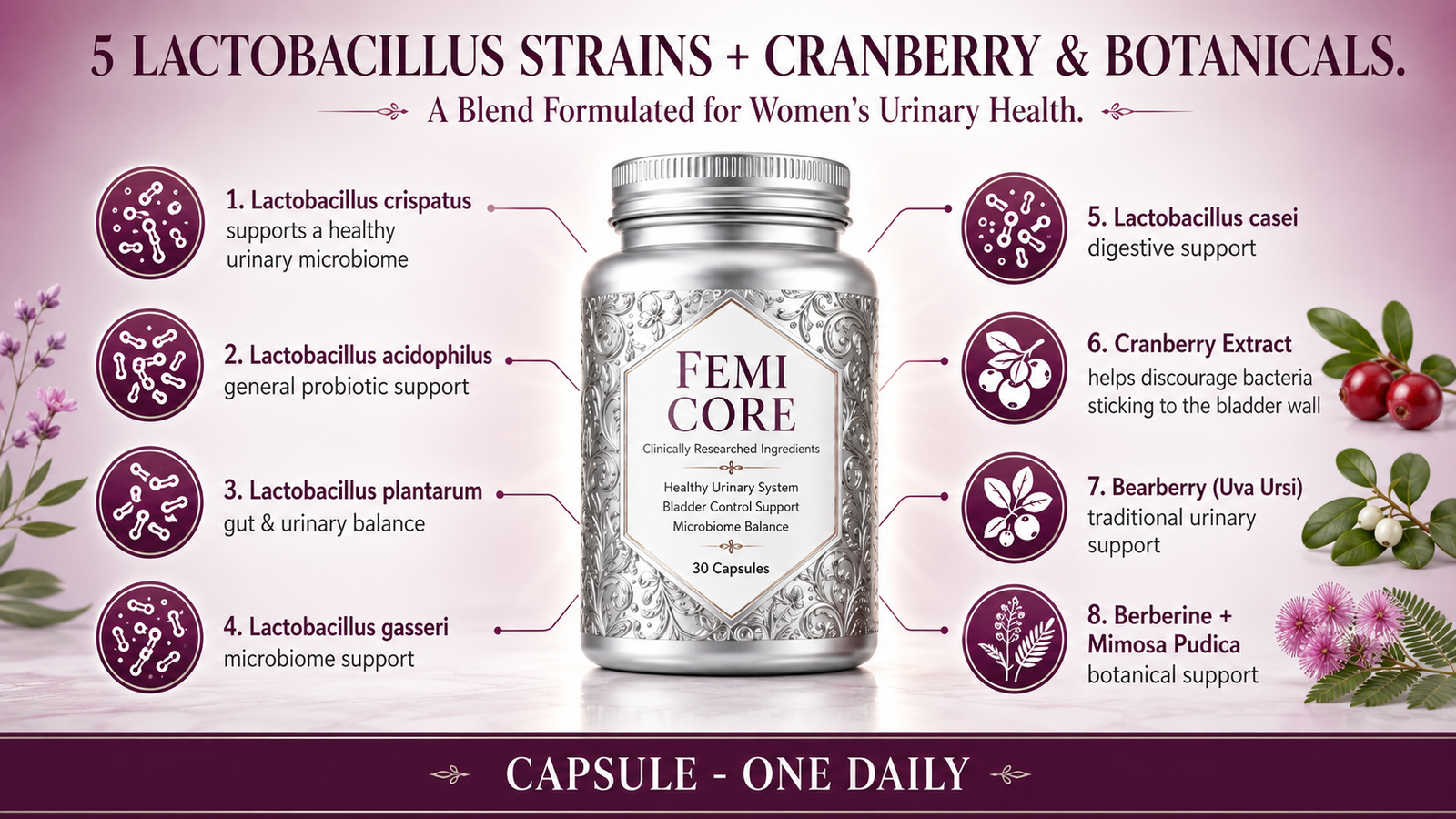
Lactobacillus crispatus & other strains
Best-studied here
Cranberry Extract
Moderate for UTI prevention
Bearberry (Uva Ursi)
Traditional / use with caution
Granular Berberine
Weak for bladder
Mimosa Pudica
Weak / traditional
See the current formula, pricing & guarantee
Check the official Supplement Facts panel and today’s bundle prices directly.
Official site · 60-day money-back guarantee
Benefits You Might Reasonably Expect
Stripping away the marketing, here’s an honest picture of what a formula like this might realistically do for some women — framed as support, not treatment:
- Fewer recurrent UTIs, for some. Between the Lactobacillus strains and cranberry, women prone to repeat infections may see a modest reduction over time — the best-supported potential benefit here.
- Microbiome support. Topping up Lactobacillus is a reasonable goal for urinary and vaginal balance, especially around menopause when that balance shifts.
- Mild comfort support. Some women report feeling generally more “settled” in their urinary comfort, though this is subjective and inconsistent.
What you should not expect: an end to stress leaks or urgency, a cure for an overactive bladder, or a replacement for treating an active infection. Anyone promising those things from a capsule is overselling.
FemiCore vs Other Approaches
| Approach | Best for | Evidence | Notes |
|---|---|---|---|
| FemiCore (probiotic + botanical capsule) | UTI prevention + microbiome support | Ingredient-level, modest; product untested | Convenient daily habit; doses undisclosed; 60-day guarantee |
| Pelvic-floor training / physiotherapy | Stress leaks & urgency | Strong | The highest-leverage move for most leaks; free to start |
| Vaginal estrogen (post-menopause) | Urinary & tissue changes | Strong (doctor-prescribed) | Very effective for many women; needs a prescription |
| Cranberry (alone, standardized) | Recurrent UTIs | Modest | Cheaper as a single ingredient at a known dose |
| Bladder training & fluid habits | Urgency & frequency | Good | Free; underused; often as effective as medication |
The takeaway: FemiCore competes as a convenience-and-microbiome product, not as a substitute for the treatments that actually move the needle on leaks and urgency. For UTI-prone women who already have the fundamentals in place, it’s an optional add-on; for real incontinence, the higher-evidence routes belong first.
Who FemiCore Is For — and Who Should Skip It

A reasonable fit if you:
- Are a woman prone to recurrent UTIs wanting extra support
- Want to support a Lactobacillus-friendly urinary microbiome
- Have mild, occasional urinary discomfort
- Prefer a once-daily capsule and already do the fundamentals
- Value a 60-day money-back guarantee to trial it
Skip it / see a doctor first if you:
- Have burning, pain, fever, or blood in your urine (possible infection)
- Have significant or worsening leaks or urgency
- Are pregnant or breastfeeding (bearberry/berberine cautions)
- Take medication affected by berberine (see safety)
- Have an allergy to any ingredient
⚠ A word specifically about symptoms
Burning when you urinate, needing to go constantly, pain, fever, or any blood in the urine should be evaluated by a doctor promptly — those can signal an infection that needs proper treatment, not a supplement. New or worsening leakage also deserves a proper assessment, because the cause dictates the fix (and most causes are very treatable). A supplement that delays a work-up does more harm than good.
Side Effects & Safety
For generally healthy women, the probiotics and cranberry in FemiCore are usually well tolerated. But “natural” is not “risk-free,” and a few points deserve real attention here:
- Bearberry (uva ursi). Generally recommended only for short-term use and not during pregnancy or breastfeeding; long-term daily use is not advised because of its arbutin/hydroquinone content. Its presence in a daily product is worth discussing with a pharmacist.
- Berberine interactions. Berberine can affect blood sugar and interacts with several medications (including some for diabetes, blood pressure, and drugs processed by the liver). If you take prescription medication, check first.
- Digestive upset. Probiotics and botanicals can cause mild bloating, gas, or stomach discomfort, especially at first.
- Pregnancy & breastfeeding. Because of the bearberry and berberine, this product is best avoided unless a doctor clears it.
If you take any prescription medication, are pregnant or trying to conceive, or have a medical condition, talk to your doctor or pharmacist before starting — the botanicals here, not the probiotics, are the reason.
What Users Tend to Report
Because FemiCore is sold mainly through its own funnel, most visible testimonials live on marketing pages and should be read skeptically. Across the pattern of what women typically say about products like this, a realistic summary is:
- The positives: some report fewer UTI flare-ups or feeling more comfortable over a few weeks, and many like the simple once-daily routine and the refund window.
- The mixed middle: a large share notice little change — common for microbiome products, where non-response is the norm.
- The negatives: complaints tend to cluster around price, auto-ship/billing confusion, and disappointment when it didn’t resolve leaks or urgency (which it was never going to do).
The useful lens: treat sales-page reviews as marketing, weight independent and refund-related feedback more heavily, and judge for yourself within the guarantee window.
How to Take FemiCore & a Realistic Timeline
The standard direction is one capsule daily with water. [Confirm exact directions on the label.] A few practical notes:
- Take it consistently, ideally with food to reduce the chance of stomach upset.
- Give it a real runway. Microbiome and UTI-prevention effects, if they come, build over several weeks — not days.
- Keep hydrating and don’t stop your usual habits — water, not “holding it,” and normal hygiene all still matter.
- Track flare-ups honestly so you can judge whether it’s actually helping, and decide within the 60-day window.
The Part That Matters Most: Pelvic Floor & Your Doctor
No bladder supplement, FemiCore included, replaces the two things that actually move the needle on leaks and urgency: pelvic-floor training and a doctor’s evaluation of your symptoms.
The evidence-backed fundamentals look like this. Pelvic-floor muscle training (done correctly — a physiotherapist can check your technique) is genuinely effective for stress leaks and is often recommended before medication. Bladder-training and sensible fluid habits help urgency and frequency. For post-menopausal women, vaginal estrogen prescribed by a doctor can transform urinary comfort. And any pain, burning, fever, or blood in the urine needs prompt assessment. A supplement can sit on top of that foundation as an optional extra; it can never substitute for it. If FemiCore gives you a little added support while you keep the fundamentals in place, that’s a reasonable use. If it becomes a reason to postpone seeing a doctor about a real symptom, that’s a problem.
Getting the Most Out of FemiCore
- Pair it with pelvic-floor training. That’s the highest-leverage thing you can do for leaks — the supplement is the sidekick, not the hero.
- Stay hydrated. Cutting fluids to avoid the bathroom actually concentrates urine and can worsen irritation.
- Buy the bundle only after a shorter trial unless the per-bottle savings plus the guarantee make the risk acceptable to you.
- Keep a simple symptom log. Rate comfort and count any flare-ups weekly — it’s the honest way to know if it’s doing anything.
- Re-read the guarantee terms so you know how and by when to request a refund.
Common Mistakes With Bladder Supplements
- Using them to avoid a doctor. The biggest mistake — self-treating symptoms that could be an infection or need proper assessment.
- Expecting a cure for leaks. No supplement fixes stress incontinence; pelvic-floor work does the heavy lifting.
- Ignoring dose and strain. With probiotics and cranberry, undisclosed amounts are a yellow flag.
- Overlooking the botanicals. Bearberry and berberine aren’t neutral — check interactions and pregnancy cautions.
- Quitting after three days — or never stopping. Give it a fair few weeks, then honestly decide; don’t keep paying out of inertia.
Pricing, Guarantee & Where to Buy
FemiCore is sold through its official online listing, with tiered bundle pricing (confirm the exact wording on the live page):
| Package | Price | Notes |
|---|---|---|
| Starter (2 bottles) | ~$79 + shipping | Entry option |
| 3 bottles | ~$69 each + shipping | Mid tier |
| 6 bottles | ~$49 each, free shipping | Lowest per-bottle; includes bonuses |
Every package is backed by a 60-day money-back guarantee. A few honest notes: shipping is added on the smaller tiers; multi-bottle tiers are where the value is if you intend to use it for months; and buying through the official listing is what keeps the guarantee valid. Third-party marketplace listings risk expired or improperly stored probiotics — a real concern for live bacteria — and usually void the refund policy.
Check today’s FemiCore pricing
Bundles and the 60-day guarantee are handled on the official site.
Official site · secure checkout · 60-day guarantee
What the Research Actually Shows
It’s worth separating what the science supports from what the marketing implies.
On the supportive side, the female urinary and vaginal microbiome is a real and active field, Lactobacillus strains (especially L. crispatus) have legitimate research for supporting that balance and reducing recurrent UTIs, and cranberry has modest but real evidence for UTI prevention. Those are reasonable, evidence-touched ingredients.
On the cautionary side, three things matter. First, dose and strain and delivery are everything, and FemiCore doesn’t publish CFU counts or milligram amounts — so we can’t confirm any ingredient is present at a researched level. Second, the botanical half (bearberry, berberine, mimosa pudica) leans on tradition and “cleanse” marketing more than bladder science, and two of those carry real cautions. Third, and most important: FemiCore as a finished product has not been tested in a published clinical trial, and nothing in it has been shown to treat incontinence or an overactive bladder.
The honest bottom line: a plausible microbiome-and-UTI-support blend with a couple of genuinely evidence-touched ingredients, wrapped in marketing that promises more control over leaks than the science delivers.
Is FemiCore Legitimate, or a Scam?
“Scam” is the wrong frame for most products like this; the better question is whether it’s a legitimate supplement sold with hype. On the evidence available, FemiCore appears to be a real product with a disclosed (if un-dosed) ingredient list and a functioning 60-day refund policy — not a phantom that takes your money and vanishes.
Where skepticism is warranted is the marketing — the framing that leaks and urgency come down to “bad bacteria” a supplement can fix, which oversells a real-but-limited science. The responsible reading is to ignore the hype, judge it on its ingredients and your own response, buy through the official listing so the guarantee applies, and keep your expectations set to “gentle microbiome and UTI-prevention support,” not “bladder cure.” Used that way, with a doctor still in the loop for any real symptoms, it’s a legitimate — if unproven-as-a-whole — option.
FemiCore FAQ
Our Editorial Verdict

FemiCore has a couple of genuinely evidence-touched ingredients for the female urinary microbiome and UTI prevention, and a fair refund window. It’s a reasonable optional add-on for UTI-prone women who already do the fundamentals. Undisclosed doses, a couple of botanicals with real cautions, an untested finished formula, and marketing that overpromises on “leaks” keep it from scoring higher — and it is not a treatment for incontinence or infection, which need a doctor.
What we liked
- Includes genuinely-studied strains (esp. L. crispatus) + cranberry
- Simple once-daily capsule
- 60-day money-back guarantee
- Transparent ingredient list; non-GMO
What gave us pause
- Per-ingredient doses and CFU counts not disclosed
- Bearberry & berberine carry real cautions for daily use
- Finished product never tested in a trial
- Not a treatment for leaks, urgency, or infection
Ready to try FemiCore?
Order through the official site so the 60-day guarantee applies.
Get FemiCore – Official Site →
Official site · 60-day money-back guarantee
References
1. Stapleton AE, et al. Randomized, placebo-controlled phase 2 trial of a Lactobacillus crispatus probiotic given intravaginally for prevention of recurrent urinary tract infection. Clin Infect Dis. 2011. PubMed 21498386. Meta-analysis of Lactobacillus for recurrent UTI: PubMed 23433130.
2. Williams G, et al. Cranberries for preventing urinary tract infections. Cochrane Database of Systematic Reviews. 2023. PubMed 37068952.
3. Herbal treatment with uva ursi extract versus fosfomycin in women with uncomplicated urinary tract infection: a randomized clinical trial. Clin Microbiol Infect. 2021. PubMed 34111592. On the arbutin/hydroquinone short-term-use limit: PubMed 24296864.
4. Efficacy and safety of berberine for dyslipidaemias: a systematic review and meta-analysis of randomized clinical trials. 2019. PubMed 30466986. (Berberine’s evidence is metabolic, not bladder-specific, and it interacts with several medications.)
5. Mimosa pudica: human clinical evidence for bladder or urinary benefit is essentially absent; its use here rests on traditional practice and preclinical data only.
6. Dumoulin C, et al. Pelvic floor muscle training versus no treatment, or inactive control treatments, for urinary incontinence in women (Cochrane systematic review). 2018. PubMed 30704907 — supports pelvic-floor training as first-line for stress incontinence.
Medical disclaimer: This article is for informational purposes only and is not medical advice. These statements have not been evaluated by the Food and Drug Administration. FemiCore is not intended to diagnose, treat, cure, or prevent any disease. Consult a qualified healthcare professional before starting any supplement, especially if you are pregnant, breastfeeding, take medication, or have any urinary symptoms.
Affiliate disclosure: Men’s Health Authority may earn a commission if you purchase through links on this page, at no additional cost to you. This does not influence our editorial assessment; our ratings reflect an independent review of the available evidence.
Editorial note: Ingredients, format, price, and guarantee were confirmed from the current official sales page as of July 2026; per-ingredient doses and CFU counts are not publicly disclosed. Verify all figures against the live Supplement Facts panel and listing before relying on them.