
Written by: Malkiat Singh
Published: June 14, 2026 | Last Updated: June 14, 2026
⏱️ 8 min read | ✓ Editorially Reviewed | ⓘ Affiliate Disclosure
Home » Ingredients » Pycnogenol + L-Arginine
Pycnogenol and L-arginine are two of the most-studied blood-flow ingredients — and they were specifically researched together for mild-to-moderate erectile difficulty. Here’s why the pairing works, what the evidence shows, and how to use it.
What Are Pycnogenol and L-Arginine?
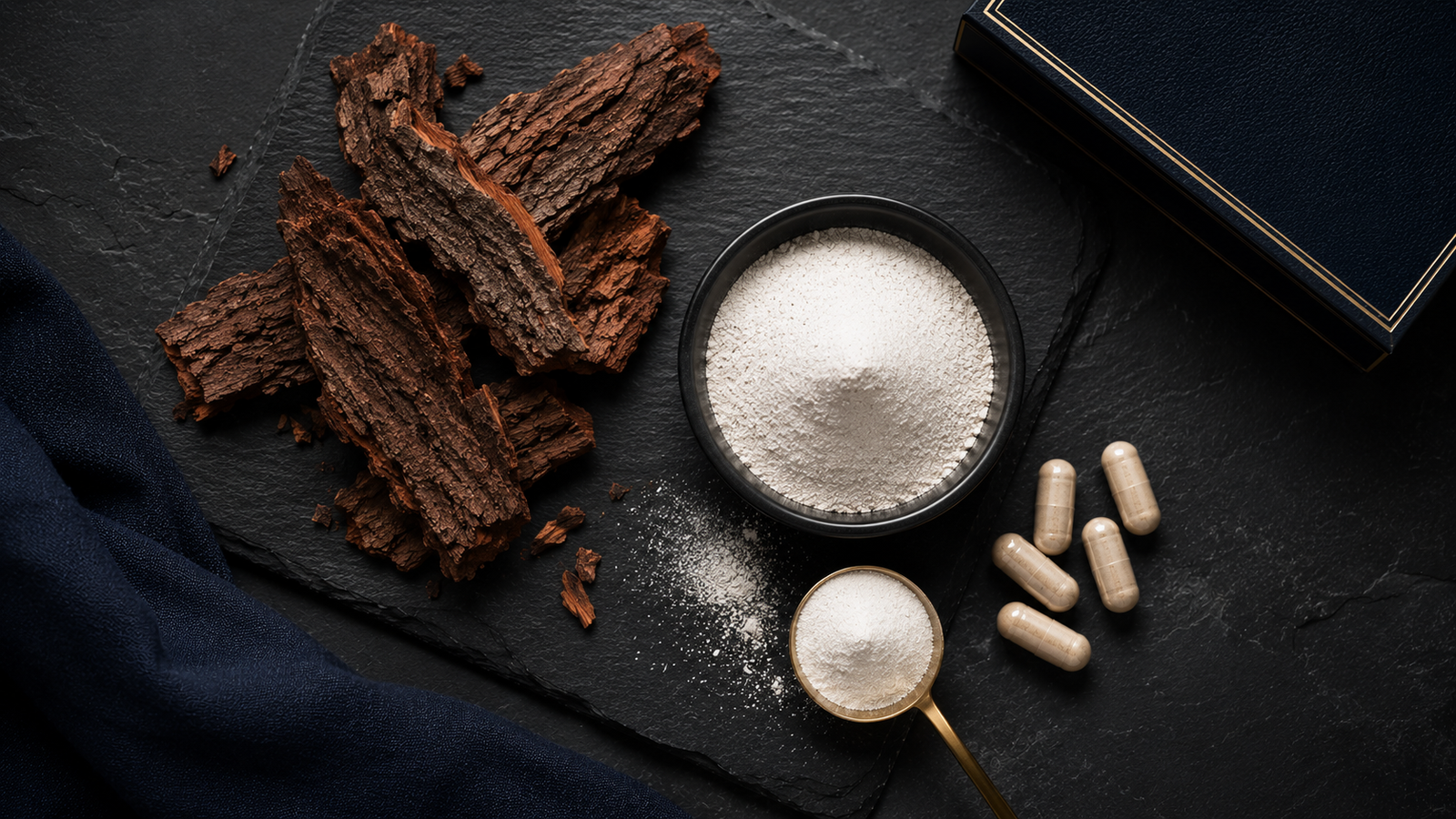
Pycnogenol is a branded, standardized extract of French maritime pine bark, rich in antioxidant plant compounds called procyanidins and flavonoids. It has been studied for circulation, blood-vessel health, and inflammation for decades. L-arginine is an amino acid your body uses to produce nitric oxide, the molecule that signals blood vessels to relax and widen. On their own, each supports blood flow; together, they were formulated and studied specifically as a combination (sold under names such as Prelox) for male sexual performance.
The reason they are paired is that they support the same goal — healthy nitric-oxide-driven blood flow — through complementary actions, which appears to make the combination more effective than either ingredient used alone.
How the Combination Works
L-arginine is the raw material for nitric oxide, so supplying more of it gives the body more to work with. The challenge is that oral L-arginine is broken down quickly and inconsistently. This is where Pycnogenol earns its place: its antioxidant compounds help protect and support the enzyme (nitric-oxide synthase) that actually produces nitric oxide, and they help shield the blood-vessel lining from oxidative stress. In practical terms, Pycnogenol helps the body make better use of the arginine you provide — more raw material plus a more efficient production line. Since erections are fundamentally a blood-flow event, improving nitric-oxide availability supports the vascular response involved.
What the Research Actually Shows
The combination has genuine human evidence. In a randomized, double-blind, placebo-controlled study, men with mild-to-moderate erectile dysfunction who took Pycnogenol together with L-arginine experienced improved erectile function over a period of months. [1] Other trials of the pairing have reported similar directional benefits. The honest framing: the effects are real but build gradually over weeks to months, the studied population had mild-to-moderate difficulty, and this is supportive nutrition — not a substitute for prescription medication in more significant cases, and not an on-demand solution.
Pycnogenol alone also has separate research for circulation and vascular health, and L-arginine alone has been studied for blood-flow and exercise outcomes, so the combination draws on two ingredients each with their own track record.
Potential Benefits
- Supports erectile function in mild-to-moderate cases by improving nitric-oxide blood flow.
- Supports general circulation and blood-vessel health, a benefit of both ingredients.
- May support exercise blood flow and “pump”, largely from the arginine side.
- Antioxidant support for the vascular lining from Pycnogenol’s plant compounds.
How Much to Take (Dosage)
Studies of the combination have typically used L-arginine in the range of about 1.5 to 3 grams per day alongside Pycnogenol around 80 to 120 mg per day, though specific products and protocols vary. Because both ingredients work by supporting an ongoing process rather than producing an instant effect, consistency matters: give the combination at least several weeks, and often two to three months, before judging it. Many men find a pre-formulated combination product simpler than dosing the two separately.
If you prefer, L-citrulline can be used in place of, or alongside, L-arginine, since citrulline raises arginine levels more efficiently — a point worth discussing if you are building your own stack.
Safety and Side Effects
Both ingredients are generally well tolerated. L-arginine can cause mild digestive upset at higher doses and, like other nitric-oxide ingredients, can lower blood pressure — usually harmless, but important if you take blood-pressure or, especially, nitrate medications. Pycnogenol is generally considered safe with few side effects. One specific note on arginine: because it can influence certain viruses, people with a history of frequent cold sores or genital herpes sometimes find high-dose arginine can trigger outbreaks, so that is worth bearing in mind.
Who Should Avoid It
Talk to your doctor first if you take nitrates or other heart medication, blood-pressure medication, or erectile-dysfunction drugs, since the blood-pressure-lowering effects can stack dangerously. The same applies if you have low blood pressure, significant heart disease, or are due for surgery (arginine can affect blood pressure during procedures), or if you have a history of frequent herpes outbreaks. And as always, new, persistent, or moderate-to-severe erectile difficulty deserves a medical evaluation first, because it can be an early warning sign of cardiovascular disease.
How to Choose a Quality Product
- Look for standardized Pycnogenol (the branded pine-bark extract) rather than a generic, uncharacterized pine-bark powder.
- Check the L-arginine dose is in the studied range, not a token sprinkle in a blend.
- A pre-formulated combination can simplify dosing if you want the researched pairing.
- Favor third-party-tested products for purity and label accuracy.
Benefits Beyond the Bedroom
Because this pairing works on the fundamentals of circulation, its potential benefits are not limited to sexual performance. Pycnogenol has been studied on its own for general vascular health, leg-vein comfort, blood-pressure support, exercise recovery, and even skin quality, thanks to its antioxidant and circulation-supporting properties. L-arginine, as a nitric-oxide precursor, is widely used by active men for blood flow and the “pump” during training, and has been examined for cardiovascular and exercise outcomes. Viewed together, the combination is really a healthy-blood-flow stack that happens to benefit erectile function as one expression of better circulation. That framing is useful: the same habits and ingredients that support your vascular system support performance, which is why this pairing fits naturally alongside cardio exercise, a heart-healthy diet, and the other lifestyle factors that keep blood vessels working well. It also means men who take it primarily for circulation or training may notice performance benefits as a welcome side effect, and vice versa — the underlying mechanism is the same.
What to Realistically Expect
This combination is a slow-and-steady supporter, not a switch. Men with mild-to-moderate difficulty who respond tend to notice gradual improvement over a couple of months of consistent daily use, ideally alongside the lifestyle factors that drive vascular health — exercise, not smoking, healthy weight, and managed blood pressure. If your difficulty is significant, sudden, or accompanied by other symptoms, the right move is a doctor’s visit rather than waiting on a supplement, both because medical treatment is more effective and because the symptom itself can be an early flag for heart health.
Frequently Asked Questions
Why combine Pycnogenol with L-arginine instead of using arginine alone?
Pycnogenol’s antioxidant compounds help the body produce and preserve nitric oxide more efficiently, so it appears to make the arginine work better. The two were studied together specifically for this reason.
How long until it works?
Expect a gradual effect over several weeks to a few months of consistent daily use, not an immediate result.
Can I use L-citrulline instead of L-arginine?
Yes — L-citrulline raises arginine levels more efficiently than arginine itself, so some men use it alongside or in place of arginine. Pycnogenol still adds antioxidant support to the nitric-oxide pathway.
Related Reading
Sources
- Ledda A, Belcaro G, Cesarone MR, Dugall M, Schönlau F. (2010). Investigation of a complex plant extract (Pycnogenol + L-arginine) for mild to moderate erectile dysfunction: a randomized, double-blind, placebo-controlled study. BJU International, 106(7):1030-1033. PubMed