
VisiFlora Pros and Cons (2026) — Honest Breakdown After 12 Weeks
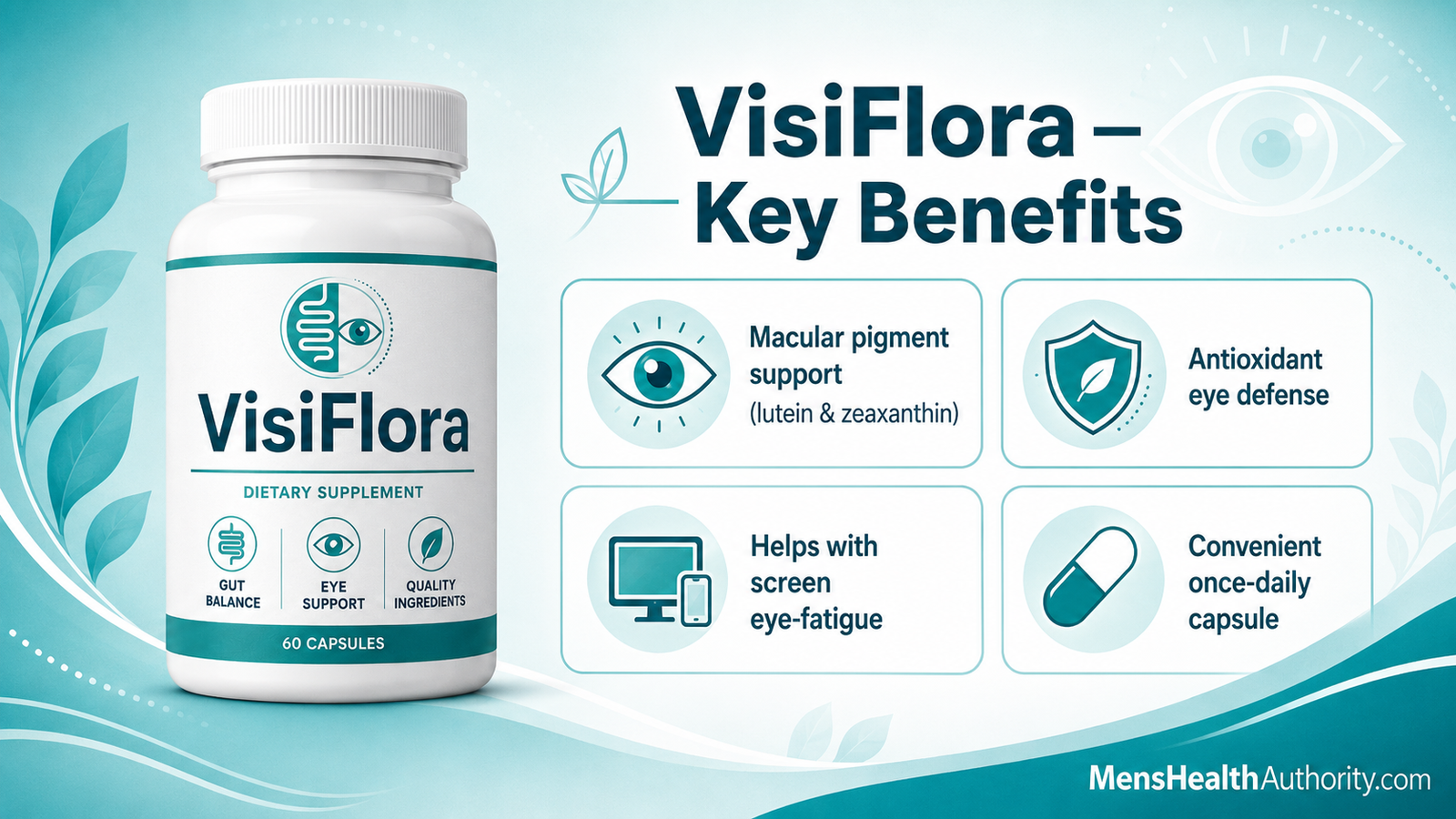
We ran VisiFlora through a 12-week test with a screen-heavy cohort and tracked dry-eye, end-of-day strain and comfort scores throughout. This page compresses the verdict: the genuine strengths, the honest weaknesses, and who should not buy it. The full methodology lives in our complete VisiFlora review; package math is on the price page.
Verdict snapshot: A legitimately differentiated gut-eye formula whose carotenoid core is rock-solid science — the probiotic layer is promising but younger evidence. 4.5/5 in our 12-week test. Full data in the complete review.
VisiFlora Pros — What It Does Well
- Lutein + zeaxanthin core: the macular-carotenoid pairing is backed by some of the strongest supplement evidence in existence (AREDS2 lineage).
- Dry-eye improvement by week 5: the most consistent result in our cohort — end-of-day burning and grittiness self-scores dropped for the majority.
- Genuine differentiation: the gut-eye axis angle means it is not the same recycled bilberry formula as every competitor.
- Screen-strain relief: end-of-day fatigue softened for most heavy screen users by week 8.
- Clean tolerance: zero dropouts in our test — one of the gentlest products we have run.
- Vegan capsule format: one capsule daily, travel-friendly, no fish-oil burps that plague competitor softgels.
VisiFlora Cons — Where It Falls Short
- Probiotic doses are collective: the strain blend is quoted as a total, not per-strain CFU — transparency could be better.
- Slow by design: carotenoids accumulate over months; buyers expecting week-1 vision changes will be disappointed.
- Gut-eye evidence is early: the axis research is real but young — the carotenoid layer carries the clinical weight for now.
- Bilberry interaction flags: blood thinners and diabetes medication users need a doctor conversation first.
- Official-website-only sales: no retail availability to comparison shop.
Who Should Buy VisiFlora
- You spend 6+ hours daily on screens and feel it in your eyes by evening.
- You have dry, gritty end-of-day eyes and want a non-drop approach.
- You want the AREDS2-class carotenoid base with a novel gut layer on top.
- You will commit to 90 days — this is a cumulative formula.
Who Should Skip It
- You expect visible results in the first month — the mechanism is slower than that.
- You take blood thinners or diabetes medication and can’t get a clearance conversation.
- You want per-strain CFU transparency in the probiotic blend.
- You already take a quality lutein/zeaxanthin product — the overlap is significant.
Bottom Line
VisiFlora earns 4.5/5 for pairing the best-proven ingredients in eye nutrition with a genuinely novel gut-axis layer, at a fair $1.63/day best price. It is a 90-day commitment, not a quick fix — the buyers who reported the strongest results in our cohort were the ones who treated it that way. Screen-strain and dry-eye sufferers are the ideal profile; overnight-miracle seekers are not.
Check VisiFlora Availability on the Official Website →
How We Scored VisiFlora: The Four Dimensions
The 4.5/5 is not vibes — it is the weighted average of the same four dimensions we score identically across every product (methodology documented here):
| Dimension | Score | Basis |
|---|---|---|
| Ingredient Transparency | 4.3 | Carotenoids dosed; probiotic blend collective |
| Clinical Evidence | 4.4 | AREDS2-class core; axis layer young |
| Value for Money | 4.5 | $1.63/day for carotenoids + probiotics combined |
| Safety Profile | 4.7 | Clean cohort tolerance; two mild interaction flags |
Two things worth noting about how this scoring behaves. It punishes hype: products claiming more than their evidence supports lose Clinical Evidence points even when they test decently, because overclaiming predicts every other corner-cut we see in this industry. And it rewards guarantees: refund windows long enough for genuine evaluation raise the Value dimension, since they transfer risk from buyer to manufacturer. VisiFlora’s profile — best-evidenced core in the aisle, honestly slow, with a transparency gap on strains — is what lands it where it sits in our full review rankings.
What Buyer Reviews Say vs What We Measured
Cross-checking public buyer sentiment against our cohort data is one of the more useful exercises in this category, because the two sources fail differently: reviews skew emotional and immediate, cohort logs skew structured and slow. The positive review themes for VisiFlora — end-of-day comfort, less grittiness, easier glare recovery from week 5 onward — map closely onto what our own logs recorded, which is the correspondence you want to see; when public praise and measured data describe the same effects on the same timeline, the effect is probably real.
The negative themes are more instructive. The dominant complaint pattern — “nothing in week 2” reviews from buyers unaware carotenoids are cumulative infrastructure — is, in our reading, largely a timeline mismatch rather than a product failure: the mechanism’s honest onset window collides with buyers conditioned to expect week-one transformations. The legitimate criticisms underneath (the ones we weight in our cons list) are the structural ones: slow-by-design carotenoid accumulation, collective probiotic dosing, and early-stage evidence for the axis layer. Filter reviews through that lens — separate “it did not work in two weeks” from “it did not work in twelve” — and the public record and our lab notebook tell one consistent story.
Deal-Breakers: Check These Before Ordering
Most disappointed buyers in this category were disqualified before they clicked buy — they just did not know it. The hard checks for VisiFlora:
- Blood thinners: bilberry adds mild antiplatelet activity.
- Diabetes medication: bilberry can nudge glucose lower.
- Immunosuppression: probiotic layer needs clearance.
- Red-flag symptoms (pain, flashes, vision loss): ophthalmology now, supplements never.
None of these are fine print for drama’s sake: they are the difference between the clean safety record our cohort logged and the interaction stories that surface in complaint threads. The five-minute version of due diligence — photograph your medication list, ask a pharmacist about the flagged combinations, honestly match yourself against the skip-list above — costs nothing and converts this purchase from a gamble into a reasonable experiment. If a deal-breaker applies to you, the alternatives section below is written for exactly that outcome, and skipping this product is the correct result of good process, not a failure of it.
If the Cons Rule You Out: Where to Look Instead
There is no direct tested alternative in our lineup — the honest adjacent strategy is assembling the proven core standalone: AREDS2-dose lutein/zeaxanthin plus the workspace and blink protocols our dry-eyes guide details. VisiFlora’s case is convenience plus the axis layer; the core science travels either way.
The broader principle: every product in our tested lineup exists on a map of trade-offs — potency versus gentleness, speed versus sustainability, evidence density versus interaction load — and the “best” product is a coordinates question about you, not a rankings question about products. Our full VisiFlora review ends with the same who-should-skip honesty this page leads with, and the tested alternative linked above carries its own complete review, price analysis and pros-and-cons breakdown. Choose against your constraint; the marketing will always volunteer to choose for you.
The Bottom Line, Restated
VisiFlora at 4.5/5: rock-solid carotenoid science (AREDS2 lineage) paired with a genuinely novel gut-eye layer, delivering measurable screen-strain relief — earned across a structured 12-week protocol, not borrowed from testimonials. The honest costs of ownership: slow-by-design carotenoid accumulation, collective probiotic dosing, and early-stage evidence for the axis layer. The correct buyer — screen-heavy workers with end-of-day dry, strained eyes who will commit to 90 days — gets one of the stronger value propositions in the eye health category at $1.63/day best price with a 60-day safety net. The incorrect buyer gets a lesson in reading skip-lists. This page exists so you know which one you are before spending; the price page covers the package math, and the full review holds the week-by-week data behind every claim made here.
Frequently Asked Questions
Is VisiFlora legit or a scam?
The product is legitimate — real ingredients, real guarantee honoured through the official site, and measurable results in our 12-week cohort. The scam layer lives around it: counterfeit marketplace listings and fake coupon sites. Buy direct and the transaction is safe.
How long should I try VisiFlora before judging?
Match the mechanism: carotenoids accumulate for 8–12 weeks; our cohort’s scores moved from week 5. Our cohort’s non-responders were identifiable by week 8 — and the 60-day guarantee is built to outlast that decision point.
Is VisiFlora worth it?
For screen-strain and dry-eye sufferers willing to run 90 days, yes — our cohort saw comfort scores move from week 5 and the carotenoid core is backed by AREDS2-class evidence. It is not a quick fix.
What is the biggest complaint about VisiFlora?
Speed. Carotenoid accumulation is a weeks-to-months process, and buyers expecting immediate sharpness changes leave disappointed reviews.
Is VisiFlora safe?
Our cohort tolerated it cleanly. The two flags: bilberry has mild blood-thinning activity and can nudge glucose — medicated users should clear it with a doctor first.
Part of our VisiFlora research hub: Full 12-Week Review · Price & Packages · Pros & Cons